
 대표어
대표어
권호기사보기
| 기사명 | 저자명 | 페이지 | 원문 | 기사목차 |
|---|
결과 내 검색
동의어 포함
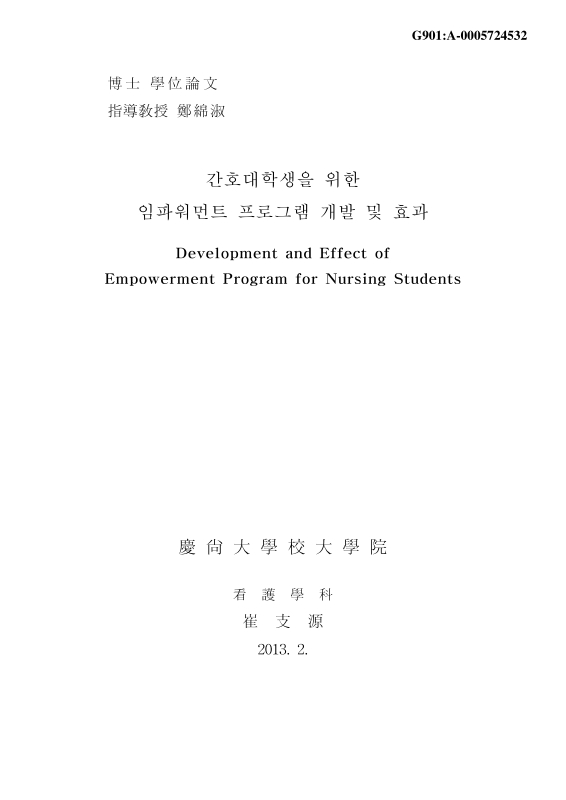
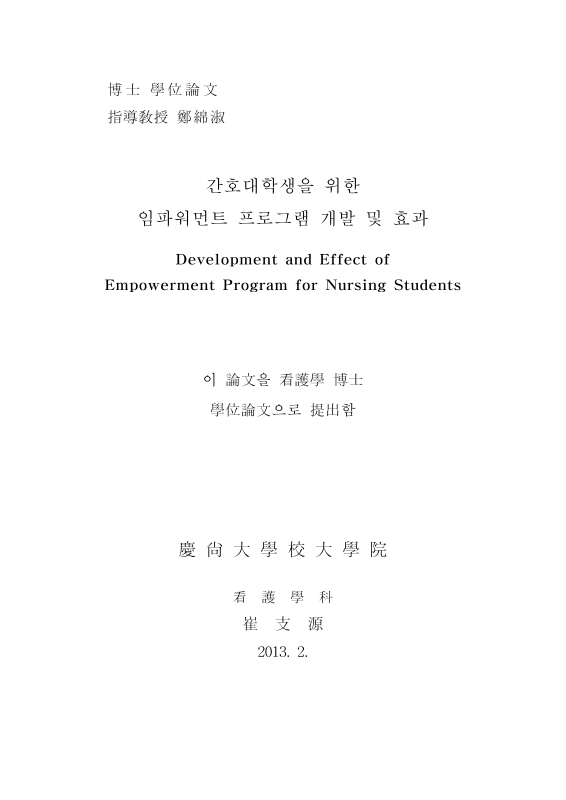
표제지
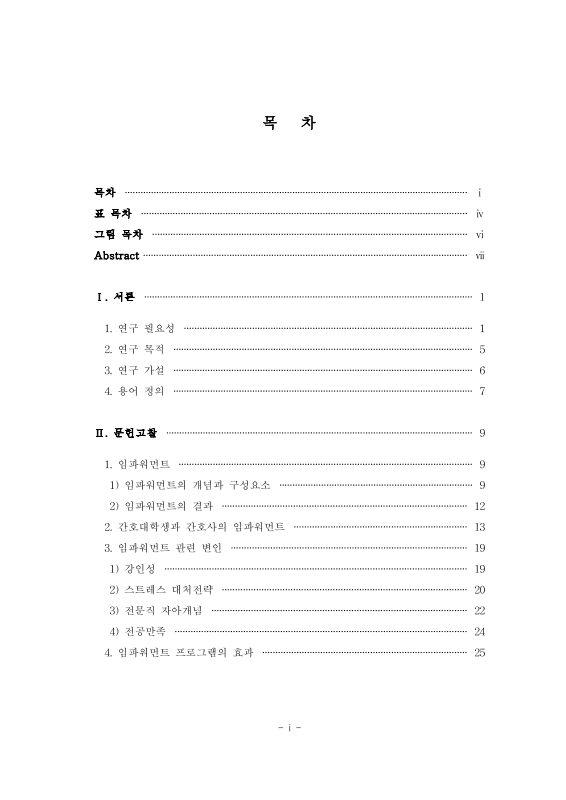
목차
ABSTRACT 11
I. 서론 15
1. 연구 필요성 15
2. 연구 목적 19
3. 연구 가설 20
4. 용어 정의 21
1) 임파워먼트 21
2) 임파워먼트 프로그램 21
3) 강인성 21
4) 스트레스 대처전략 22
5) 전문직 자아개념 22
6) 전공만족 22
II. 문헌고찰 23
1. 임파워먼트 23
1) 임파워먼트의 개념과 구성요소 23
2) 임파워먼트의 결과 26
2. 간호대학생과 간호사의 임파워먼트 27
1) 간호대학생의 스트레스와 임파워먼트 29
2) 간호사의 임파워먼트 31
3. 임파워먼트 관련 변인 33
1) 강인성 33
2) 스트레스 대처전략 34
3) 전문직 자아개념 36
4) 전공만족 38
4. 임파워먼트 프로그램의 효과 39
III. 이론적 기틀 45
IV. 연구 방법 46
1. 연구 설계 46
2. 연구 대상 47
1) 연구 대상자 선정 47
2) 표집 크기와 방법 48
3. 연구 도구 49
1) 임파워먼트 49
2) 강인성 49
3) 스트레스 대처전략 50
4) 전문직 자아개념 50
5) 전공만족 50
6) 프로그램 만족도 51
4. 임파워먼트 프로그램 개발 51
1) 연구자 준비 51
2) 임파워먼트 프로그램의 개발 과정 51
3) 임파워먼트 프로그램 구성 54
5. 연구 진행 절차 69
1) 사전조사 69
2) 중재 69
3) 사후조사 1 69
4) 사후조사 2 70
6. 자료 분석 71
V. 연구 결과 72
1. 대상자의 일반적 특성과 사전 동질성 검정 72
2. 연구 변수의 사전 동질성 검정 74
3. 연구 도구의 신뢰도 검정 76
4. 연구 변수의 정규성 검정 77
5. 임파워먼트 프로그램의 효과 검증 78
1) 제 1가설: 임파워먼트 프로그램에 참여한 실험군은 참여하지 않은 대조군에 비해 임파워먼트 정도가 증가할 것이다. 78
2) 제 2가설: 실험군은 대조군에 비해 강인성 정도가 증가할 것이다. 86
3) 제 3-1가설: 실험군은 대조군에 비해 문제해결 중심 대처전략 정도가 증가할 것이다. 88
4) 제 3-2가설: 실험군은 대조군에 비해 사회적 지지추구 중심 대처전략 정도가 증가할 것이다. 90
5) 제 3-3가설: 실험군은 대조군에 비해 회피 중심 대처전략 정도가 감소할 것이다. 92
6) 제 4가설: 실험군은 대조군에 비해 전문직 자아개념 정도가 증가할 것이다. 94
7) 제 5가설: 실험군은 대조군에 비해 전공만족 정도가 증가할 것이다. 96
6. 임파워먼트 프로그램의 만족도 98
VI. 논의 99
1. 임파워먼트 프로그램이 간호대학생의 임파워먼트에 미치는 효과 99
2. 임파워먼트 프로그램이 간호대학생의 강인성, 스트레스 대처전략, 전문직 자아개념 및 전공만족에 미치는 효과 103
3. 임파워먼트 프로그램 평가 105
VII. 결론 및 제언 109
1. 결론 109
2. 제언 113
참고문헌 114
부록 127
부록 1. 참가자 서면 동의 설명문 및 동의서 127
부록 2. 설문지 129
Figure 1. Theoretical Framework 45
Figure 2. Research Design 46
Figure 3. Research Process 70
Figure 4. Change of Empowerment by Group 79
Figure 5. Change of Personal Competence by Group 81
Figure 6. Change of Group Orientation by Group 83
Figure 7. Change of Self-determination by Group 85
Figure 8. Change of Hardiness by Group 87
Figure 9. Change of Problem Solving by Group 89
Figure 10. Change of Social Support Seeking by Group 91
Figure 11. Change of Avoidance by Group 93
Figure 12. Change of Professional Self-concept by Group 95
Figure 13. Change of Major Satisfaction by Group 97
This study was conducted to develop and confirm the effectiveness of empowerment program applying to nursing students. The study design is a nonequivalent control group design with repeated measures as quasi-experimental design.
A total of 42 subjects were recruited to this study with 21 subjects in experimental group and 21 in the control group respectively from junior students of the nursing department of M college in C city.
This study used 29 questions of personal inner empowerment scale of Bolton and Brookings(1998) revised by Joo(2006) for empowerment, 30 questions for hardiness scale of Bartone, Ursano, Wright, and Ingraham(1989) translated and verified by Lee(2005) and revised by the investigator, 33 questions for stress coping strategy scale of Amirkhan(1990) revised Shin(2002), 27 questions for professional self-concept scale of Arthur(1995) revised by Sohng and Noh(2006), 13 questions for major satisfaction scale of Ha(2000) and Nam(2010).
The experimental intervention was carried out from 4th July 2011 to 28th July 2011 for 150minutes a cycle, twice a week, for 4 weeks, a total of 20 hours empowerment program. The empowerment program components in this study used personal competence, group orientation, self determination of Bolton and Brooking(1998). The topics of empowerment were self orientation, self esteem, communication, personal relations, motivation, autonomy and self leadership. The training methods were lecture, presentation, personal activity, group activity group discussion, modeling, and homework, and for training material, videos, e-book, and MBTI were used.
Data was collected from July 4th 2011 to August 25th 2011. Data was analyzed using descriptive statistics with PASW Statistics 18.0, χ² test with Fisher's exact test, t-test, Repeated measure ANOVA and paired t-test.
The results of this study are as follows:
1) There was no significant difference on homogeneity test result depending on general characteristics of age, gender, religion, residence type, school record, satisfaction of the college life, and nursing choice motivation between study group and control group and the two groups are homogeneous since there was no significant difference in the dependent variable.
2) This study showed empowerment program is effective to increase empowerment as the empowerment score of the participated group was significantly increased(F=24.011, p〈.001).
(1) This study showed empowerment program is effective to increase personal competence as the score of the participated group was significantly increased compared to that of the non participated group(F=29.869, p〈.001).
(2) This study showed empowerment program is effective to increase group orientation as the score of the participated group was significantly increased compared to that of the non participated group(F=8.718, p=.005).
(3) This study showed empowerment program is effective to increase self determination as the score of the participated group was significantly increased compared to that of the non participated group(F=6.574, p=.014).
3) This study showed empowerment program is effective to increase hardiness as the score of the participated group was significantly increased compared to that of the non participated group(F=35.601, p〈.001).
4) This study showed the use of stress copying strategy between the participated and the non participated groups.
(1) This study showed empowerment program is effective to increase problem solving coping strategy as the score in the participated group was significantly increased compared to that of the non participated group(F=29.869, p〈.001).
(2) This study showed empowerment program is effective to increase social support seeking coping strategy as the score in the participated group was significantly increased compared to that of the non participated group(F=4.292, p=.045).
(3) This study showed empowerment program is effective to increase avoidance coping strategy as the score in the participated group was significantly increased compared to that of the non participated group(F=4.299, p=.045).
5) This study showed empowerment program is effective to increase professional self-concept as the score of the participated group was significantly increased compared to that of the non participated group(F=15.197, p〈.001).
6) This study showed empowerment program is effective to increase major satisfaction as the score in the participated group was significantly increased compared to that of the non participated group(F=4.416, p=.042).
In conclusion, the empowerment program developed in this study has been identified as an effective intervention for promoting empowerment, hardiness, problem solving coping strategy, social support seeking coping strategy, professional self concept, major satisfaction and reducing avoidance coping strategy of nursing college students. Therefore, promoting the empowerment of the nursing college students will be helpful for adjusting to college life and their major by coping college life stress and clinical practice stress as well as the nursing organization in the effectiveness of human resource management by reducing the turnover rate of new nurses. It is recommended that such empowerment programs are applied to the nursing curriculum.*표시는 필수 입력사항입니다.
| 전화번호 |
|---|
| 기사명 | 저자명 | 페이지 | 원문 | 기사목차 |
|---|
| 번호 | 발행일자 | 권호명 | 제본정보 | 자료실 | 원문 | 신청 페이지 |
|---|
도서위치안내: / 서가번호:

우편복사 목록담기를 완료하였습니다.
*표시는 필수 입력사항입니다.
저장 되었습니다.
