
 대표어
대표어


권호기사보기
| 기사명 | 저자명 | 페이지 | 원문 | 기사목차 |
|---|
결과 내 검색
동의어 포함
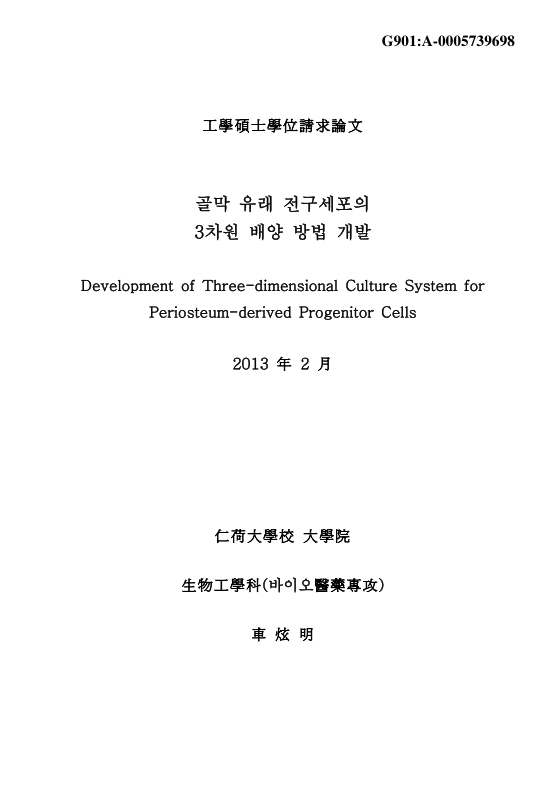
표제지
요약
Abstract
목차
1. 서론 13
1.1. 세포치료제 13
1.1.1. 줄기세포치료제 13
1.1.2. 줄기세포치료제 시장 14
1.2. 줄기세포 14
1.2.1. 성체줄기세포 20
1.2.2. 배아줄기세포 23
1.2.3. 유도만능줄기세포 23
1.3. 줄기세포 배양 24
2. 연구 목적 25
3. 재료 및 방법 26
3.1. 골막 유래 세포의 초대배양 26
3.2. 골막 유래 전구세포의 분리 및 2차원 배양 26
3.3. 골막 유래 전구세포의 3차원 배양 27
3.4. 역전사 중합효소 연쇄반응(RT-PCR)과 quantitative RT-PCR 27
3.5. 면역형광염색(immunofluorescence staining) 28
3.6. 유세포 분석(flow-cytometric analysis) 28
3.7. WST-1 assay 30
3.8. 골막 유래 전구세포의 3차원 분화 배양 30
3.8.1. 연골세포 분화 30
3.8.2. 지방세포 분화 31
3.8.3. 뼈세포 분화 31
4. 결과 및 고찰 32
4.1. 골막 유래 전구세포의 3차원 배양 방법 확립 32
4.1.1. 배양 방법에 따른 증식 능력 확인 35
4.1.2. 면역표시인자 확인 36
4.1.3. 배양 방법에 따른 줄기세포 특이 유전자 발현 비교 36
4.2. 뼈, 연골, 지방 세포로의 분화 확인 42
4.3. Scale-up 가능성 확인 42
5. 결론 45
6. 참고문헌 46
Figure 1. Clinical trials for stem cell therapy in the world 17
Figure 2. Comparison of culture method for the formation of spheroid. Method of rotary mass suspension was formed compact spheres. 33
Figure 3. Culture conditions tested by using a rotation platform as a result, 60 rpm is optimal condition. the number of cells was seeded 4 × 10⁵ per dish.(이미지참조) 34
Figure 4. DAPI staining for viable cells (stained blue). The spheres maintained viability. 37
Figure 5. Comparison of the proliferation of PDPCs in different culture methods. 38
Figure 6. FACS analysis of the cells composing spheres. The spheres expressed stem cell markers (CD9, CD90, CD166). 39
Figure 7. The mRNA expressions of stemness marker genes (Nanog, Oct4) and housekeeping gene (GAPDH). 40
Figure 8. Comparison of expression level of the stemness genes in different culture methods. The PDPCs in 3D culture showed more expression of stem-cell-associated genes than that in 2D culture. 41
Figure 9. Multilineage differentiation of PDPCs in 2D and 3D culture at 7 day. Osteogenic differentiation was assessed by von Kossa staining and adipogenic differentiation was detected by Oil Red O staining. ECM deposition was analyzed by using Alcian blue staining for chondrogenic differentiation. 43
Figure 10. Confirming the possibility of scale-up. 44
세포치료제는 기존과 다른 새로운 치료 방법으로 질병의 근원적인 치료가 가능하여 의학적으로 높은 잠재성을 가지고 있다. 줄기세포는 자가 증식력과 치료의 목적에 따라 다양한 세포로 분화할 수 있는 능력을 가진다. 특히, 중간엽줄기세포(mesenchymal stem cells, MSCs)는 치료시 면역거부반응이 적은 장점을 가지고 있어서 세포치료제의 중요한 자원이 된다. MSCs의 배양을 위해서는 일반적으로 세포를 바닥에 부착시키는 2차원 배양이 이루어져왔다. 하지만 2차원형태의 배양은 줄기세포의 특이적 성질이 감소하며 배양 면적의 제한이 문제가 된다. 따라서 다양한 3차원 배양 방법이 개발되어 왔다. 많은 3차원 배양 방법 중에 세포의 aggregation을 이용하여 sphere를 형성시키는 방법은 세포 사이의 신호에 영향을 주어 줄기세포와 관련된 유전자의 발현을 증가시켜 치료적 잠재성을 높여준다.
본 연구에서는 골막 유래 전구세포(periosteum-derived progenitor cells, PDPCs)에서 유도된 sphere를 이용한 3차원 배양 방법을 개발하였다. PDPCs는 MSCs의 한 종류이며 높은 증식 능력을 가지고 있다. PDPCs의 3차원 배양은 sphere가 형성되었을 때 영양분과 산소의 공급을 위해서 rotation platform을 이용하였다. 배양 조건은 PDPCs를 세포의 부착 유도인자가 없는 35-㎜ culture dish에 200,000 cells/mL의 농도로 접종하고 60rpm을 유지하였다. 위와 같은 조건으로 Erlenmeyer flask까지 적용하여 PDPCs를 배양할 수 있었다. 형성된 sphere는 증식력과 줄기세포의 특이적 성질을 유지하였다. 또한, 3차원 배양에서는 줄기세포와 관련된 유전자가 2차원 배양보다 높게 발현되었고 분화 시간도 단축되었다.
결과적으로, 본 연구를 통해 배양이 간단하고 경제적인 3차원 배양 방법을 개발하였다. 새로운 방법의 3차원 배양은 조작이 쉽고, 배양에 투자 하는 시간이 적으며 효율적인 scale-up이 가능한 장점이 있다. 따라서 새로운 배양 방법을 이용하여 세포치료제의 자원으로 사용할 수 있는 PDPCs의 잠재성을 높일 수 있었다.*표시는 필수 입력사항입니다.
| 전화번호 |
|---|
| 기사명 | 저자명 | 페이지 | 원문 | 기사목차 |
|---|
| 번호 | 발행일자 | 권호명 | 제본정보 | 자료실 | 원문 | 신청 페이지 |
|---|
도서위치안내: / 서가번호:

우편복사 목록담기를 완료하였습니다.
*표시는 필수 입력사항입니다.
저장 되었습니다.
