
 대표어
대표어

권호기사보기
| 기사명 | 저자명 | 페이지 | 원문 | 기사목차 |
|---|
결과 내 검색
동의어 포함
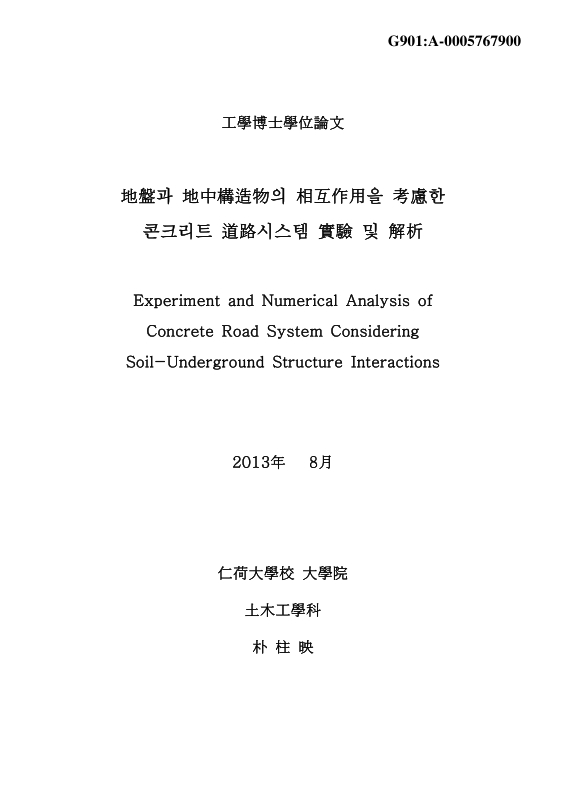
표제지
요지
Abstract
목차
기호 17
제1장 서론 19
1.1. 연구배경 19
1.2. 연구목적 및 범위 21
1) 지중구조물 시스템 평가와 구조적 개선을 위한 이론 고찰 21
2) 콘크리트 포장 하부 지반 공동 평가 모형 제시 22
3) 유한요소 모델에 의한 지중구조물 시스템 거동 해석 22
4) 포장가속 시험을 통한 동적 거동 해석 23
1.3. 논문의 구성 23
제2장 이론적 배경 25
2.1. 하부 지반 상태 예측을 위한 비파괴 시험 25
2.1.1. 동적 충격 하중을 이용한 포장하부 지반 예측 26
2.1.2. 전자파 반사원리를 이용한 포장하부 지반 예측 28
2.2. 마찰에 의한 구조물의 접촉 경계 특성 31
2.2.1. 가상일의 원리에 기반한 접촉면 구성 관계 32
2.2.2. 경계면의 마찰 접촉 특성 37
2.3. 지반 재료의 역학적 특성 39
2.3.1. 응력-변형률 텐서와 불변량 39
2.3.2. 탄소성 재료 모형 43
2.4. 동적 유한요소 해석 방법 48
2.4.1. 운동방정식의 유한요소 정식화 48
2.4.2. 시간이력해석을 위한 수치해석 기법 50
2.5. 소결 52
제3장 현장 조사 54
3.1. 조사 위치 54
3.2. 슬래브 파손 현황 및 토피고 측량 55
3.3. 하부 지반 상태 조사 61
3.4. 소결 71
제4장 지중구조물 시스템 하부지반 평가모형 72
4.1. 슬래브 처짐에 의한 포장 강성 추정 72
4.2. 하부 지반 공동 평가 모형 개발 78
4.3. 하부지반 평가모형 검증 82
4.4. 소결 89
제5장 지중구조물 시스템 유한요소모형 개발 및 해석 90
5.1. 유한요소 모형 개발 91
5.2. 현장을 모사한 유한요소 모형 분석 98
5.3. 줄눈 위치와 암거 크기에 따른 거동 분석 102
5.3.1. 적정 줄눈 위치 102
5.3.2. 암거 크기에 따른 적정 슬래브 길이 109
5.4. 박스 암거 수평경사각에 따른 거동 분석 113
5.5. 토피고에 따른 거동 분석 121
5.6. 보강슬래브 폭에 따른 거동 분석 132
5.7. 소결 137
제6장 포장 가속 시험 139
6.1. 설계 139
6.2. 시공 148
6.3. 시험 결과 분석 157
6.4. 해석적 검증 164
6.5. 소결 169
제7장 결론 170
7.1. 연구 결과 170
7.2. 연구의 활용도 173
7.3. 향후 연구 방향 174
참고문헌 175
APPENDIX 185
APPENDIX A. Underground exploration result of GPR(2-D analysis) 185
APPENDIX B. Structure calculation of reinforced slab(L=3.000m) 189
Fig. 2.1. Composition of falling weight deflectometer(FWD) 26
Fig. 2.2. Trend Line of Relation between Deflection and Load 28
Fig. 2.3. Wave through boundary surface between two medium 28
Fig. 2.4. Example of GPR 2D analysis result 29
Fig. 2.5. Two deformable bodies in contact 32
Fig. 2.6. Definition of contact traction 35
Fig. 2.7. Contact status in contact surface pair 38
Fig. 2.8. Mohr-Coulomb failure criteria 45
Fig. 2.9. Yield surface on π Plane 46
Fig. 3.1. Transverse cracking of slab above box culvert(KEC Test Road) 57
Fig. 3.2. Transverse cracking of slab above box culvert(□□□ Expressway) 59
Fig. 3.3. Transverse cracking of slab above box culvert(△△-○○○ Expressway) 60
Fig. 3.4. 69.24km(◇◇-20) 62
Fig. 3.5. 83.70km(◇◇-57) 64
Fig. 3.6. 87.08km(◇◇-73) 65
Fig. 3.7. 76.16km(▽▽-139) 67
Fig. 3.8. 76.12km(▽▽-140) 68
Fig. 3.9. Assessment of underground by conventional method 70
Fig. 4.1. Finite element model 74
Fig. 4.2. Relation between x-intercept and composite modulus of subgrade reaction 76
Fig. 4.3. Relation between composite modulus of subgrade reaction and radius of relative stiffness 78
Fig. 4.4. Evaluation results by improved method 79
Fig. 4.5. Field test 82
Fig. 4.6. Load loading position and pavement condition 83
Fig. 4.7. Range of coefficients for cavity existence 84
Fig. 4.8. Load loading position and GPR measurement range 85
Fig. 4.9. 2D exploration result of GPR (Longitudinal section) 86
Fig. 4.10. 2D exploration result of GPR (Floor plan) 87
Fig. 4.11. 3D analysis result of GPR 88
Fig. 5.1. Finite element model of underground structure system 92
Fig. 5.2. Pavement shape by curling 96
Fig. 5.3. Location and moving direction of traffic load 98
Fig. 5.4. Result of finite element analysis 100
Fig. 5.5. Actively yielding domains of soil 101
Fig. 5.6. Finite element model to decide the optimal joint position 103
Fig. 5.7. Highest maximum tensile stress according to joint position and loading combination 106
Fig. 5.8. Position of highest maximum tensile stress and corresponding position of axle load 108
Fig. 5.9. maximum tensile stress according to slab width 112
Fig. 5.10. Finite element model of horizontally inclinded box culvert 114
Fig. 5.11. Position of highest maximum tensile stress and corresponding position of axle load 118
Fig. 5.12. Highest maximum tensile stress according to joint position and loading combination 120
Fig. 5.13. Axle loading position Where tensile stress of slab is maximized (Positive temperature gradient) 125
Fig. 5.14. Highest maximum tensile stress according to soil cover depth and joint position(Positive temperature gradient) 126
Fig. 5.15. Axle loading position where tensile stress of slab is maximized (Negative temperature gradient) 130
Fig. 5.16. Highest maximum tensile Stress according to soil cover depth and joint position(Negative temperature gradient) 131
Fig. 5.17. Highest maximum tensile stress according to soil cover depth and width of reinforced slab(Positive temperature gradient) 134
Fig. 5.18. Highest maximum tensile stress according to soil cover depth and width of Reinforced Slab(Negative temperature gradient) 136
Fig. 6.1. Floor plan of vehicle in accelerated test 143
Fig. 6.2. Result of finite element analysis (JPCP) 144
Fig. 6.3. Result of finite element analysis (JPCP applied to '1/2' similitude ratio) 145
Fig. 6.4. Design drawing of accelerated test for underground structure system 147
Fig. 6.5. Fixed strain gauge and thermocouple 148
Fig. 6.6. Making process of concrete mass 149
Fig. 6.7. Construction of subgrade and reinforced slab 150
Fig. 6.8. Subgrade compaction and lean concrete construction 152
Fig. 6.9. Install of load transfer device and measuring instrument 153
Fig. 6.10. Membrane construction and slab placing 155
Fig. 6.11. Accelerated test 156
Fig. 6.12. Temperature distribution of test center and inner part of slab 158
Fig. 6.13. Roadbed (Experiment) 160
Fig. 6.14. CASE 1 (Experiment) 161
Fig. 6.15. CASE 7 (Experiment) 161
Fig. 6.16. 1m Reinforced slab (Experiment) 163
Fig. 6.17. 3m Reinforced slab (Experiment) 163
Fig. 6.18. Finite element model of Mobile Loading Simulator 165
Fig. 6.19. Roadbed (Experiment & FEM) 166
Fig. 6.20. CASE 1 (Experiment & FEM) 167
Fig. 6.21. CASE 7 (Experiment & FEM) 167
Fig. 6.22. 1m Reinforced slab (Experiment & FEM) 168
Fig. 6.23. 3m Reinforced slab (Experiment & FEM) 168
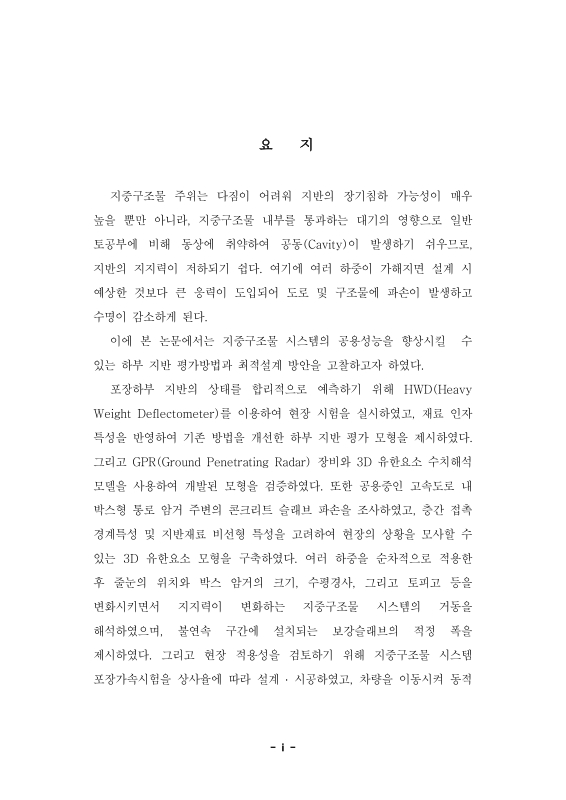
지중구조물 주위는 다짐이 어려워 지반의 장기침하 가능성이 매우 높을 뿐만 아니라, 지중구조물 내부를 통과하는 대기의 영향으로 일반 토공부에 비해 동상에 취약하여 공동(Cavity)이 발생하기 쉬우므로, 지반의 지지력이 저하되기 쉽다. 여기에 여러 하중이 가해지면 설계 시 예상한 것보다 큰 응력이 도입되어 도로 및 구조물에 파손이 발생하고 수명이 감소하게 된다.
이에 본 논문에서는 지중구조물 시스템의 공용성능을 향상시킬 수 있는 하부 지반 평가방법과 최적설계 방안을 고찰하고자 하였다.
포장하부 지반의 상태를 합리적으로 예측하기 위해 HWD(Heavy Weight Deflectometer)를 이용하여 현장 시험을 실시하였고, 재료 인자 특성을 반영하여 기존 방법을 개선한 하부 지반 평가 모형을 제시하였다. 그리고 GPR(Ground Penetrating Radar) 장비와 3D 유한요소 수치해석 모델을 사용하여 개발된 모형을 검증하였다. 또한 공용중인 고속도로 내 박스형 통로 암거 주변의 콘크리트 슬래브 파손을 조사하였고, 층간 접촉 경계특성 및 지반재료 비선형 특성을 고려하여 현장의 상황을 모사할 수 있는 3D 유한요소 모형을 구축하였다. 여러 하중을 순차적으로 적용한 후 줄눈의 위치와 박스 암거의 크기, 수평경사, 그리고 토피고 등을 변화시키면서 지지력이 변화하는 지중구조물 시스템의 거동을 해석하였으며, 불연속 구간에 설치되는 보강슬래브의 적정 폭을 제시하였다. 그리고 현장 적용성을 검토하기 위해 지중구조물 시스템 포장가속시험을 상사율에 따라 설계·시공하였고, 차량을 이동시켜 동적 응답 특성을 분석하였다. 이를 시간이력해석 방법으로 비교·분석하여 지중구조물 시스템의 합리적 설계방안을 검증하였다.*표시는 필수 입력사항입니다.
| 전화번호 |
|---|
| 기사명 | 저자명 | 페이지 | 원문 | 기사목차 |
|---|
| 번호 | 발행일자 | 권호명 | 제본정보 | 자료실 | 원문 | 신청 페이지 |
|---|
도서위치안내: / 서가번호:

우편복사 목록담기를 완료하였습니다.
*표시는 필수 입력사항입니다.
저장 되었습니다.
