
 대표어
대표어
권호기사보기
| 기사명 | 저자명 | 페이지 | 원문 | 기사목차 |
|---|
결과 내 검색
동의어 포함
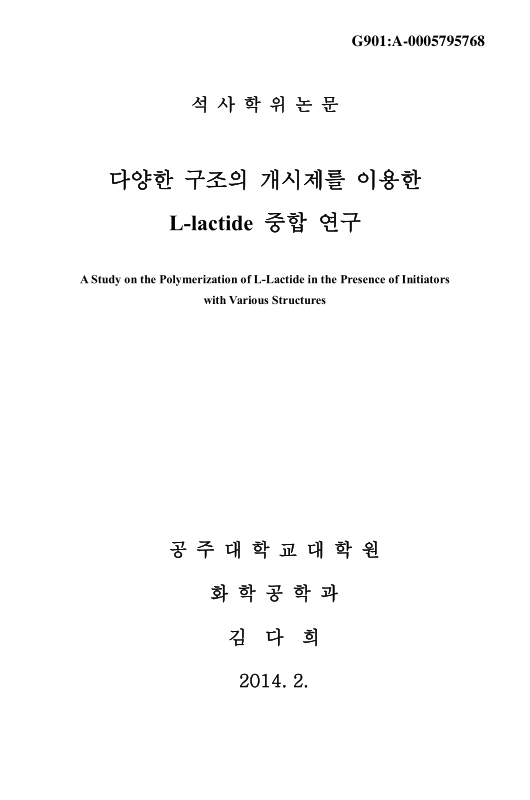
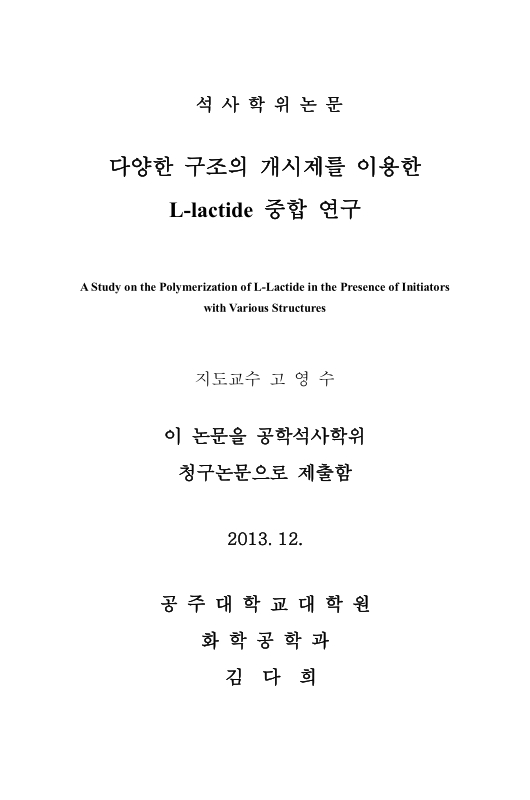
표제지
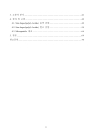
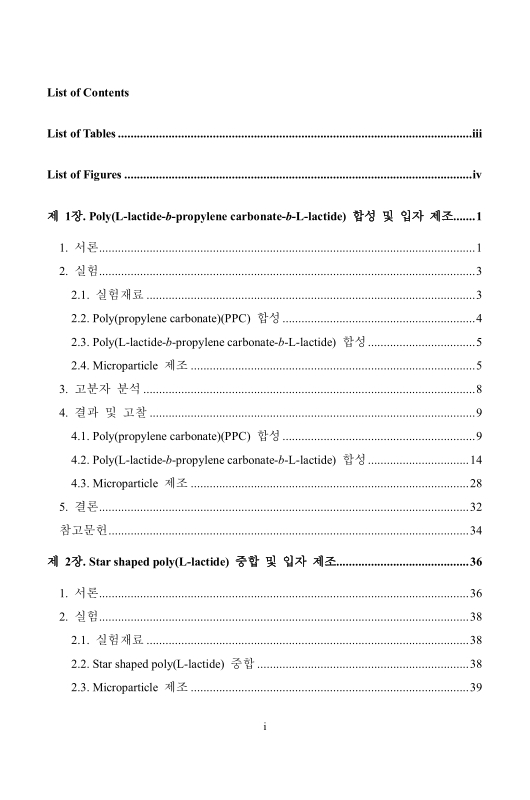
목차
제1장 Poly(L-lactide-b-propylene carbonate-b-L-lactide) 합성 및 입자 제조 10
1. 서론 10
2. 실험 12
2.1. 실험재료 12
2.2. Poly(propylene carbonate)(PPC) 합성 13
2.3. Poly(L-lactide-b-propylene carbonate-b-L-lactide) 합성 14
2.4. Microparticle 제조 14
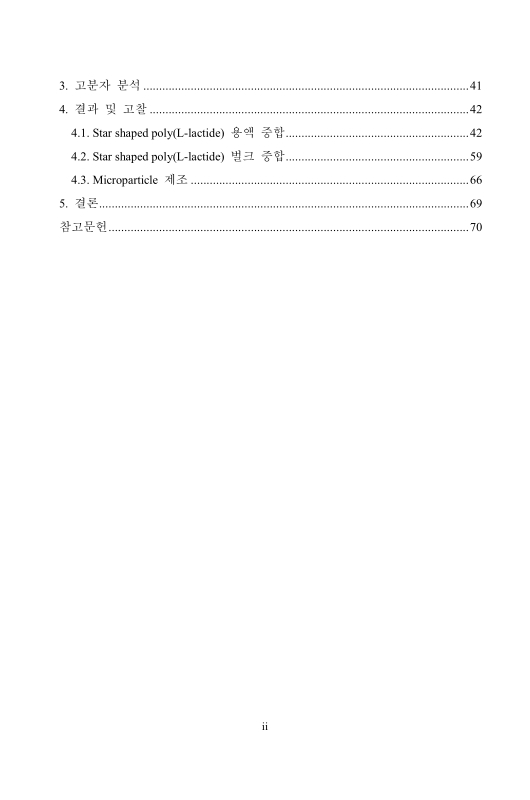
3. 고분자 분석 17
4. 결과 및 고찰 18
4.1. Poly(propylene carbonate)(PPC) 합성 18
4.2. Poly(L-lactide-b-propylene carbonate-b-L-lactide) 합성 23
4.3. Microparticle 제조 37
5. 결론 41
참고문헌 43
제2장 Star shaped poly(L-lactide) 중합 및 입자 제조 45
1. 서론 45
2. 실험 47
2.1. 실험재료 47
2.2. Star shaped poly(L-lactide) 중합 47
2.3. Microparticle 제조 48
3. 고분자 분석 50
4. 결과 및 고찰 51
4.1. Star shaped poly(L-lactide) 용액 중합 51
4.2. Star shaped poly(L-lactide) 벌크 중합 68
4.3. Microparticle 제조 75
5. 결론 78
참고문헌 79
ABSTRACT 80
Figure I-1. Structure of Co-salen complex 1. 15
Figure I-2. Scheme of microsphere preparation method. 16
Figure I-3. Schematic diagram of synthesis of the poly(propylene carbonate). 19
Figure I-4. ¹H-NMR spectrum of PPC. 21
Figure I-5. FT- IR spectra of PPC(Mn=32000 g/mol). 21
Figure I-6. GPC curves of PPC. 22
Figure I-7. DSC curves of PPC. 22
Figure I-8. Ring-opening polymerization of L-lactide in the presence of dihydroxyl PPC using Sn(Oct)₂ as catalyst. 25
Figure I-9. ¹H-NMR spectrum of triblock copolymer. 27
Figure I-10. FT-IR spectra of PLLA, PPC, and triblock copolymer. 27
Figure I-11. Change in the molecular weight as a function of the [LA]/[PPC] molar ratio. 29
Figure I-12. GPC curves of PPC and triblock copolymers. 30
Figure I-13. DSC curves of PLLA(Mn=8700 g/mol). 32
Figure I-14. Structure of triblock copolymers. 32
Figure I-15. DSC curves of PPC and triblock copolymers. 33
Figure I-16. Change in the degree of polymerization as a function of the [LA]/[PPC] molar ratio with different PPC chain length. 36
Figure I-17. SEM photographs of (a)PLLA(Mn=8700 g.mol) and (b)PPC(Mn=31000 g/mol) microspheres. 38
Figure I-18. SEM photographs of triblock copolymer microspheres. 39
Figure I-19. Difference of evaporation rate on the surface of microparticle during the preparation of microparticles. 40
Figure II-1. Polymerization mechanism of L-lactide in solution polymerization with TEA. 53
Figure II-2. Change in the conversion as a function of the reaction time in solution polymerization. 55
Figure II-3. GPC curves of PLLA[Polymerization time= 3 h]. 57
Figure II-4. Change in the molecular weight as a function of the polymerization time. 57
Figure II-5. Change of molecular weight as a function of [LA]/[I] molar ratio in solution polymerization. 60
Figure II-6. GPC curves of PLLA. 61
Figure II-7. Transesterification mechanism. 62
Figure II-8. DSC curves of PLLA prepared with various initiators([LA]/[Cat]=200, [LA]/[I]=200). 64
Figure II-9. ¹H-NMR spectra of 1L and 2L in solution polymerization([LA]/[Cat.]=200, [LA]/[I]=50). 65
Figure II-11. FT-IR spectra of PLLA, 2L, and 4S([LA]/[Cat.]=400, [LA]/[I]=50). 67
Figure II-12. Molecular weight and melting temperature as function of various initiators([LA]/[Cat.]=400, [LA]/[I]=50). 70
Figure II-13. DSC curves of PLLA prepared with various initiators([LA]/[Cat]=400, [LA]/[I]=50). 70
Figure II-14. GPC curves of PLLA([LA]/[Cat]=200, [LA]/[I]=30). 72
Figure II-15. ¹H-NMR spectra of 2L and 3S in bulk polymerization([LA]/[Cat.]=200, [LA]/[I]=50). 73
Figure II-16. ¹H-NMR spectra of 4S in bulk polymerization([LA]/[Cat.]=200, [LA]/[I]=50). 74
Figure II-17. SEM photographs of polymers in solution polymerization([LA]/[Cat.]=200, [LA]/[I]=50). 76
Figure II-18. SEM photographs of polymers in bulk polymerization([LA]/[Cat.]=200, [LA]/[I]=50). 77
The Poly(L-lactide-b-propylene carbonate-b-L-lactide) triblock copolymer was synthesized by ring opening polymerization of L-lactide with poly(propylene carbonate) as macroinitiator and Sn(Oct)2 as catalyst. The structure and composition of the synthesized triblock copolymer were determined by 1H-NMR spectroscopy. The degree of polymerization of L-lactide in the triblock copolymer was calculated based on the ratio of the peak areas of 1H-NMR spectrum. The GPC curve clearly showed that increasing the [LA]/[PPC] molar ratio shifted the curve of the triblock copolymers to a shorter retention time region without a change in the shape of GPC curve. These mean that the triblock copolymer was successfully prepared. The glass transition temperature of triblock copolymers were lower than those of PLLA homopolymer. The melting temperature of triblock copolymer was also lower than that of PLLA and absent in the case of shorter PLLA length of triblock copolymer. These findings showed that the presence of PPC block in the triblock copolymer caused increasing its chain mobility and flexibility and lowering crystallinity.
PLLA was prepared by ring-opening polymerization of L-lactide in the presence of monohydroxyl, dihydroxyl, or multiarm initiator. Star-shaped PLLA was successfully synthesized with multiarm initiators. The molecular weight of star-shaped PLLA was changed by the number of hydroxyl group of initiator and the molar ratio of monomer to initiator. The Tm and crystallinity of star shaped PLLA were found to be lower than those of the linear PLLA. Star-shaped PLLA had a bimodal GPC curve depending on the polymerization condition.
Microparticles were successfully prepared via single O/W emulsification technique. Microparticles of poly(L-lactide-b-propylene carbonate-b-L-lactide) and star-shape PLLA can be considered as a promising carrier for drug delivery purpose due to their controlled crystallinity and porosity.*표시는 필수 입력사항입니다.
| 전화번호 |
|---|
| 기사명 | 저자명 | 페이지 | 원문 | 기사목차 |
|---|
| 번호 | 발행일자 | 권호명 | 제본정보 | 자료실 | 원문 | 신청 페이지 |
|---|
도서위치안내: / 서가번호:

우편복사 목록담기를 완료하였습니다.
*표시는 필수 입력사항입니다.
저장 되었습니다.
