
 대표어
대표어
권호기사보기
| 기사명 | 저자명 | 페이지 | 원문 | 기사목차 |
|---|
결과 내 검색
동의어 포함
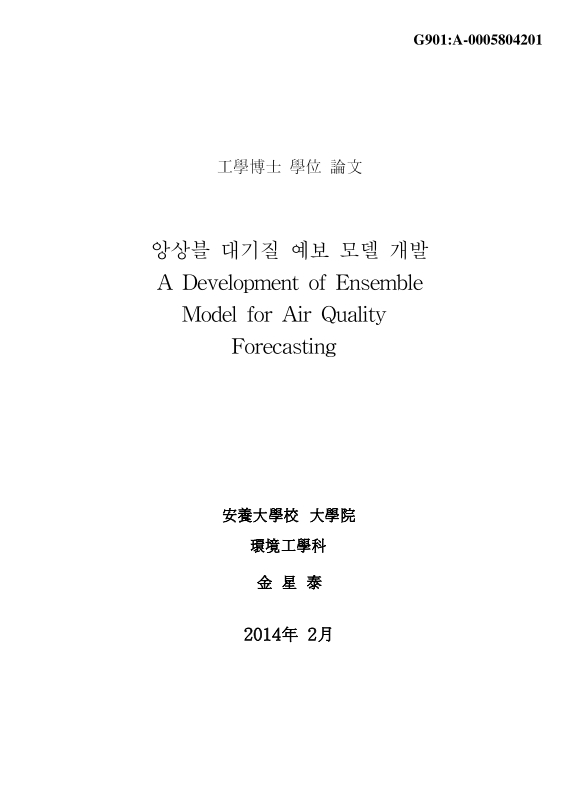
표제지
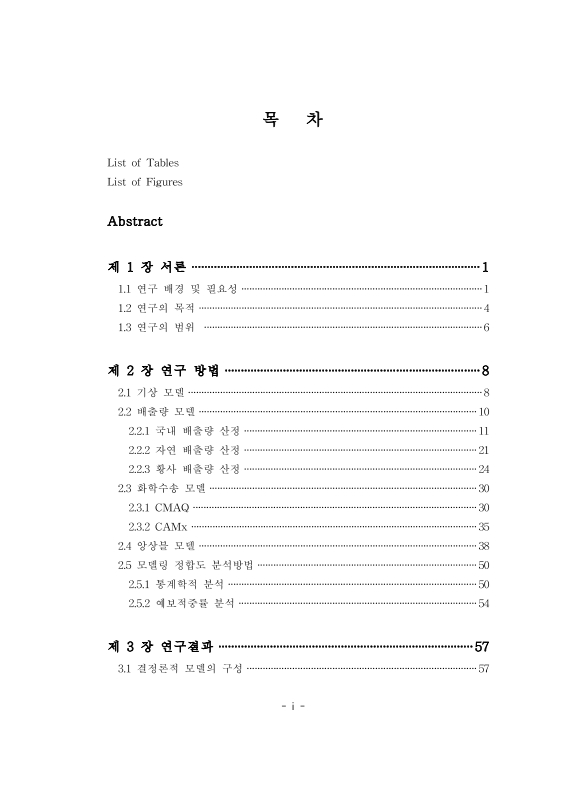
목차
Abstract 11
제1장 서론 14
1.1. 연구 배경 및 필요성 14
1.2. 연구의 목적 17
1.3. 연구의 범위 19
제2장 연구 방법 21
2.1. 기상 모델 21
2.2. 배출량 모델 23
2.2.1. 국내 배출량 산정 24
2.2.2. 자연 배출량 산정 34
2.2.3. 황사 배출량 산정 37
2.3. 화학수송 모델 43
2.3.1. CMAQ 43
2.3.2. CAMx 48
2.4. 앙상블 모델 51
2.5. 모델링 정합도 분석방법 63
2.5.1. 통계학적 분석 63
2.5.2. 예보적중률 분석 67
제3장 연구결과 70
3.1. 결정론적 모델의 구성 70
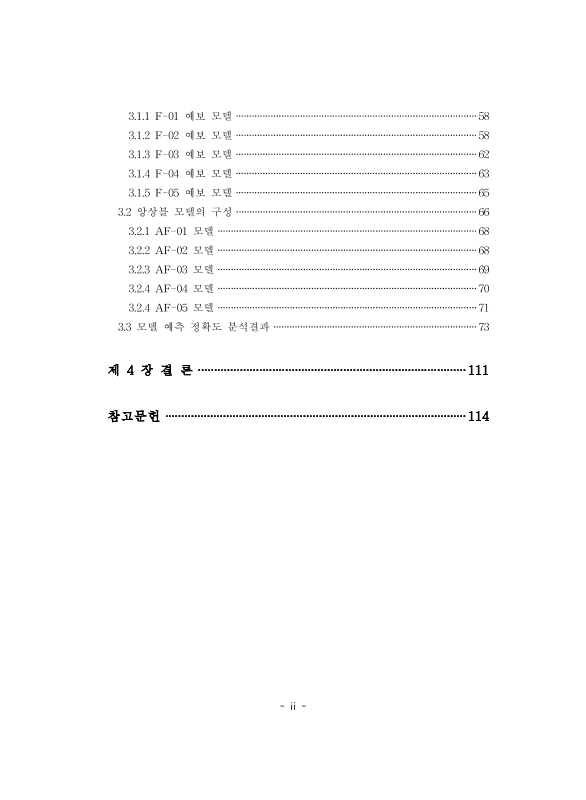
3.1.1. F-01 예보 모델 71
3.1.2. F-02 예보 모델 71
3.1.3. F-03 예보 모델 75
3.1.4. F-04 예보 모델 76
3.1.5. F-05 예보 모델 78
3.2. 앙상블 모델의 구성 79
3.2.1. AF-01 모델 81
3.2.2. AF-02 모델 81
3.2.3. AF-03 모델 82
3.2.4. AF-04 모델 83
3.2.4. AF-05 모델 84
3.3. 모델 예측 정확도 분석결과 86
제4장 결론 124
참고문헌 127
〈Fig. 1〉 WRF schematic diagram 22
〈Fig. 2〉 SMOKE schematic diagram 23
〈Fig. 3〉 Distribution of point sources for various emission species in CAPSS 2007 28
〈Fig. 4〉 Distribution of area sources for various emission species in CAPSS 2007 30
〈Fig. 5〉 Distribution of mobile sources for various emission species in CAPSS 2007 32
〈Fig. 6〉 The spatial distribution of surface soil type in the Asian dust source region 38
〈Fig. 7〉 The spatial distribution of NDVI averaged for the period from 21 March to 10 April for 9 years (1998-2006) 41
〈Fig. 8〉 CMAQ modeling system for air quality forecasting 44
〈Fig. 9〉 CAMx Modeling System 49
〈Fig. 10〉 Schematic illustration of some concepts in ensemble forecasting 51
〈Fig. 11〉 Category classification to evaluate forecasting accuracy 67
〈Fig. 12〉 Comparisons of forecasted pbl (planetary boundary layer) heights and PM₁0 with the observation(이미지참조) 74
〈Fig. 13〉 Location of air quality monitoring stations and corresponding identification numbers 89
〈Fig. 14〉 Time-series comparision of hourly forecasted PM₁0 with observations in Seoul(이미지참조) 93
〈Fig. 15〉 Time-series comparision of daily forecasted PM₁0 with observations in Seoul(이미지참조) 94
〈Fig. 16〉 Scatter plot of observed vs. forecasted hourly PM₁0 in Seoul(이미지참조) 95
〈Fig. 17〉 Time series of PM₁0, temperature, humidity, wind speed, and pbl height predicted by F-02 in Seoul(이미지참조) 98
〈Fig. 18〉 The simulated PM₁0 concentration distribution during 12-13 Jan, 2013(이미지참조) 99
〈Fig. 19〉 Observed PM₁0 (black) and forecasted PM₁0 contribution of Asian dust (red)(이미지참조) 101
〈Fig. 20〉 Variation of Kz with height at various times (UTC) 104
〈Fig. 21〉 Comparison of observed PM₁0 with forecasted ones with/without using KVPATCH and forecasted pbl height by F-05...(이미지참조) 105
〈Fig. 22〉 Category analysis of forecast performance of hourly PM₁0 in Seoul(이미지참조) 112
〈Fig. 23〉 Category analysis of forecast performance of daily PM₁0 in Seoul(이미지참조) 113
〈Fig. 24〉 Category analysis of forecast performance of hourly PM₁0 in Incheon(이미지참조) 114
〈Fig. 25〉 Category analysis of forecast performance of daily PM₁0 in Incheon(이미지참조) 115
〈Fig. 26〉 Time-series comparision of hourly forecasted PM₁0 with observations in Seoul(이미지참조) 116
〈Fig. 27〉 Time-series comparision of daily forecasted PM₁0 with observations in Seoul(이미지참조) 117
〈Fig. 28〉 Time-series comparision of hourly forecasted PM₁0 with observations in Incheon(이미지참조) 118
〈Fig. 29〉 Time-series comparision of daily forecasted PM₁0 with observations in incheon(이미지참조) 119
〈Fig. 30〉 Scatter plot of observed vs. forecasted hourly PM₁0 in Seoul(이미지참조) 120
〈Fig. 31〉 Scatter plot of observed vs. forecasted daily PM₁0 in Seoul(이미지참조) 121
〈Fig. 32〉 Scatter plot of observed vs. forecasted hourly PM₁0 in Incheon(이미지참조) 122
〈Fig. 33〉 Scatter plot of observed vs. forecasted daily PM₁0 in Inchoen(이미지참조) 123
The East Asia region is the world's most populous area with a rapidly growing economy resulting in large air pollutant emissions. The urban and industrial development of China in this region leads to substantial increase of anthropogenic emission and it causes heavy and complex air pollution problems in China and neighboring countries. The air quality in the Seoul Metropolitan Area (SMA), Korea has deteriorated due to emissions in the SMA itself as well as the growing influence from China. The large anthropogenic emission from megacity clusters in North and East China such as the Beijing-Tianjin-Hebei province, the Yangtze River delta and Shenyang located in eastern China can be transported to the SMA by the prevailing northwestern winds in Winter and Spring season. Moreover, dust emission from deserts in northwestern China can be also moved to the Korean peninsula causing the dust event from Winter to early Summer.
It's thus necessary to promote the method of protecting the people's living environment by publicizing the possibility of a pollutant event with high concentration of fine PM (Particulate Matter) in advance before air quality gets worse in order to minimize its consequential health damage. The biggest issue in the advance alarming of air quality is how to secure the accuracy in the air quality forecasting; actually, a lot of research work is under way in an effort to improve the accuracy in the air quality forecasting at home and abroad.
This study was carried out to improve the accuracy of forecasting model using various prognostic and assemble approaches based on the previous research works. The 5 prognostic forecast models were proposed using various combinations of WRF updated versions as a meteorological model, emission processing methods using SMOKE, and different chemical transport models of CMAQ and CAMx. The 5 ensemble forecast models were also proposed based on the following configurations: ① a method of simply doing an arithmetical mean of 5 prognostic model outcomes, ② a super-ensemble method in which the weighted values of the prognostic models are applied, ③ a method of the expanded super-ensemble in which the weighted values of the prognostic models are calculated by group classified by the main wind direction of the previous day, ④ a method of the expanded super-ensemble in which the weighted values of the prognostic models are calculated by group classified by the wind speed of the previous day, ⑤ a method of an expanded super-ensemble in which the weighted values of the prognostic models are calculated by group classified by the humidity of the previous day.
The forecasted results from the proposed 5 prognostic models (F01 to F05) and 5 ensemble models (AF01 to AF05) were compared with air quality and meteorological observations in the SMA. The period of forecast performance test was from January to March in 2013.
The results of comparison in daily PM10 concentration in the Seoul metropolis shows that AF-04 to which the weighted values were applied based on wind speed has the highest accuracy rate with 76.4% while the other ensemble models are 66.2 - 75.2% accuracy rate. In the false warning rate, the ensemble models are from 30.7% to 47.0%, showing an exceptionally improvement comparing to a single prognostic model whose false warning rate stayed between 47.6% and 56.6%.
The comparison shows that the ensemble models with weighted values on meteorological conditions, such as wind direction, wind speed and humidity improve the accuracy in the forecasting. This study also prove that the reliability in the air quality forecasting can be improved employing the ensemble approach rather than using a single prognostic model and the ensemble methods in determining weighted values are important.
To improve the accuracy in the air quality forecasting in the future, it's necessary to continue not only the research work in the direction of enhancing the reliability in the individual prognostic forecast model but also the research work on developing optimal ensemble model using various combinations of prognostic models.| 번호 | 참고문헌 | 국회도서관 소장유무 |
|---|---|---|
| 1 | 국가 대기오염물질 배출량 산정방법편람(II), 2010, 국립환경과학원 | 미소장 |
| 2 | 지표특성 자료 향상에 의한 복잡지형하에서 고해상도 기후 모사의 평가 및 예측 | 소장 |
| 3 | 대기오염물질 배출량, 2009, 국립환경과학원 | 미소장 |
| 4 | CAMx를 이용한 동북아시아 지역 대기오염물질의 장거리 이동 평가 연구 | 소장 |
| 5 | 광화학 반응 메커니즘 변화에 따른 대기질 모델링의 민감도 분석 연구 | 소장 |
| 6 | 슈퍼앙상블 계절예측시스템 연구(I), 2004, 기상연구소 | 미소장 |
| 7 | 2009, 자료동화 및 Physics Scheme에 따른 기상모델(WRF)의 민감도 분석, 안양대학교 대학원 공학석사 학위 논문 | 미소장 |
| 8 | 황사감시 및 예측기술 개발(I), 2005, 기상연구소 | 미소장 |
| 9 | 태안반도에서 관측된 고농도 오존 현상의 특성 및 광화학 모델을 이용한 모사 | 소장 |
| 10 | 회귀분석, 2000, 나남출판 | 미소장 |
| 11 | Effect of Direct Radiative Forcing of Asian Dust on the Meteorological Fields in East Asia during an Asian Dust Event Period  |
미소장 |
| 12 | Critical Evaluation of and Suggestions for a Comprehensive Project Based on the Special Act on Seoul Metropolitan Air Quality Improvement | 소장 |
| 13 | 2009, A demonstration of the natinal air quality forecast capability, U.S. EPA's 2009 Natinal Air Quality Conference. | 미소장 |
| 14 | CAMx User's Guide, 2013, ENVIRON | 미소장 |
| 15 | A neural network based ensemble approach for improving the accuracy of meteorological fields used for regional air quality modeling |
미소장 |
| 16 | An Evaluation of the Influence of Boundary Conditions from GEOS-Chem on CMAQ Simulations over East Asia | 소장 |
| 17 | 2010, An enhanced PM2.5 air quality forecast model based on nonlinear regression and back-trajectory concentraions, Atmos. Environ., 44(25), 3015-3023 | 미소장 |
| 18 | Dalla-Fort Worth Modeling Support : Improving Vertical Mixing, Plume-in-Grid, and Photolysis Rates in CAMx, 2012, ENVIRON | 미소장 |
| 19 | Ensemble and bias-correction techniques for air quality model forecasts of surface O 3 and PM 2.5 during the TEXAQS-II experiment of 2006 |
미소장 |
| 20 | Stochastic dynamic prediction |
미소장 |
| 21 | ENSEMBLE and AMET: Two systems and approaches to a harmonized, simplified and efficient facility for air quality models development and evaluation |
미소장 |
| 22 | Guidance for Demonstrating Attainment of Air Quality Goals for PM-2.5 and Regional Haze, 2001, U.S. EPA | 미소장 |
| 23 | Guidance on the Use of Models and Other Analyses for Demonstrating Attainment of Air Quality Goals for Ozone, PM-2.5, and Reginal Haze, 2007, U.S. EPA | 미소장 |
| 24 | Guidelines for Developing and Air Quality(Ozone and PM-2.5) Forecasting Program, 2003, U.S. EPA | 미소장 |
| 25 | Uncertainty and Estimation of Health Burden from Particulate Matter in Seoul Metropolitan Region | 소장 |
| 26 | Local Versus Nonlocal Boundary-Layer Diffusion in a Global Climate Model |
미소장 |
| 27 | A neural network forecast for daily average PM 10 concentrations in Belgium |
미소장 |
| 28 | High-resolution Simulation of Meteorological Fields over the Coastal Area with Urban Buildings | 소장 |
| 29 | The Analysis of PM10 Concentration and the Evaluation of Influences by Meteorological Factors in Ambient Air of Daegu Area | 소장 |
| 30 | 2003, The soil particle size dependent emissin parameterization for an Asian dust (Yellow Sand) observed in Korea in April 2002, Atmos. Environ., 37(33), 4625-4636 | 미소장 |
| 31 | 2009, Development of PM2.5 forecasting model and a web-based air quality mapping and forecasting system for Ohio, U.S. EPA's 2009 Natinal Air Quality Conference. | 미소장 |
| 32 | Air Pollution in Seoul Caused by Aerosols | 소장 |
| 33 | 2010, Analysis of the trend of atmospheric PM10 concentration over the Seoul Metropolitan Area between 1999 and 2008, Korean J. of Environ. Impact Assessment, 19(1), 5-74 | 미소장 |
| 34 | Calculation of wind in a Tokyo urban area with a mesoscale model including a multi-layer urban canopy model |
미소장 |
| 35 | Development of a Multi-Layer Urban Canopy Model for the Analysis of Energy Consumption in a Big City: Structure of the Urban Canopy Model and its Basic Performance |
미소장 |
| 36 | A Development of PM10 Forecasting System | 소장 |
| 37 | 2012, Performance evaluation of the updated air quality forecasting system for Seoul Predicting PM10, Atmos. Environ., 58, 56-69 | 미소장 |
| 38 | Improved Weather and Seasonal Climate Forecasts from Multimodel Superensemble |
미소장 |
| 39 | Multimodel Ensemble Forecasts for Weather and Seasonal Climate |
미소장 |
| 40 | Effects Study on the Accuracy of Photochemical Modeling to MM5 Four Dimensional Data Assimilation Using Satellite Data | 소장 |
| 41 | 2011, A Study of Urban Heat Island in Chuncheon Using WRF Model and Field Measurements, J. Korean Soc. Atmos. Environ., 28(2), 119-130 | 미소장 |
| 42 | Theoretical Skill of Monte Carlo Forecasts |
미소장 |
| 43 | Deterministic Nonperiodic Flow |
미소장 |
| 44 | Air quality modeling: From deterministic to stochastic approaches |
미소장 |
| 45 | The ECMWF Ensemble Prediction System: Methodology and validation |
미소장 |
| 46 | An ensemble air-quality forecast over western Europe during an ozone episode |
미소장 |
| 47 | Sensibility Study for PBL Scheme of WRF-CMAQ | 소장 |
| 48 | Evaluation of Ensemble Approach for O3 and PM2.5 Simulation |
미소장 |
| 49 | 2007, A comparison between statistical models and three demensional air quality models: is the more and better, U.S. EPA's 2008 Natinal Air Quality Conference. | 미소장 |
| 50 | Application of dynamic linear regression to improve the skill of ensemble-based deterministic ozone forecasts |
미소장 |
| 51 | The Asian Dust Aerosol Model 2 (ADAM2) with the use of Normalized Difference Vegetation Index (NDVI) obtained from the Spot4/vegetation data |
미소장 |
| 52 | Parameterization of Asian dust (Hwangsa) particle-size distributions for use in dust emission models |
미소장 |
| 53 | 2006, An integrated neural network model for PM10 forecasting, Atmos. Environ., 40, 2845-2851 | 미소장 |
| 54 | 2006, Health Effects of Fine Particulate Air Pollution : Lines that Connect, J. Air Waste Manag. Assoc. , 56, 709-747 | 미소장 |
| 55 | Numerical prediction of northeast Asian dust storms using an integrated wind erosion modeling system |
미소장 |
| 56 | The Influence of Meteorological Factors on PM10Concentration in Incheon | 소장 |
| 57 | Dynamic parameter estimation for a street canyon air quality model |
미소장 |
| 58 | 2013, Identifying pollutioin sources and predicting urban air quality using ensemble learning methods, Atmos. Environ., 80, 426-437 | 미소장 |
| 59 | Ensemble Forecasting at NCEP and the Breeding Method |
미소장 |
| 60 | Skill and uncertainty of a regional air quality model ensemble |
미소장 |
| 61 | Evaluation of the meteorological forcing used for the Air Quality Model Evaluation International Initiative (AQMEII) air quality simulations |
미소장 |
| 62 | A two-dimensional numerical investigation of the dynamics and microphysics of Saharan dust storms |
미소장 |
| 63 | 2006, Statistical Methods in the Atmospheric Sciences, Academic Press, Elsevier. Second Edition | 미소장 |
| 64 | World Health Organization, 2004, Health Aspects of Air pollution-Results from the WHO project Systematic Review of Health Aspects of Air Pollution in Europe | 미소장 |
| 65 | A multi-model superensemble algorithm for seasonal climate prediction using DEMETER forecasts |
미소장 |
| 66 | A WRF/Chem sensitivity study using ensemble modelling for a high ozone episode in Slovenia and the Northern Adriatic area |
미소장 |
| 67 | 2012, Real-time air quality forecasting, part II: State of the science, current research needs, and future prospects, Atmos. Environ., 60, 656-676 | 미소장 |
*표시는 필수 입력사항입니다.
| 전화번호 |
|---|
| 기사명 | 저자명 | 페이지 | 원문 | 기사목차 |
|---|
| 번호 | 발행일자 | 권호명 | 제본정보 | 자료실 | 원문 | 신청 페이지 |
|---|
도서위치안내: / 서가번호:

우편복사 목록담기를 완료하였습니다.
*표시는 필수 입력사항입니다.
저장 되었습니다.
