
 대표어
대표어

권호기사보기
| 기사명 | 저자명 | 페이지 | 원문 | 기사목차 |
|---|
결과 내 검색
동의어 포함
Title Page
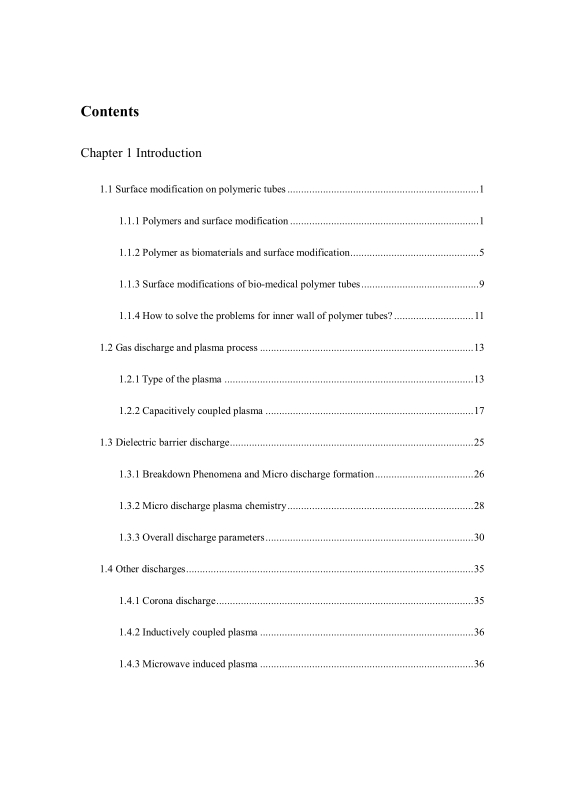
Contents
Abstract 15
Chapter 1. Introduction 17
1.1. Surface modification on polymeric tubes 17
1.1.1. Polymers and surface modification 17
1.1.2. Polymer as biomaterials and surface modification 21
1.1.3. Surface modifications of bio-medical polymer tubes 25
1.1.4. How to solve the problems for inner wall of polymer tubes? 27
1.2. Gas discharge and plasma process 29
1.2.1. Type of the plasma 29
1.2.2. Capacitively coupled plasma 33
1.3. Dielectric barrier discharge 41
1.3.1. Breakdown Phenomena and Micro discharge formation 42
1.3.2. Micro discharge plasma chemistry 44
1.3.3. Overall discharge parameters 46
1.3.4. Dielectric materials and frequency dependence 48
1.4. Other discharges 51
1.4.1. Corona discharge 51
1.4.2. Inductively coupled plasma 52
1.4.3. Microwave induced plasma 52
1.5. Surface and interface chemistry 54
1.5.1. Effect of plasma gas 54
1.5.2. Aging effect 55
1.5.3. Interfacial chemistry 55
References 57
Chapter 2. Experiments 62
2.1. Plasma modification systems 62
2.1.1. Inner surface modification system of polymer tube 62
2.1.2. Plasma power generator 66
2.2. Plasma modification process 68
2.2.1. PTFE and PE modification procedure 68
2.3. I-V Characteristics and Plasma Diagnostics 70
2.3.1. Oscilloscope Measurement 70
2.3.2. Optical emission spectrometry 72
2.4. Surface analysis 74
2.4.1. XPS 74
2.4.2. ATR-FTIR 74
2.4.3. Contact angle analysis 75
2.4.4. FE-SEM 75
2.5. Biological analysis 77
2.5.1. SMC attachments 77
2.5.2. Albumin attachments 77
References 79
Chapter 3. Results and discussion 81
3.1. Characteristics of surface plasma for polymer tubes 81
3.1.1. Paschen's curve of breakdown 83
3.1.2. I-V characteristics of surface plasma 91
3.1.3. Oscilloscopic measurement of current and voltage 97
3.1.4. Optical diagnostics of surface plasma 106
3.2. Surface modification of PTFE tube by the hydrocarbon grafting 119
3.2.1. Understanding of inner wall surface modification 119
3.2.2. Hydrogen plasma treatment 121
3.2.3. Hydrocarbon grafting and activation by the oxygen plasma 125
3.2.4. Smooth Muscle Cell (SMC) attachments 131
3.3. Surface modification of narrow polymer tubes 133
3.3.1. Plasma generation and surface modification in narrow tubes 133
3.3.2. Plasma induced grafting onto inner wall of narrow tubes 134
3.3.3. Surface analysis of inner wall 140
References 153
Chapter 4. Conclusions 159
4.1. Characteristics of surface plasma for polymer tubes 159
4.2. Surface modification of PTFE tube by the hydrocarbon coating 160
4.3. Surface modification of narrow polymer tubes 161
Abstract (Korean) 163
Publications in journals 165
Proceedings of conferences 166
Invented patents 169
Figure 1.1. Properties of biocompatible materials. 21
Figure 1.2. Polymer surface modification method and immobilization. 24
Figure 1.3. Polymer surface modification method by plasma irradiation. 26
Figure 1.4. Plasma types by electron density and temperature. 30
Figure 1.5. Electron and ion temperatures as a function of pressure. 30
Figure 1.6. Typical electrode arrangements of dielectric barrier discharges in RF discharge reactors. 34
Figure 1.7. Typical Paschen’s curve for various gases. 35
Figure 1.8. RF connections to parallel plate reactor with unequal electrodes and developed self-bias. 37
Figure 1.9. Development of a self-bias in a parallel plate discharge (a) applied voltage; (b) voltage across the discharge versus time. 39
Figure 1.10. Development of a self-bias with a sinusoidal wave of unequal electrodes. 39
Figure 1.11. Typical electrode arrangements of dielectric barrier discharges in atmospheric plasma. 42
Figure 1.12. Sketch of a micro discharge and a simple equivalent circuit. 43
Figure 1.13. Time scale of the relevant processes of the filamentary barrier discharge. 45
Figure 1.14. Symbolic presentations of micro discharge activity and corresponding voltage charge Lissajous figure. 48
Figure 1.15. Comparison of theoretical and experimental value of the real and imaginary parts of the dielectric constant of polystyrene respectively. 49
Figure 2.1. Polymer surface modification system. 63
Figure 2.2. Schematic diagram of dielectric barrier discharge in tube coating configuration and concepts of electrodes. 65
Figure 2.3. Pictures of plasma generation on polymeric tubes a) inner diameter of 3.8 mm, b) inner diameter of 2.3 mm, c) view of plasma generation. 65
Figure 2.4. Configuration of electrode and plasma generator. 67
Figure 2.5. Graph of voltage vs. time, illustrating the period (T), peak to peak voltage (Vpp) and amplitude (V0) of a sine wave.(이미지참조) 71
Figure 3.1. Schematic diagram of diagnostic system. 82
Figure 3.2. Breakdown voltage variation of a function of pressure and discharge gap (Paschen's curve). 83
Figure 3.3. Measured breakdown voltages of Ar discharge for various tubes as a function of pressure. 84
Figure 3.4. Measured breakdown voltages for various plasma gases as a function of pressure. 87
Figure 3.5. Free radical reactions occur in the polymer tube. 89
Figure 3.6. Measured breakdown voltages for various mixed plasma gases as a function of pressure. 90
Figure 3.7. Voltage and current of breakdown according to the electrode distance and pressure (pd) of the different inner diameter of PTFE tubes. 91
Figure 3.8. Relationship of voltage and current in PTFE tubes 93
Figure 3.9. Voltage-current characteristic of the DC glow discharge 94
Figure 3.10. Relationship of the polymer tube breakdown voltage and voltage and current. 95
Figure 3.11. Overall voltage and current with respect to PE and PFTE polymer tubes whose inner diameters were different. 96
Figure 3.12. Photo of the polymer discharge tube 98
Figure 3.13. I-V curves and Lissajous figures of surface discharge for PTFE tubes 99
Figure 3.14. Typical form of two-dimensional Lissajous figures of resistor, capacitor, inductor, and combination form of DBD 101
Figure 3.15. Series of filamentary discharge and surface discharge in the discharge tube 102
Figure 3.16. Schematic diagrams of equivalent electric circuit of capacitive impedance and parallel model of for breakdown and surface discharge. 104
Figure 3.17. Current and voltage waveform of surface plasma on the polymer is analyzed by the oscilloscope. 105
Figure 3.18. Optical emission spectrometry of emitted spectral line by ions and radicals 107
Figure 3.19. OES spectrum measured at three points 108
Figure 3.20. OES spectrums of argon discharge and the mixed gas discharge of argon and oxygen 109
Figure 3.21. Spectrum of the argon discharge in wavelength range of 200-450 nm (PTFE polymer tubes) 112
Figure 3.22. Emission intensity changes in the CH line analysis in accordance with the discharge time (PTFE) 114
Figure 3.23. Spectrum of the argon discharge in wavelength range of 200-450 nm (PE polymer tubes) 116
Figure 3.24. Emission intensity changes in the analysis according to the discharge time OH line and CH line(PE) 117
Figure 3.25. Variation of OH lines and CH lines during Ar discharge with discharge time till 50 min. 118
Figure 3.26. ATM mode FT-IR spectra of PTFE with various hydrogen plasma treatment times. 123
Figure 3.27. The XPS C1s peaks of (a) the untreated PTFE, (b) the H₂plasma treated PTFE, and (c) the hydrocarbon deposited PTFE. 124
Figure 3.28. SEM surface morphologies of specimens with various treatment conditions 126
Figure 3.29. D1 Water contact angles (WCA) of specimens with various treatment conditions 129
Figure 3.30. XPS C1s spectra of specimens treated by O₂plasma; (a) for 30 seconds and (b) for 60 seconds 130
Figure 3.31. Observation of SMC attachments on untreated and modified PTFE tube inner surfaces 132
Figure 3.32. Variation of water contact angles of the PE tubes after the plasma surface modification. Surface showed hydrophilic property. 135
Figure 3.33. Albumin (protein) adsorption tests of modified polymers tubes 138
Figure 3.34. the results of carbohydrate (red-dextran) adsorption test 139
Figure 3.35. the results of leukocyte (THP-1 cell) adsorption test 139
Figure 3.36. the features of grafted PE polymer tube as surface modification steps 141
Figure 3.37. the features of grafted PTFE polymer tube as surface modification steps 141
Figure 3.38. ATR FTIR absorption spectrum of the PE polymer 145
Figure 3.39. C1s peaks of PE specimen by the XPS 147
Figure 3.40. C1s peaks of PTFE specimen by the XPS 147
Figure 3.41. Fitting analysis of the C1s peak of the grafted hydrocarbon polymer thin film on the surface of PE 149
Figure 3.42. Distribution of functional groups in surface of PE polymer by the XPS and Gaussian curve fitting program 150
Figure 3.43. Distribution of functional groups in surface of PTFE polymer by the XPS and Gaussian curve fitting program 150
좁은 관경을 갖는 상대 유전율 3 이하인 PTFE와 PE 고분자 튜브 내부에 플라즈마 방전을 일으켜 고분자 튜브 표면 그래프팅 기술을 연구하였다. 스텐트 및 인공혈관 등에 적용이 가능한 내부지름 3 mm 이하의 원통형 고분자 생체 식립체 내부 표면을 그래프팅하는 기술이다.
저 유전물질인 PTFE와 PE 고분자 튜브의 플라즈마 방전을 위해 유전체 장벽방전 방법을 이용하였다. 플라즈마 그래프팅 방법은 알곤과 수소 플라즈마를 이용한 표면 활성화, 탄화수소박막(a-C:H)의 증착, 산소와 수소 플라즈마를 이용한 재활성화의 세가지 방법을 단계적으로 수행하였다. 결과적으로 소수성 고분자 표면은 탄화수소 박막으로 그래프팅되어 표면은 생물학적 기능성을 갖는 친수성 표면으로 변화하였다.
좁은 고분자 튜브 내부에 생성되는 플라즈마는 고분자의 관경에 의해 방전 개시 전압이 결정되었다. 방전개시 이후 DC 글로우 방전에서 나타나는 전압과 전류의 특징이 나타났다. 전압과 전류의 파형 분석을 통해 고분자 표면과 가스 간의 새로운 용량성 임피던스가 병렬회로로 나타나는 것을 밝혀냈다. 그리고 고분자 내부 표면 전체에 플라즈마가 형성되었고, 방전 형태는 면 방전의 형태로 나타났다.
탄화수소박막의 그래프팅과 산소 플라즈마 처리를 통해 표면의 carbonyls (C-O, C=O 결합)의 기능성 그룹은 생물학적 흡착이 가능한 반응기를 형성할 수 있다는 것을 생물학적 실험을 통해 증명하였다. PTFE 고분자는 표면이 소수성으로 세포의 부착이 어려웠으나, 친수성으로 그래프팅된 새로운 표면은 세포가 부착하였다. 수소 플라즈마 처리는 표면에 C-O, C=O 결합을 줄이고 수소와의 결합된 -H 끝단의 기능성 그룹과 graphitic C-C 결합 그룹을 표면에 형성시켰다. 생물학적 실험에서 그래프팅과 수소플라즈마 처리 표면에서 알부민의 흡착이 억제되었다.*표시는 필수 입력사항입니다.
| 전화번호 |
|---|
| 기사명 | 저자명 | 페이지 | 원문 | 기사목차 |
|---|
| 번호 | 발행일자 | 권호명 | 제본정보 | 자료실 | 원문 | 신청 페이지 |
|---|
도서위치안내: / 서가번호:

우편복사 목록담기를 완료하였습니다.
*표시는 필수 입력사항입니다.
저장 되었습니다.
