
 대표어
대표어
권호기사보기
| 기사명 | 저자명 | 페이지 | 원문 | 기사목차 |
|---|
결과 내 검색
동의어 포함
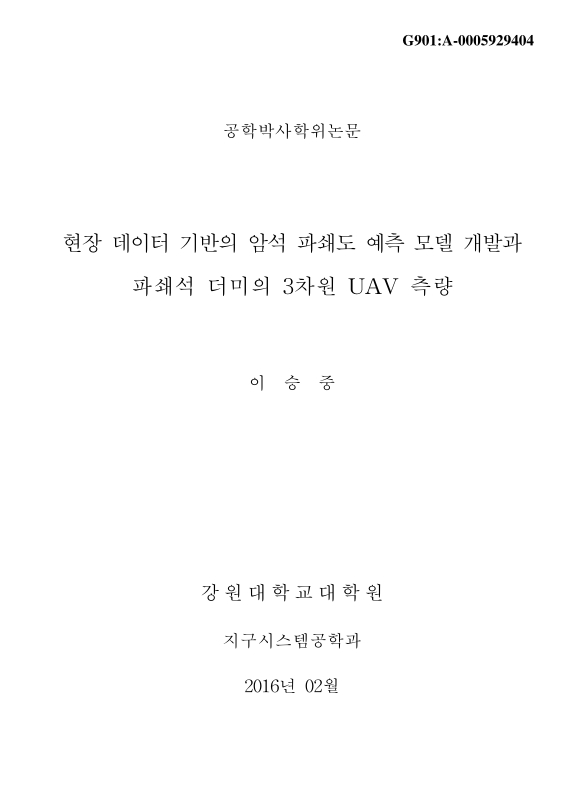
표제지
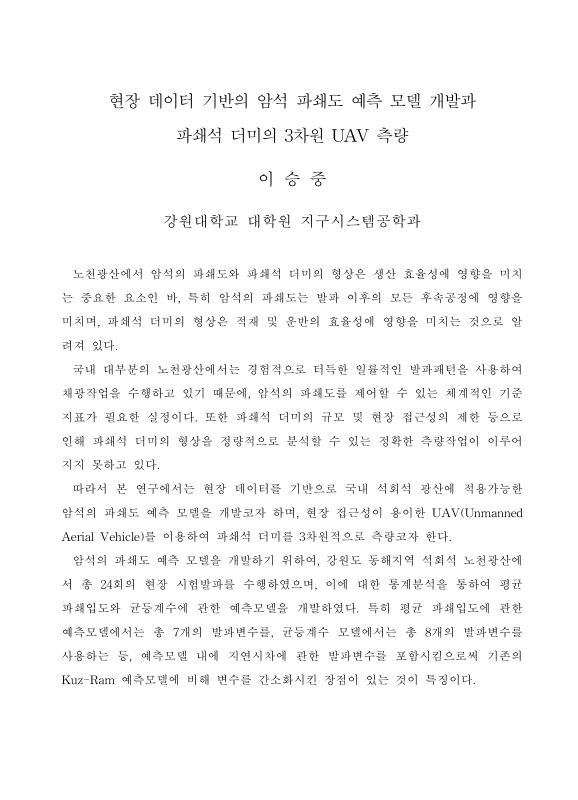
요약
목차
제1장 서론 16
제2장 암석의 파쇄도에 관한 선행 연구 사례분석 22
2.1. 암석의 파쇄도 예측 모델 24
2.1.1. Langefors and Kihlstrom의 모델 24
2.1.2. Gustafsson의 모델 25
2.1.3. Larsson의 모델 26
2.1.4. Kou and Rustan의 모델 26
2.1.5. Kuz-Ram 모델 27
2.2. 지연시차가 파쇄도에 미치는 영향 39
제3장 암석의 파쇄도 예측 모델 개발을 위한 시험발파 42
3.1. 현장 개요 43
3.2. 지형 및 지질 44
3.3. 절리의 분포 특성 46
3.4. 암석 및 암반의 공학적 특성 55
3.4.1. 암석의 공학적 특성 55
3.4.2. 암반의 공학적 특성 56
3.5. 시험발파 조건 64
3.5.1. 사용 화약류 64
3.5.2. 발파 패턴 65
3.6. 파쇄도 분석 69
3.7. 측정된 결과와 지연시차와의 상관성 분석 78
3.8. Kuz-Ram 모델에 의해 추정된 결과와 현장에서 측정된 결과와의 비교 82
제4장 통계분석에 의한 파쇄도 예측 모델 개발 89
4.1. 발파변수간의 상관관계 분석 91
4.2. 다중 선형회귀분석 99
4.2.1. X50에 관한 다중 선형회귀분석(이미지참조) 100
4.2.2. n에 관한 다중 선형회귀분석 105
4.3. 암석의 파쇄도 예측 모델 개발 109
4.4. 현장 적용성 평가 112
4.4.1. 예측 모델의 적용 조건 112
4.4.2. 시험 발파조건 및 현장 조사 113
4.4.3. 현장 적용성 평가 122
4.4.4. Kuz-Ram 모델과 개발된 예측 모델의 현장 적용성에 관한 고찰 127
제5장 파쇄석 더미의 3차원 UAV 측량 132
5.1. 3차원 측량기법 133
5.1.1. 3D Laser Scanner를 이용한 측량기법 133
5.1.2. 입체사진측량기법 134
5.2. 3차원 정보 복원에 관한 기초 이론 136
5.2.1. 공액 기하학 136
5.2.2. 영상 정합 기법 138
5.2.3. 3차원 깊이 정보획득 이론 138
5.3. 현장시험 140
5.3.1. UAV를 이용한 항공촬영 시스템 141
5.3.2. 공간좌표 설정 144
5.3.3. 항공 사진촬영 및 3차원 영상 처리 147
5.3.4. 3차원 영상 처리 결과 분석 159
5.4. 3차원 영상 처리 결과에 대한 고찰 167
제6장 결론 170
참고문헌 176
부록 8
부록 A. 절리군의 분포특성 조사 184
부록 B. 발파 후 벤치의 영상 210
부록 C. 파쇄도 분석 결과 224
Abstract 250
Fig. 2.1. Suggested method for estimating the mean fragmentation size (Langefors and... 24
Fig. 2.2. Suggested method for estimating the mean fragmentation size 25
Fig. 2.3. Algorithm showing the effect of delay time on mean fragmentation size 35
Fig. 2.4. Relationship between mean fragmentation size and delay time per burden 39
Fig. 2.5. Relationship between mean fragmentation size and delay time per burden 41
Fig. 3.1. Location of blasting tests in Donghae limestone mine 43
Fig. 3.2. Geological map of Donghae limestone mine 45
Fig. 3.3. Field measurement of joint distribution patterns 47
Fig. 3.4. Distribution characteristics of joints at SL200 site 48
Fig. 3.5. Distribution characteristics of joints at SL260 site 49
Fig. 3.6. Distribution characteristics of joints at SL290 site 50
Fig. 3.7. Joint distribution pattern at each site 51
Fig. 3.8. Rock specimens for testing of each site 55
Fig. 3.9. Field survey note of RMR classification for blast No. 1 at SL200 site 60
Fig. 3.10. Field survey for RQD calculation 63
Fig. 3.11. Charging process for test blasting 64
Fig. 3.12. Schematic of blasting pattern used at each site 67
Fig. 3.13. View of test blasting bench for blast No. 1 at SL200 site 71
Fig. 3.14. View of test blasting bench for blast No. 16 at SL260 site 72
Fig. 3.15. View of test blasting bench for blast No. 19 at SL290 site 73
Fig. 3.16. Fragmentation analysis using image processing technique for blast No. 1 at... 74
Fig. 3.17. Fragmentation analysis using image processing technique for blast No. 16 at... 75
Fig. 3.18. Fragmentation analysis using image processing technique for blast No. 19 at... 76
Fig. 3.19. Distribution pattern of fragmentation 77
Fig. 3.20. Variation of fragmentation size X50 with increasing delay time(이미지참조) 79
Fig. 3.21. Drilling trace and reversed dip direction of joint to bench face for blast No. 22... 80
Fig. 3.22. Variation of n with increasing delay time 81
Fig. 3.23. Measured X50 and estimated X50 by Kuz-Ram model(이미지참조) 85
Fig. 3.24. Comparison of the analyzed n with the estimated n by Kuz-Ram model 86
Fig. 4.1. Correlation between blast parameter (single variables) and X50(이미지참조) 93
Fig. 4.2. Mean fragmentation size and powder factor of each site 94
Fig. 4.3. Mean fragmentation size and charge length of each site 94
Fig. 4.4. Correlation between blast parameter (single variables) and n 95
Fig. 4.5. Correlation between blast parameter (combination variables) and X50(이미지참조) 98
Fig. 4.6. Correlation between blast parameter (combination variables) and n 98
Fig. 4.7. Standardized coefficients of blast parameters for X50(이미지참조) 104
Fig. 4.8. Standardized coefficients of blast parameters for n 108
Fig. 4.9. Correlation between measured X50 and estimated X50 by multiple linear...(이미지참조) 110
Fig. 4.10. Correlation between analyzed n and estimated n by multiple linear... 110
Fig. 4.11. Application of prediction model 113
Fig. 4.12. Distribution of joints at each bench 115
Fig. 4.13. Fragmentation analysis using image processing technique for blast No. a1 at... 118
Fig. 4.14. Fragmentation analysis using image processing technique for blast No. a2 at... 119
Fig. 4.15. Fragmentation analysis using image processing technique for blast No. a3 at... 120
Fig. 4.16. Distribution pattern of fragmentation 121
Fig. 4.17. Variation of XM50, XK50 and XP50 with increasing delay time for 3 blasts(이미지참조) 126
Fig. 4.18. Variation of nA, nK and nP with increasing delay time for 3 blasts(이미지참조) 126
Fig. 4.19. Single row blasting patterns 128
Fig. 4.20. Multi row blasting patterns 128
Fig. 5.1. Problem areas for obtaining laser scan data in open-pit mine 134
Fig. 5.2. Epipolar geometry 137
Fig. 5.3. Photographing condition for stereo image 137
Fig. 5.4. Correlation between distance and depth 139
Fig. 5.5. View of test blasting bench for blast No. 11, 14 and 16 at SL260 140
Fig. 5.6. UAV and remote controller 142
Fig. 5.7. Lab camera calibration using multi sheets in the installation package of... 143
Fig. 5.8. Measurement of target points to set up coordinate system 145
Fig. 5.9. Target points of coordinate set-1 145
Fig. 5.10. Target points of coordinate set-2 146
Fig. 5.11. Generated shadow zone from photos taken at horizontal angle of view 147
Fig. 5.12. Camera points and images where the photos were taken from for blast No. 11... 149
Fig. 5.13. Modeling images of bench for blast No. 11 at SL260 site 150
Fig. 5.14. Modeling images of bench for blast No. 14 at SL260 site 151
Fig. 5.15. Modeling images of bench for blast No. 16 at SL260 site 152
Fig. 5.16. Analysis area for blast No. 11 at SL260 site 153
Fig. 5.17. Analysis area for blast No. 14 at SL260 site 154
Fig. 5.18. Analysis area for blast No. 16 at SL260 site 155
Fig. 5.19. Sampling image of muck pile for blast No. 11 at SL260 site 156
Fig. 5.20. Sampling image of muck pile for blast No. 14 at SL260 site 156
Fig. 5.21. Sampling image of muck pile for blast No. 16 at SL260 site 157
Fig. 5.22. Volume measurement for images of analysis area and muck pile 158
Fig. 5.23. Height, width and length of muck pile for blast No. 11 at SL260 site 161
Fig. 5.24. Height, width and length of muck pile for blast No. 14 at SL260 site 162
Fig. 5.25. Height, width and length of muck pile for blast No. 16 at SL260 site 163
노천광산에서 암석의 파쇄도와 파쇄석 더미의 형상은 생산 효율성에 영향을 미치는 중요한 요소인 바, 특히 암석의 파쇄도는 발파 이후의 모든 후속공정에 영향을 미치며, 파쇄석 더미의 형상은 적재 및 운반의 효율성에 영향을 미치는 것으로 알려져 있다.
국내 대부분의 노천광산에서는 경험적으로 터득한 일률적인 발파패턴을 사용하여 채광작업을 수행하고 있기 때문에, 암석의 파쇄도를 제어할 수 있는 체계적인 기준지표가 필요한 실정이다. 또한 파쇄석 더미의 규모 및 현장 접근성의 제한 등으로 인해 파쇄석 더미의 형상을 정량적으로 분석할 수 있는 정확한 측량작업이 이루어지지 못하고 있다.
따라서 본 연구에서는 현장 데이터를 기반으로 국내 석회석 광산에 적용가능한 암석의 파쇄도 예측 모델을 개발코자 하며, 현장 접근성이 용이한 UAV(Unmanned Aerial Vehicle)를 이용하여 파쇄석 더미를 3차원적으로 측량코자 한다.
암석의 파쇄도 예측 모델을 개발하기 위하여, 강원도 동해지역 석회석 노천광산에서 총 24회의 현장 시험발파를 수행하였으며, 이에 대한 통계분석을 통하여 평균 파쇄입도와 균등계수에 관한 예측모델을 개발하였다. 특히 평균 파쇄입도에 관한 예측모델에서는 총 7개의 발파변수를, 균등계수 모델에서는 총 8개의 발파변수를 사용하는 등, 예측모델 내에 지연시차에 관한 발파변수를 포함시킴으로써 기존의 Kuz-Ram 예측모델에 비해 변수를 간소화시킨 장점이 있는 것이 특징이다.
본 연구에서 개발된 예측모델의 현장 적용성 평가를 위해, 총 3회의 현장 시험발파가 수행되었으며, 이로부터 평균 파쇄입도 및 균등계수에 대한 예측값과 측정값의 차이는 각각 최대 3 cm 및 0.125 이내인 것으로 분석되었다. 이는 본 대상광산에서의 발파결과에 대한 예측모델의 적용타당성을 잘 보여주는 사례이다.
한편, UAV를 이용한 파쇄석 더미의 3차원 측량에 관한 연구는, 총 24회의 시험발파 중 3회의 시험발파에 대한 현장시험을 토대로 수행되었다. UAV를 이용하여 촬영된 발파 전후의 항공사진들을 이용하여 입체사진측량기법을 통해 파쇄석 더미의 3차원 정보를 획득하였으며, 이로부터 파쇄석 더미의 길이, 폭, 그리고 높이를 산정한 결과, 실측값과의 차이는 최대 1.65 m 인 것으로 조사되었다. 또한 발파 전후의 3차원 영상분석을 통해 시험대상 암반의 발파에 의한 부피팽창률은 평균 59.14% 인 것으로 분석되었으며, 이는 건설표준품셈에서 60%로 제시하고 있는 석회석의 평균 부피팽창률과 매우 유사한 값을 보이고 있음을 확인하였다.*표시는 필수 입력사항입니다.
| 전화번호 |
|---|
| 기사명 | 저자명 | 페이지 | 원문 | 기사목차 |
|---|
| 번호 | 발행일자 | 권호명 | 제본정보 | 자료실 | 원문 | 신청 페이지 |
|---|
도서위치안내: / 서가번호:

우편복사 목록담기를 완료하였습니다.
*표시는 필수 입력사항입니다.
저장 되었습니다.
