
 대표어
대표어



권호기사보기
| 기사명 | 저자명 | 페이지 | 원문 | 기사목차 |
|---|
결과 내 검색
동의어 포함
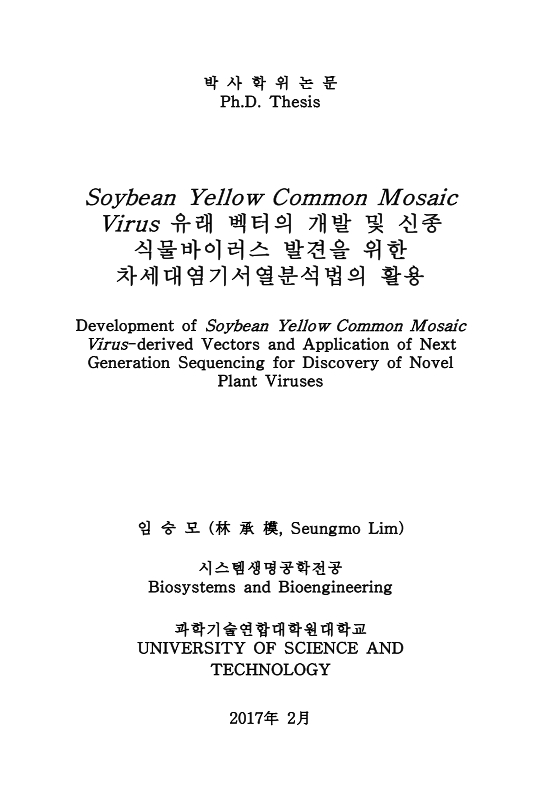
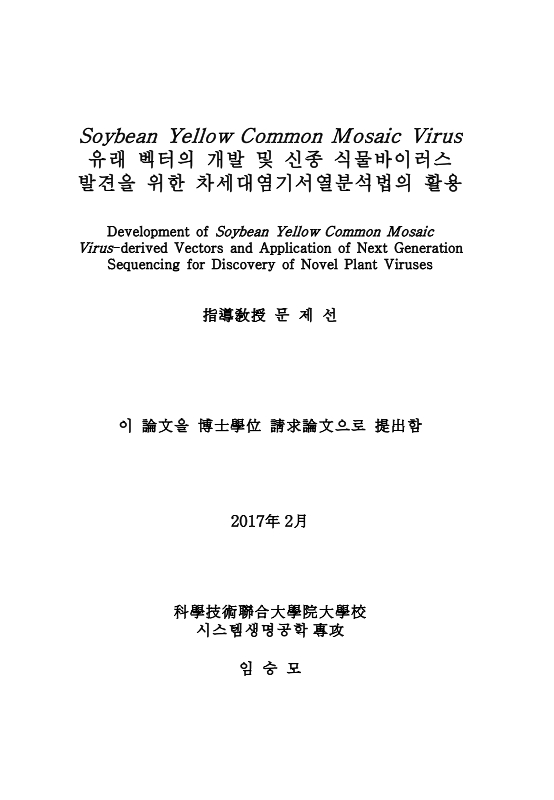
Title Page
국문초록
ABSTRACT
Contents
Chapter 1. Development of Soybean yellow common mosaic virus-derived vectors 19
1.1. Introduction 20
1.2. Materials and Methods 21
1.2.1. Construction of CaMV 35S promoter-driven SYCMV vectors 22
1.2.2. Propagation and diagnosis of SYCMV 25
1.2.3. In vitro transcription of pSYCMVT7-full and inoculation 25
1.2.4. Three inoculation methods to deliver SYCMV-derived vectors into soybeans 26
1.2.5. Northern blot analysis 27
1.2.6. Western blot analysis 28
1.3. Results 28
1.3.1. 35S promoter-driven SYCMV vectors 28
1.3.2. Evaluation of SYCMV-derived VIGS vectors 30
1.3.3. Alternative methods, particle bombardment and direct plasmid DNA-rubbing 32
1.3.4. SYCMV-derived vector for expression of heterologous protein 33
1.4. Discussion 33
1.5. References 47
Chapter 2. Application of next generation sequencing for discovery of novel plant viruses 55
2.1. Introduction 56
2.2. Materials and Methods 58
2.2.1. Sample collection and total RNA preparation 58
2.2.2. Library construction and paired-end RNA sequencing 58
2.2.3. Analysis of metatranscriptome data 59
2.2.4. Detection and characterization of plant viruses 60
2.3. Results 62
2.3.1. Virome analysis in the first experiment 62
2.3.2. Genomic detection and characterization of a ssRNA virus 63
2.3.3. Genomic detection and characterization of a dsRNA virus 65
2.3.4. Genomic detection and characterization of a reverse-transcribing dsDNA virus 66
2.3.5. Molecular characterization of a putative novel caulimovirus with subgenomic DNA species 70
2.3.6. Virome analysis in the second experiment 73
2.3.7. Putative novel positive-sense ssRNA viruses 74
2.3.8. A putative novel negative-sense ssRNA virus 76
2.3.9. Putative novel dsRNA viruses 77
2.3.10. Putative novel reverse-transcribing dsDNA viruses 78
2.3.11. Divergent isolates of known plant viruses 79
2.4. Discussion 82
2.5. References 134
Figure 1-1. Schematic representation of the SYCMV-derived vectors. Each... 38
Figure 1-2. The SYCMV strain induced moderate symptoms in G. max and G. soja. (A-D) G. max. (E-H) G. soja. (A, E) Healthy plants... 40
Figure 1-3. VIGS phenotypes induced by the down-regulation of either PDS transcripts or RbcS transcripts via the SYCMV-based VIGS... 41
Figure 1-4. Detection of accumulation of the VIGS-targeted mRNAs and SYCMV RNA via northern blotting. 42
Figure 1-5. Inoculation of SYCMV-derived vectors via the particle... 43
Figure 1-6. Expression of the heterologous protein induced by the... 45
Figure 2-1. A symptomatic peach tree and genome map of a Korean isolate of... 86
Figure 2-2. Phylogenetic trees based on amino acid sequence alignments... 87
Figure 2-3. Phylogenetic trees based on amino acid sequence alignments... 89
Figure 2-4. Schematic representation of the HPEV genome. Open boxes... 90
Figure 2-5. Comparison of the putative polyprotein of HPEV and those of... 92
Figure 2-6. The phylogenetic tree showing amino acid sequence divergence of partial RdRp regions (aa positions 4570-4695 in HPEV)... 93
Figure 2-7. The symptomatic A. macrocephala sample and linear... 94
Figure 2-8. The 5'-leader sequence of RNA intermediate of AMMV. Eleven... 95
Figure 2-9. Phylogenetic trees based on sequence alignments between AMMV... 96
Figure 2-10. The symptomatic A. dahurica sample and genome organization of... 97
Figure 2-11. Phylogenetic trees based on sequence alignments of AnBSV and... 99
Figure 2-12. Multiple bands observed from PCR results for five primer sets in... 100
Figure 2-13. Multiple bands reconfirmed from PCR results for different... 101
Figure 2-14. Schematic diagram of taxonomic classification constructed with 519 contigs related to plant viruses on the basis of viral... 102
Figure 2-15. Schematic diagram of taxonomic classification constructed with 519 contigs related to plant viruses on the basis of viral... 103
Figure 2-16. Phylogenetic tree of taxonomic classification constructed with 519 contigs related to plant viruses in the second experiment. 104
Figure 2-17. Sequence coverage of reads (read depth) along the four individual contigs representing near-complete nucleotide sequences... 105
Figure 2-18. A symptomatic P. scabiosaefolia sample and genome... 106
Figure 2-19. Comparison of the complete nucleotide sequence of a putative novel umbravirus isolated from P. scabiosaefolia and those... 107
Figure 2-20. A symptomatic B. juncea sample and genome organization of a... 108
Figure 2-21. Comparison of the complete nucleotide sequence of segment L of a putative novel tospovirus isolated from B. juncea and... 109
Figure 2-22. A symptomatic C. lanceolata sample and genome organization of... 110
Figure 2-23. Comparison of the polyprotein (ORF3) of a putative novel... 112
Figure 2-24. A symptomatic M. japonica sample and genome organizations of... 113
Figure 2-25. Comparison of the complete nucleotide sequences of two M.... 115
Figure 2-26. Comparison of the complete polymerase gene (ORF5) sequences... 117
콩에서 발견된 신종바이러스인 Soybean yellow common mosaic virus (SYCMV)를 이용하여 T7 프로모터 (pSYCMVT7-full) 또는 Cauliflower mosaic virus 35S 프로모터 (pSYCMV-full)에 의해서 발현되는 감염성 클론을 제작하였었다. 자연상에서 SYCMV에 감염된 콩 잎과 두 가지 감염성 클론에 접종된 콩 잎에서 야기되는 바이러스 병징의 정도는 거의 동일하였다. 따라서, pSYCMV-full 클론을 이용하여 콩에서 유전자 기능을 분석할 수 있는 VIGS (virus-induced gene silencing) 벡터를 제작하였다. SYCMV 유래 VIGS 벡터의 활용도를 측정하기 위해서 Phytoene desaturase (PDS) gene (pSYCMV-PDS1)과 small subunit of ribulose-1,5-bisphosphate carboxylase/oxygenase (RbcS) gene (pSYCMV-RbcS2)을 이용하였다. 그 결과, pSYCMV-PDS1 벡터로 접종된 콩에서는 백화현상을 확인할 수 있었으며, pSYCMV-RbcS2 벡터로 접종된 콩에서는 황화 및 옅은 녹색의 표현형을 확인할 수 있었다. 표현형이 변화된 샘플들을 northern blotting으로 확인해 본 결과, 해당 유전자의 전사체 발현량이 pSYCMV-full로 접종된 대조군과 비교해서 상당히 감소되어 있음을 확인할 수 있었다. 바이러스 유래 벡터를 식물에 접종할 때 주로 아그로박테리움 (Agrobacterium)을 이용하는데, 본 연구에서는 유전자총법 (gene gun/particle bombardment)과 direct plasmid DNA rubbing법도 실시하여 대체방법들의 활용 가능성을 확인하였다. SYCMV 유래 벡터를 콩에서 외래 단백질을 발현하는 도구로써 활용하기 위해서, 구제역바이러스 (Foot-and-mouth disease virus, FMDV) serotype O1 Campos (O1C)의 항원결정기인 VP1 (아미노산 서열 135-160)을 이용하였다 (pSYCMV-FMDV). pSYCMV-FMDV에 접종된 콩은 pSYCMV-full로 접종된 콩처럼 병징이 야기되었으며, western blotting을 통해서 해당 항원결정기 단편의 단백질 발현을 확인할 수 있었다.
바이러스는 살아있는 생물체에서 생활환을 지속할 수 있는 순활물 기생체이다. 식물에 병을 야기하는 바이러스를 진단하기 위해서 혈청학적 방법인 효소면역측정법 (enzyme-linked immunosorbent assay)과 분자생물학적 방법인 역전사 중합효소 연쇄반응 (reverse transcription-polymerase chain reaction), 고리매개 등온증폭법 (loop-mediated isothermal amplification), 올리고칩 (oligonucleotide chip) 등이 개발되어 이용되고 있다. 최근에는 차세대염기서열분석법 (next-generation sequencing, NGS)과 분석 파이프라인 (analysis pipeline)을 식물에 감염하는 신종 또는 변종 바이러스의 진단에 응용하고 있다. 따라서, 본 연구에서는 바이러스 감염 병징을 보이는 총 234개의 식물 샘플들을 NGS를 이용한 진단 시스템을 활용하여 두 차례에 나누어 실험을 진행하였다. 두 번의 실험에서 얻은 metatranscriptome data를 분석한 결과, 700개 이상의 식물바이러스 관련 컨티그를 얻을 수 있었으며 182개에 대해서는 개별 식물샘플에서의 확인이 이루어졌다. 그 결과, 현재까지 17개 식물 종으로부터 19개의 신종 식물바이러스가 확인이 되었다. 신종 뿐만 아니라 많은 수의 변종 바이러스도 확인할 수 있었으며, 잘 알려져 있는 식물바이러스에서 유래된 컨티그도 상당 부분을 차지하고 있었다. 변종을 포함하여 알려져 있는 바이러스들의 대부분이 새로운 기주 혹은 새로운 지역적 장소 (한국)에서 최초로 진단 된 것으로써 의미를 가지고 있었으며, 이러한 바이러스들의 지놈 분석을 통해서 식물바이러스 병역학에 대한 이해를 높일 수 있을 것이다. 모든 결과들을 종합해볼 때, 자연계에 존재하는 다양한 식물 종에는 가늠할 수 없을 정도로 많은 미지의 바이러스가 존재하고 있음을 짐작할 수 있으며, 이를 탐색함에 있어서 NGS를 활용한 진단 시스템이 기존 진단법들의 단점을 매우 효율적으로 보완하는 대안이 될 수 있을 것이다.*표시는 필수 입력사항입니다.
| 전화번호 |
|---|
| 기사명 | 저자명 | 페이지 | 원문 | 기사목차 |
|---|
| 번호 | 발행일자 | 권호명 | 제본정보 | 자료실 | 원문 | 신청 페이지 |
|---|
도서위치안내: / 서가번호:

우편복사 목록담기를 완료하였습니다.
*표시는 필수 입력사항입니다.
저장 되었습니다.
