
 대표어
대표어
권호기사보기
| 기사명 | 저자명 | 페이지 | 원문 | 기사목차 |
|---|
결과 내 검색
동의어 포함
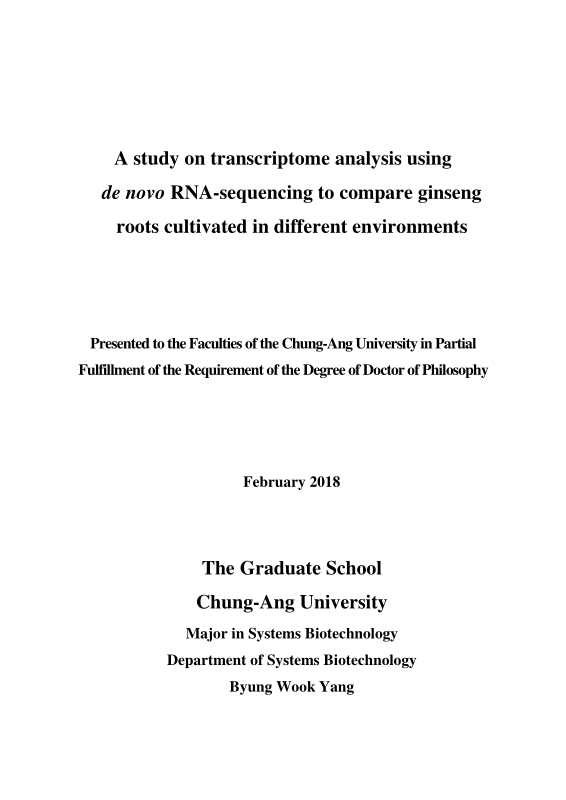
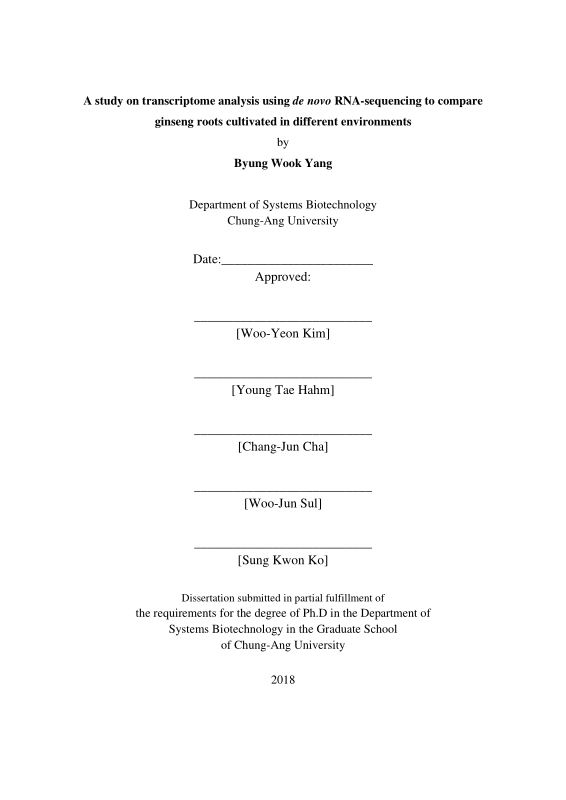
Title Page
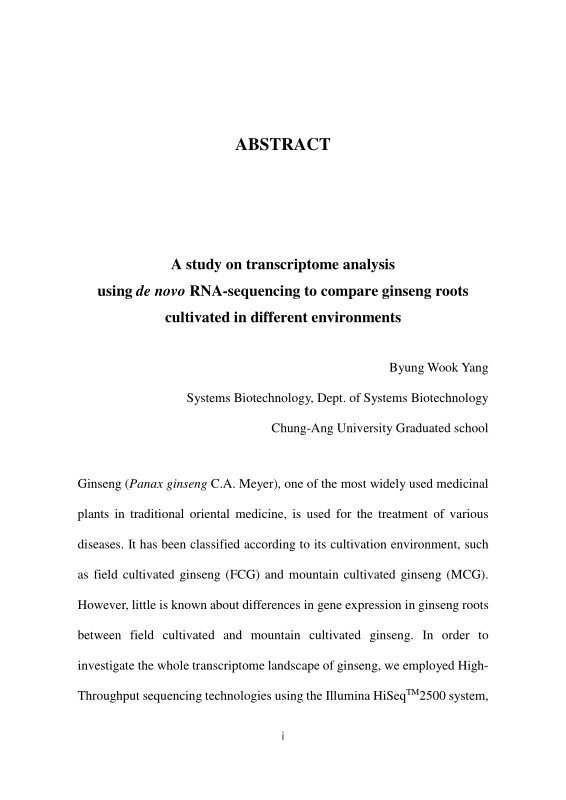
ABSTRACT
Contents
List of Abbreviations 11
1. INTRODUCTION 12
1.1. Ginseng cultivation in different environments 13
1.2. Genetic studies on ginseng 14
2. PART I. Isolation of total RNA from Panax ginseng C.A. Meyer 16
2.1. Materials and Methods 17
2.1.1. Plant materials 17
2.1.2. RNA preparation 20
2.2. Results and Discussion 22
3. PART II. De novo RNA sequencing and assembly 29
3.1. Materials and Methods 30
3.1.1. RNA sequencing 30
3.1.2. De novo assembly and clustering 31
3.1.3. Analysis of homogeny and gene function 34
3.2. Results and Discussion 35
3.2.1. De novo assembly and validation of Illumina paired-end sequences 35
3.2.2. Gene cluster analysis and identification of novel transcripts from the ginseng RNA-Seq sequences 40
4. PART III. Analysis of differentially expressed genes 43
4.1. Materials and Methods 44
4.1.1. Functional annotation of P. ginseng unigenes 44
4.1.2. Expression profiling 45
4.1.3. Pathway assignment with KEGG 46
4.2. Results and Discussion 47
4.2.1. Functional annotation and classification 47
4.2.2. Gene expression profiling 49
4.2.3. Pathway assignment by KEGG 54
5. CONCLUSION 57
References 61
APPENDIX. The list of differentially expressed genes 70
국문초록 120
Figure 1. Panax ginseng C.A. Meyer cultivated in different environments. 18
Figure 2. The collected location of Panax ginseng samples. 19
Figure 3. Ethidium bromide-stained 1.0% agarose gel analysis of total... 24
Figure 4. Trimmed reads and assembled unigene length distributions. 39
Figure 5. Consensus between the Blastx and InterProScan search results. 42
Figure 6. Functional classification of P. ginsengunigenes based on Gene Ontology (GO) annotation. 48
Figure 7a. Functional distribution of the 100 most highly expressed transcripts from FCG and MCG in the... 51
Figure 7b. Functional distribution of the 100 most highly expressed transcripts from FCG and MCG in the... 52
Figure 7c. Functional distribution of the 100 most highly expressed transcripts from FCG and MCG in the... 53
Figure 8. Pathway assignments based on the Kyoto Encyclopedia of Genes and Genomes (KEGG). 55
*표시는 필수 입력사항입니다.
| 전화번호 |
|---|
| 기사명 | 저자명 | 페이지 | 원문 | 기사목차 |
|---|
| 번호 | 발행일자 | 권호명 | 제본정보 | 자료실 | 원문 | 신청 페이지 |
|---|
도서위치안내: / 서가번호:

우편복사 목록담기를 완료하였습니다.
*표시는 필수 입력사항입니다.
저장 되었습니다.
