
 대표어
대표어
권호기사보기
| 기사명 | 저자명 | 페이지 | 원문 | 기사목차 |
|---|
결과 내 검색
동의어 포함
Title Page
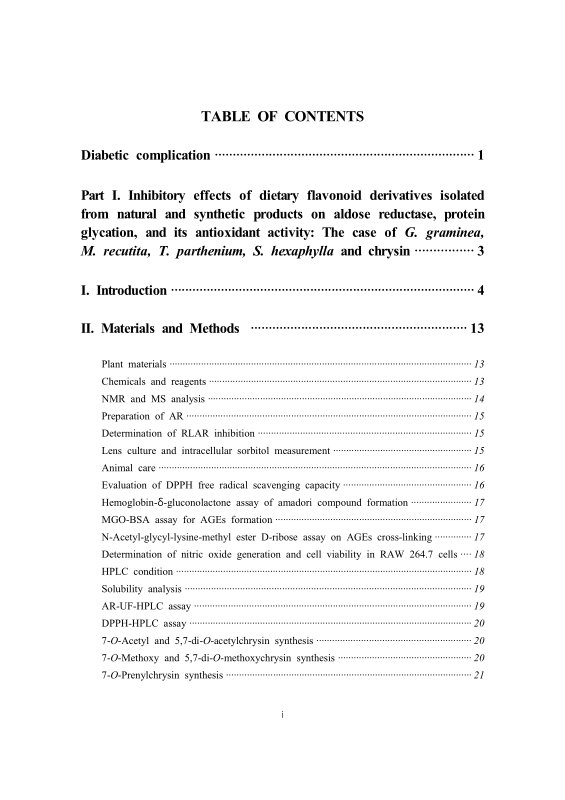
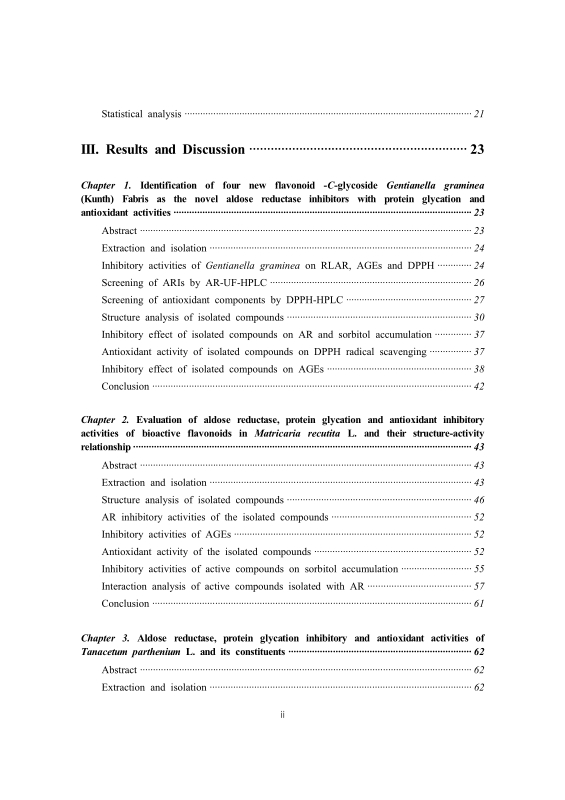
Contents
Diabetic complication 15
Part I. Inhibitory effects of dietary flavonoid derivatives isolated from natural and synthetic products on aldose reductase, protein glycation, and its antioxidant activity: The case of G. graminea, M. recutita, T. parthenium, S. hexaphylla and chrysin 17
I. Introduction 18
II. Materials and Methods 27
Plant materials 27
Chemicals and reagents 27
NMR and MS analysis 28
Preparation of AR 29
Determination of RLAR inhibition 29
Lens culture and intracellular sorbitol measurement 29
Animal care 30
Evaluation of DPPH free radical scavenging capacity 30
Hemoglobin-δ-gluconolactone assay of amadori compound formation (Early Stage) 31
MGO-BSA assay for AGEs formation (Middle Stage) 31
N-Acetyl-glycyl-lysine-methyl ester D-ribose assay on AGEs cross-linking (Last Stage) 31
Determination of nitric oxide generation and cell viability in RAW 264.7 cells 32
HPLC condition 32
Solubility analysis 33
AR-UF-HPLC assay 33
DPPH-HPLC assay 34
7-O-Acetyl and 5,7-di-O-acetylchrysin synthesis 34
7-O-Methoxy and 5,7-di-O-methoxychrysin synthesis 34
7-O-Prenylchrysin synthesis 35
Statistical analysis. 35
III. Results and Discussion 37
Chapter 1. Identification of four new flavonoid -C-glycoside Gentianella graminea (Kunth) Fabris as the novel aldose reductase inhibitors with protein glycation and antioxidant activities 37
Chapter 2. Evaluation of aldose reductase, protein glycation and antioxidant inhibitory activities of bioactive flavonoids in Matricaria recutita L. and their structure-activity relationship 57
Chapter 3. Aldose reductase, protein glycation inhibitory and antioxidant activities of Tanacetum parthenium L. and its constituents 76
Chapter 4. Inhibitory activities of Stauntonia hexaphylla leaf constituents on rat lens aldose reductase, formation of advanced glycation end products and antioxidant 94
Chaper 5. Anti-glycation, carbonyl trapping and anti-inflammatory activities of chrysin derivatives 109
IV. References 129
국문초록 148
Part II. Inhibitory effects of reaction product obtained from dietary components mixture according to amino acid addition and heat processing on aldose reductase, tyrosinase, and its antioxidant activity: The case of ribose Maillard reaction and chlorogenic acid heating model products 149
I. Introduction 150
II. Materials and Methods 154
Chemicals and reagents 154
TLC condition 154
Preparation of ribose-amino acid MRPs 154
Fractionation and purification from RH-MRPs 155
Preparation of heating model system derived from CGA and 20 amino acids 155
Purification of compounds from CGA-GT HMS 156
ABTS+ radical scavenging assay(이미지참조) 156
Tyrosinase inhibitory activity assay 156
Determination of inhibition-types of AR and tyrosinase 156
Statistical analysis 157
III. Results and Discussion 158
Chapter 6. Bioactive-guided isolation and identification of 2-hydroxy-3-methylcyclopent-2-enone from ribose-histidine maillard reaction product: Inhibitory effects against aldose reductase, tyrosinase, and DPPH radical scavenging activity 158
Chapter 7. Novel products and biological activities obtained by heat processing of chlorogenic acid and amino acids 177
IV. References 200
국문초록 212
Fig. 1. Inhibitory activities of Gentianella graminea 70% methanol extract (GGME) on... 39
Fig. 2. Screening of aldose reductase and antioxidant inhibitors in Gentianella graminea... 42
Fig. 3. Chemical structure of the five compounds isolated from Gentianella graminea... 45
Fig. 4. ¹H-¹H COSY (Bold lines, H↔H) and ¹H-¹³C HMBC (Arrow, H→C) correlations... 49
Fig. 5. The inhibitory activities of Matricaria recutita L. 70% MeOH extract on rat lens... 59
Fig. 6. The chemical structures of compounds isolated from Matricaria recutita L. 62
Fig. 7. Docking models of apigenin-7-O-β-D-glucoside (A), luteolin-7-O-β-D-glucoside (B), apigenin-7-O-β-D-glucuronide (C), luteolin-7-O-β... 72
Fig. 8. Screening of aldose reductase and antioxidant inhibitors in Tanacetum parthenium... 81
Fig. 9. The Chemical structures of compounds isolated from Tanacetum parthenium L. 83
Fig. 10. Docking models of ferulic acid (a), apigenin (b), luteolin-7-O-glucoside (c), luteolin (d), chrysosplenol (e), and kaempferol (f). The... 90
Fig. 11. The chemical structures of the compounds isolated from Stauntonia hexaphylla... 98
Fig. 12. HPLC profile of seven compounds isolated from EtOAc fraction of Stauntonia... 106
Fig. 13. Inhibitory effect of various chrysin concentrations on amadori compound (A)... 111
Fig. 14. Formation pathway of the major fragments of mono- (A) and di-MGO (B) adducts of chrysin by LC-MS/MS. 112
Fig. 15. Trapping effect of -mono (A) and di-MGO adducts (B) of chrysin formed... 117
Fig. 16. Effect of chrysin and its derivatives on NO generation (A) and cell viability... 122
Fig. 17. Proposed mechanism of chrysin-mono adduct formation. 125
Fig. 18. Changes in browning levels of MRPs of ribose and the 20 amino acids. Symbols: Ri 1,... 161
Fig. 19. Thin layer chromatography (TLC) analysis of the ribose-histidine maillard... 163
Fig. 20. Thin layer chromatography (TLC) analysis of silica gel chromatography... 165
Fig. 21. Thin layer chromatography (TLC) analysis of the methylene chloride (MC)... 166
Fig. 22. Inhibitory activities of rat lens aldose reductase (A), tyrosinase (B) and ABTS+...(이미지참조) 169
Fig. 23. Enzyme kinetic type of aldose reductase (A) and tyrosinse (B) by... 172
Fig. 24. Screening of aldose reductase inhibitors among chlorogenic acid-glutamic acid... 180
Fig. 25. Inhibitory activities of chlorogenic acid-20 amino acids produced at 120°C for... 183
Fig. 26. Chemical structure of two compounds isolated from chlorogenic acid-glutamic... 188
Fig. 27. Lineweaver–Burk plots showing the reciprocal of the HRAR velocity (1/V)... 193
Fig. 28. HPLC profiles of the chlorogenic acid (A), chlorogenic acid-glutamic acid HMS... 197
Scheme 1. Polyol pathway (PP) of diabetic complication. 18
Scheme 2. Advanced glycation end pruducts (AGEs) formation pathway. 19
Scheme 3. Ultrafiltration and DPPH-HPLC. 21
Scheme 4. Scheme for synthesis of O-acetylation (A), O-methylation (B), and... 36
I. 천연물과 합성화합물로부터 분리된 식이 플라보노이드 유도체들의 알도스 환원효소, 최종당화물 및 항산화 활성에 대한 억제효과
본 연구에서는 몇 가지 천연물 추출물을 대상으로 알도스 환원효소 및 라디칼 소거에 대한 잠재적 저해 활성에 대해 검색하였다. 그 중에서도 4개의 천연물 추출물이 최종당화산물 생성저해를 포함하여 알도스 환원효소 및 라디칼 소거에 대한 저해활성을 가지고 있음을 발견하였다. 또한, 한외여과 및 라디칼소거-엑체크로마토그래피를 사용하여 알도스 환원효소 및 라디갈 소거에 대한 추출물 내의 활성성분을 검출하고, 4개의 새로운 플라보노이드 글리코사이드 및 27개의 알려진 플라보노이드를 컬럼크로마토그래피로 분리하였으며, 이들의 구조는 1차원 및 2차원 핵자기공명분광분석에 의해 규명하였다. 이러한 결과는 한외여과 및 라디칼소거-엑체크로마토그래피가 신속한 활성성분을 검출과 분석·분리에 광범위하게 적용될 수 있으며, 4종의 신규 플라보노이드 배당체 및 플라보노이드 유도체들은 잠재적 당뇨합병증의 예방 또는 치료에 사용되는 지표 및 기능성 성분이 될 수 있음을 시사한다.
또한, 플라보노이드의 일종인 크라이신와 반응성 카보닐 화합물 메틸글리옥살의 혼합물을 배양하여 크라이신의 최종당화산물 생성저해 활성을 평가하고 메틸글리옥살-크라이신 콘쥬게이션 생성물을 형성시키고 엑체크로마토그래피-질량분석 및 핵자기공명분광분석법을 사용하여 당화과정동안 형성된 반응성 카보닐의 포접형태를 관찰하였다. 결과는 크리이신이 반응성 카보닐 화합물로부터 유도된 단백질 당화를 크라이신의 6 & 8번 탄소에서 콘쥬게이션 생성물 형태로 억제 할뿐만 아니라 환원당과 아미노기 사이의 초기 부착을 효과적으로 억제 할 수 있음을 보여주었다. 뿐만 아니라, 5가지 크라이신 유도체 중에서 5,7-다이아세틸크라이신은 3 단계 최종당화산물 형성을 가장 강력하게 억제하고 항염증 활성을 유지하면서 크라이신보다 수용성를 증가시켰다. 향후 5,7-다이아세틸크라이신의 최종당화산물 형성저해 메커니즘에 대한 연구가 필요하며, 5,7-다이아세틸크라이신이 반응성 카보닐 화합물의 수준을 감소시킬 수 있는지 여부를 더 연구하는 것은 가치가 있을 것이다.
요약하면, 본 연구에서는 당뇨합병증에 대한 예방과 치료에 관련하여 더 많은 연구를 위해 흥미로운 식물과 그 구성성분에 대한 기초자료와 전통적인 용도의 과학적 기반 및 크라이신의 최종당화산물 형성 억제제 개발에 적용 가능한 지식을 제공하였으며, 본 연구의 결과는 당뇨합병증과 관련된 기능성 식품 원료 및 유익한 물질의 개발에 도움이 될 수 있을 것 사료된다. 그러나, 생리학적 연구는 약물로서의 개발과 기능성 식품 원료의 사용을 입증하기 위해 필요할 것이다.
II. 아미노산 첨가 및 열처리에 따른 식이성분 혼합물로부터 얻어진 반응생성물의 알도스 환원효소, 타이로시네이즈 및 항산화 활성에 대한 억제효과
본 연구에서는 리보스와 클로로제닉산과 함께 각각의 20개의 아미노산과 가열하여 얻어진 마일라드반응 및 열처리모델 생성물로부터 생성된 반응산물을 분리·구조규명을 통해 새로운 당뇨합병증 기능성 식품 원료의 가능성을 연구하였다. 먼저, 리보스-20개의 아미노산 마일라드반응 생성물의 ABTS+ 라디칼 소거능을 평가하였다. 20개의 리보스-아미노산 마일라드반응 생성물 중 리보스-히스티딘 마일라드반응물은 다른 마일라드반응물보다 ABTS+ 라디칼 소거을 비롯한 알도스 환원효소 및 타이로시나제에 대해 가장 높은 저해 활성을 보였다. 항산화 및 알도스 환원효소 억제 활성을 갖는 기능성 화합물은 당뇨합병증의 예방 및 치료에 중요한 전략으로 인식되어 왔고, 티로시나아제 저해제의 탐색은 과색소 침착 치료, 피부미백제 개발 및 방부제로의 사용에 중요하다. 이를 바탕으로 본 연구에서 알도스 환원 효소 및 티로시나아제에 대한 저해 활성을 가진 화합물을 분리하고 동정하고자 하였다. 리보스-히스티딘 마일라드반응물를 120℃에서 2시간 동안 가열하고 메틸렌 클로라이드, 에틸 아세테이트, 부탄올 및 물 등의 4가지 용매를 사용하여 용매분획을 진행하였고, 가장 높은 저해가 메틸렌 클로라이드 분획물에서 검색되었다. 이 분획물로부터 두 화합물을 실리카겔컬럼 및 분취용 박층크로마토그래피로 정제하여 2-하이드록시-3-메틸사이클로펜트-2-엔온 및 퓨란-3-카복실산을 동정하였다. 그 중, 2-하이드록시-3-메틸사이클로펜트-2-엔온의 알도스 환원효소 저해, 티로시나제 저해 및 ABTS+ (50% 억제농도)는 각각 4.47, 721.91 및 9.81 μM로 확인되었다. 이 연구에서는 리보스-히스티딘 마일라드반응물로부터 분리된 2-하이드록시-3-메틸사이클로펜트-2-엔온의 억제 효과가 알도스 환원효소 & 티로시나제 저해 및 그 항산화 활성에 대해 처음으로 입증되었다.
이전 연구는 알칼리 수용액에서 클로로제닉산의 이성체화 및 변형을 조사하였다. 그러나, 본 연구에서는 수용액에서의 가열과정에서 클로로제닉산의 생물학적 활성과 화학적 변화에 대한 다양한 아미노산의 영향 및 처음으로 클로로제닉산-글루타민 열처리모델에서 활성화합물을 분리하고 특성을 규명하였다. 120℃에서 4시간 동안 가열하여 클로로제닉산와 20 개의 아미노산의 열처리모델을 제조해 시험관 내 항산화와 알도스 환원효소 억제활성을 평가하였고 그 결과, 클로로제닉산-글루탐산 열처리모델은 ABTS+ (82.37%)와 DPPH 라디칼 소거 (83.21 %) 및 알도스 환원효소 (83.21%) 억제로 나타낼 수 있는 높은 시험관 내 활성을 보였다. 클로로제닉산 및 아미노산 열처리모델의 화학적 변화, 알도스 환원효소 억제 및 항산화 활성은 아미노산 구조에 따라 다양하였다. 핵자기공명분광분석법은 선택된 클로 로제닉산-글루타민 열처리모델로부터 분리되고 3가지 시험관내 분석법으로 평가된 신규 화합물 1 및 알려진 화합물 2의 구조를 규명하였다. 새로운 화합물의 구조는 메틸-3-(((E)-3-(3,4-디히드록시페닐)아크릴로일)옥시)-4,5-디히드록시시클로헥산카르복실레이트 및 알려진 화합물의 구조는 4-O-카페올리퀴닉산으로 확인되었으며, 그 중 화합물 1의 억제 활성이 처음으로 증명되었다. 이러한 활동은 알려진 양성 대조군의 효과와 유사하며, 폴리올 경로 및 산화적 라디칼 억제에서 가능한 역할을 한다. 본 연구에서 기능성 식품 원료로서 클로로제닉산 및 아미노산 열처리모델의 개발에 기여하는 화합물 1 및 2의 형성을 위한 식품 가공 전략에 대한 새로운 토대를 제공하고 열처리를 통해 클로로제닉산로부터 기능성 물질을 얻는 방법을 제공할 것이다. 그러나, 가열 중 아미노산 첨가에 의한 클로로제닉산으로부터의 활성 화합물 형성 메커니즘은 잘 알려져 있지 않다. 향후 연구를 위해 활성 화합물 구조의 특성 및 가열 과정의 형성 메커니즘이 필요할 것이다.
요약하면, 본 연구는 리보오스와 클로로제닉산의 아미노산 첨가와 열처리에 의한 생성된 물질(성분)이 유익한 기능성 식품 원료 및 관련 산업의 원료로 개발 될 수 있는 기초자료를 제공하였으며, 이를 토대로 다양한 물질을 이용하여 잠재적인 기능성 식품 원료의 후보물질을 더 연구할 수 있는 응용지식의 기반을 제공하였다.*표시는 필수 입력사항입니다.
| 전화번호 |
|---|
| 기사명 | 저자명 | 페이지 | 원문 | 기사목차 |
|---|
| 번호 | 발행일자 | 권호명 | 제본정보 | 자료실 | 원문 | 신청 페이지 |
|---|
도서위치안내: / 서가번호:

우편복사 목록담기를 완료하였습니다.
*표시는 필수 입력사항입니다.
저장 되었습니다.
