
 대표어
대표어
권호기사보기
| 기사명 | 저자명 | 페이지 | 원문 | 기사목차 |
|---|
결과 내 검색
동의어 포함
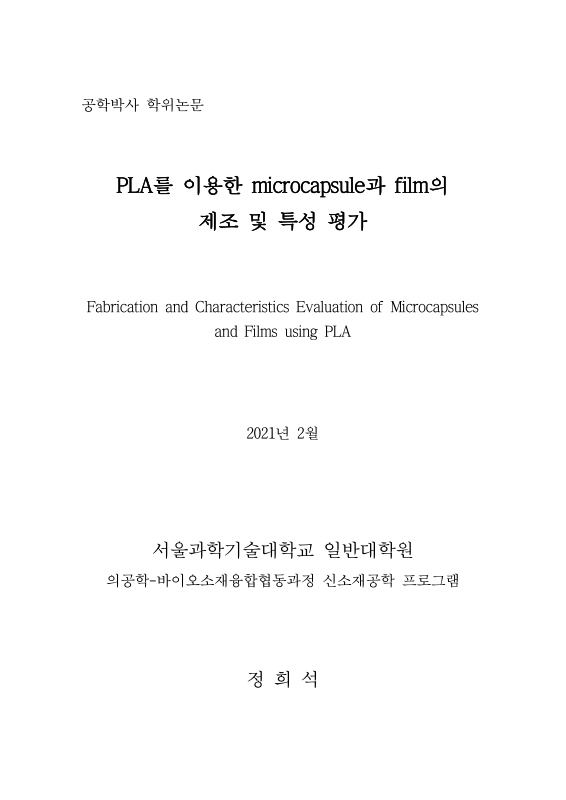
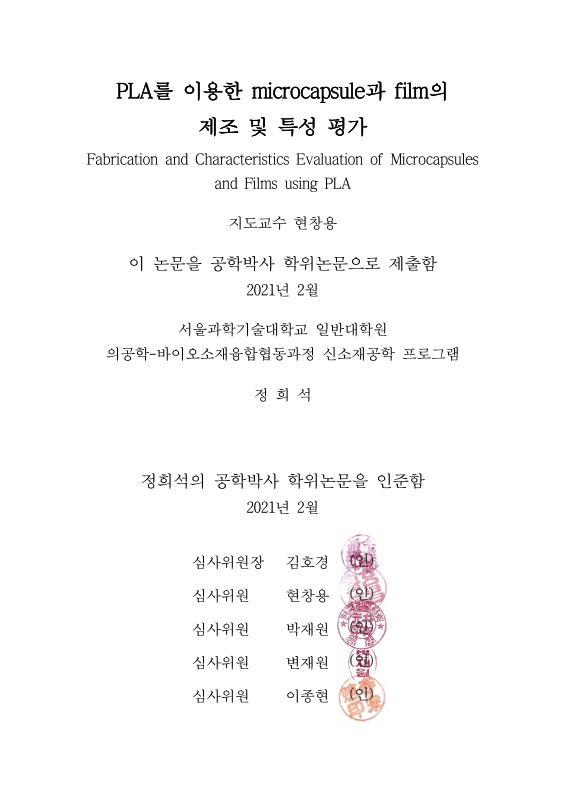
표제지
요약
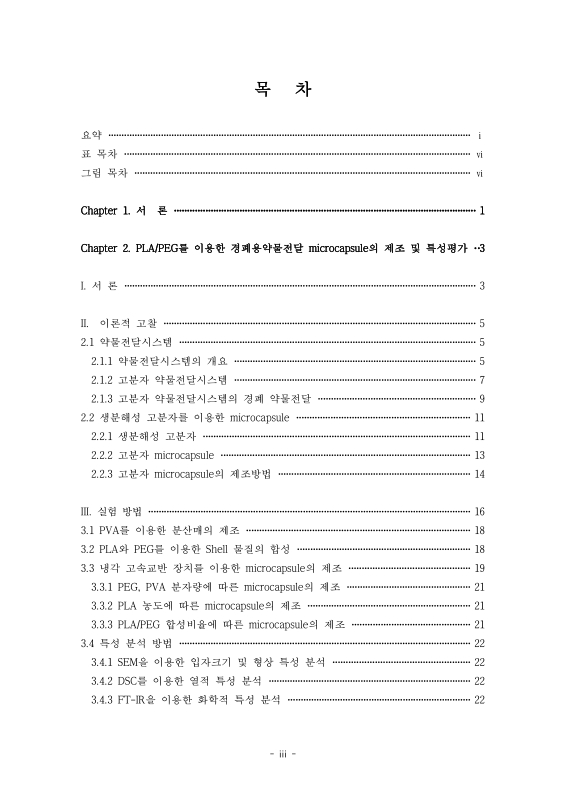
목차
Chapter 1. 서론 11
Chapter 2. PLA/PEG를 이용한 경폐용 약물전달 microcapsule의 제조 및 특성 평가 13
I. 서론 13
II. 이론적 고찰 15
2.1. 약물전달시스템 15
2.2. 생분해성고분자를 이용한 microcapsule 21
III. 실험방법 26
3.1. PVA를 이용한 분산매의 제조 28
3.2. PLA와 PEG를 이용한 Shell 물질의 합성 28
3.3. 냉각 고속교반 장치를 이용한 microcapsule의 제조 29
3.4. 특성 분석 방법 32
IV. 실험 결과 및 고찰 34
4.1. PEG, PVA 분자량에 따른 microcapsule의 제조 특성 34
4.2. 냉각고속교반 속도에 따른 microcapsule의 제조 특성 36
4.3. PVA 분산매의 농도에 따른 microcapsule의 제조 특성 40
4.4. PLA 농도에 따른 microcapsule의 제조 특성 46
4.5. PLA/PEG 합성 비율에 따른 microcapsule의 제조 특성 50
V. 결론 62
Chapter 3. Ttributyl citrate를 첨가한 의료용 PLA/PCL film의 제조 및 특성평가 63
I. 서론 63
II. 이론적 고찰 65
2.1. 의료용 고분자 film 65
III. 실험방법 69
3.1. PLA와 PCL을 이용한 film의 제조 69
3.2. 특성 분석 방법 70
IV. 실험 결과 및 고찰 72
4.1. XRD를 이용한 결정성 특성 평가 72
4.2. DSC를 이용한 열적 특성 평가 73
4.3. DMA(dynamic mechanical analysis)를 이용한 열적 특성 평가 74
4.4. DMA(dynamic mechanical analysis)를 이용한 storage modulus 특성 평가 76
4.5. 만능시험기를 이용한 인장강도 및 연신율 특성 평가 77
4.6. In-vitro 시험을 이용한 생물학적 특성 평가 80
V. 결론 82
Chapter 4. 결론 83
참고문헌 84
Abstract 95
Fig. 2.1. Schematic of application for drug delivery systems. 16
Fig. 2.2. Classes of reservoir-based polymer drug delivery systems. 18
Fig. 2.3. Schematic of drug delivery systems for Pulmonary. 20
Fig. 2.4. Schematic of types for microcapsules. 23
Fig. 2.5. Microcapsules fabrication methods: (a) self-assembly method, (b) layer-... 25
Fig. 2.6. Schematic diagram of experimental methods for PLA/PEG mlcrocapsules. 27
Fig. 2.7. Microcapsules fabrication using a high speed agitator and a syringe pump. 30
Fig. 2.8. Photographs & SEM images of microcapsules prepared with different of... 35
Fig. 2.9. SEM images of microcapsules prepared with various stirring speeds(rpm) ;... 37
Fig. 2.10. Histograms of microcapsule sizes and distributions prepared with various... 38
Fig. 2.11. Particle size distributions of microcapsules prepared with various stirring... 39
Fig. 2.12. SEM images of microcapsules prepared with various PVA concentrations... 40
Fig. 2.13. Histograms of microcapsules sizes and distributions prepared with various... 41
Fig. 2.14. Particle size distributions of microcapsules prepared with various PVA... 42
Fig. 2.15. SEM images of microcapsules prepared with various PVA concentrations... 43
Fig. 2.16. Histograms of microcapsules sizes and distributions prepared with various... 44
Fig. 2.17. Particle size distributions of microcapsules prepared with various PVA... 45
Fig. 2.18. SEM images of microcapsules prepared with various PLA concentrations... 47
Fig. 2.19. Histograms of microcapsules sizes and distributions prepared with various... 48
Fig. 2.20. Particle size distributions of microcapsules prepared with various PLA... 49
Fig. 2.21. SEM images of microcapsules prepared with various PLA/PEG weight... 51
Fig. 2.22. Histograms of microcapsules sizes and distributions prepared with various... 52
Fig. 2.23. Particle size distributions of microcapsules prepared with various... 53
Fig. 2.24. DSC curves of microcapsules prepared with various PLA/PEG weight... 54
Fig. 2.25. XRD patterns of microcapsules prepared with various PLA/PEG weight... 55
Fig. 2.26. FT-IR spectra of PLA powder, PEG powder, and PLA/PEG microcapsules... 56
Fig. 2.27. Nifedipine release behavior of PLA microcapsules prepared with various... 58
Fig. 2.28. Nifedipine release behavior of PLA/PEG microcapsules prepared with... 59
Fig. 2.29. Photographs of PLA/PEG microcapsules cell morphologies prepared with... 61
Fig. 3.1. Medical films and scaffolds for tissue engineering. 68
Fig. 3.2. XRD patterns of PCL and PLA/PCL films prepared with various PLA/PCL... 73
Fig. 3.3. DSC data of PLA/PCL films prepared with various TBC concentrations 74
Fig. 3.4. Tanδ spectra of PLA/PCL films prepared with various PLA/PCL weight... 75
Fig. 3.5. Storage modulus(G*) of PLA/PCL films prepared with various PLA/PCL...[이미지참조] 76
Fig. 3.6. Tensile strength of PLA films, PCL films and PLA/PCL films prepared with... 78
Fig. 3.7. Elongation of PLA films, PCL films and PLA/PCL films prepared with... 79
Fig. 3.8. Photographs of PLA/PCL films cell morphologies prepared with various... 81
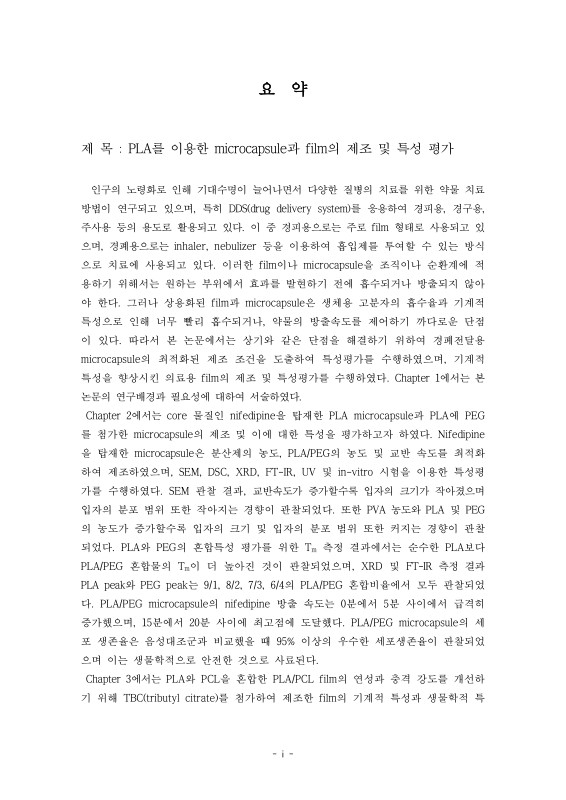
인구의 노령화로 인해 기대수명이 늘어나면서 다양한 질병의 치료를 위한 약물 치료 방법이 연구되고 있으며, 특히 DDS(drug delivery system)를 응용하여 경피용, 경구용, 주사용 등의 용도로 활용되고 있다. 이 중 경피용으로는 주로 film 형태로 사용되고 있으며, 경폐용으로는 inhaler, nebulizer 등을 이용하여 흡입제를 투여할 수 있는 방식으로 치료에 사용되고 있다. 이러한 film이나 microcapsule을 조직이나 순환계에 적용하기 위해서는 원하는 부위에서 효과를 발현하기 전에 흡수되거나 방출되지 않아야 한다. 그러나 상용화된 film과 microcapsule은 생체용 고분자의 흡수율과 기계적 특성으로 인해 너무 빨리 흡수되거나, 약물의 방출속도를 제어하기 까다로운 단점이 있다. 따라서 본 논문에서는 상기와 같은 단점을 해결하기 위하여 경폐전달용 microcapsule의 최적화된 제조 조건을 도출하여 특성평가를 수행하였으며, 기계적 특성을 향상시킨 의료용 film의 제조 및 특성평가를 수행하였다. Chapter 1에서는 본 논문의 연구배경과 필요성에 대하여 서술하였다.
Chapter 2에서는 core 물질인 nifedipine을 탑재한 PLA microcapsule과 PLA에 PEG를 첨가한 microcapsule의 제조 및 이에 대한 특성을 평가하고자 하였다. Nifedipine을 탑재한 microcapsule은 분산제의 농도, PLA/PEG의 농도 및 교반 속도를 최적화하여 제조하였으며, SEM, DSC, XRD, FT-IR, UV 및 in-vitro 시험을 이용한 특성평가를 수행하였다. SEM 관찰 결과, 교반속도가 증가할수록 입자의 크기가 작아졌으며 입자의 분포 범위 또한 작아지는 경향이 관찰되었다. 또한 PVA 농도와 PLA 및 PEG의 농도가 증가할수록 입자의 크기 및 입자의 분포 범위 또한 커지는 경향이 관찰되었다. PLA와 PEG의 혼합특성 평가를 위한 Tm 측정 결과에서는 순수한 PLA보다 PLA/PEG 혼합물의 Tm이 더 높아진 것이 관찰되었으며, XRD 및 FT-IR 측정 결과 PLA peak와 PEG peak는 9/1, 8/2, 7/3, 6/4의 PLA/PEG 혼합비율에서 모두 관찰되었다. PLA/PEG microcapsule의 nifedipine 방출 속도는 0분에서 5분 사이에서 급격히 증가했으며, 15분에서 20분 사이에 최고점에 도달했다. PLA/PEG microcapsule의 세포 생존율은 음성대조군과 비교했을 때 95% 이상의 우수한 세포생존율이 관찰되었으며 이는 생물학적으로 안전한 것으로 사료된다.
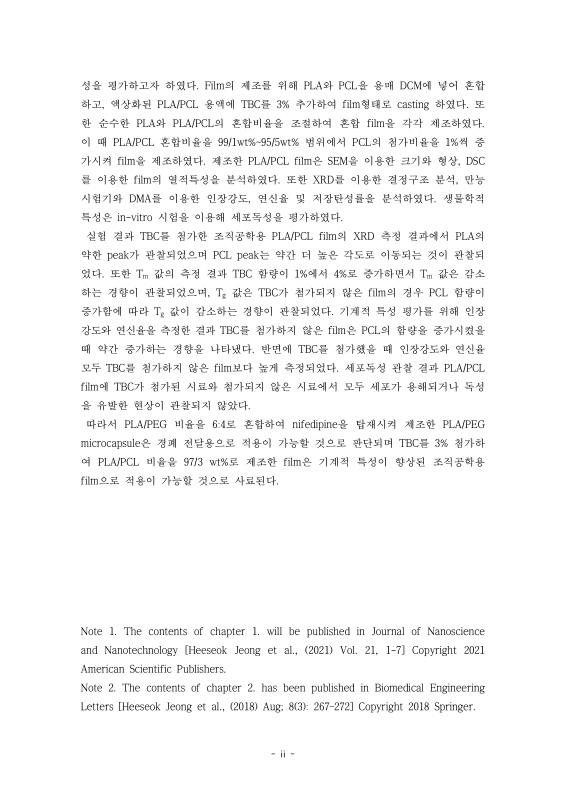
Chapter 3에서는 PLA와 PCL을 혼합한 PLA/PCL film의 연성과 충격 강도를 개선하기 위해 TBC(tributyl citrate)를 첨가하여 제조한 film의 기계적 특성과 생물학적 특성을 평가하고자 하였다. Film의 제조를 위해 PLA와 PCL을 용매 DCM에 넣어 혼합하고, 액상화된 PLA/PCL 용액에 TBC를 3% 추가하여 film형태로 casting 하였다. 또한 순수한 PLA와 PLA/PCL의 혼합비율을 조절하여 혼합 film을 각각 제조하였다. 이 때 PLA/PCL 혼합비율을 99/1wt%~95/5wt% 범위에서 PCL의 첨가비율을 1%씩 증가시켜 film을 제조하였다. 제조한 PLA/PCL film은 SEM을 이용한 크기와 형상, DSC를 이용한 film의 열적특성을 분석하였다. 또한 XRD를 이용한 결정구조 분석, 만능시험기와 DMA를 이용한 인장강도, 연신율 및 저장탄성률을 분석하였다. 생물학적 특성은 in-vitro 시험을 이용해 세포독성을 평가하였다.
실험 결과 TBC를 첨가한 조직공학용 PLA/PCL film의 XRD 측정 결과에서 PLA의 약한 peak가 관찰되었으며 PCL peak는 약간 더 높은 각도로 이동되는 것이 관찰되었다. 또한 Tm 값의 측정 결과 TBC 함량이 1%에서 4%로 증가하면서 Tm 값은 감소하는 경향이 관찰되었으며, Tg 값은 TBC가 첨가되지 않은 film의 경우 PCL 함량이 증가함에 따라 Tg 값이 감소하는 경향이 관찰되었다. 기계적 특성 평가를 위해 인장강도와 연신율을 측정한 결과 TBC를 첨가하지 않은 film은 PCL의 함량을 증가시켰을 때 약간 증가하는 경향을 나타냈다. 반면에 TBC를 첨가했을 때 인장강도와 연신율 모두 TBC를 첨가하지 않은 film보다 높게 측정되었다. 세포독성 관찰 결과 PLA/PCL film에 TBC가 첨가된 시료와 첨가되지 않은 시료에서 모두 세포가 용해되거나 독성을 유발한 현상이 관찰되지 않았다.
따라서 PLA/PEG 비율을 6:4로 혼합하여 nifedipine을 탑재시켜 제조한 PLA/PEG microcapsule은 경폐 전달용으로 적용이 가능할 것으로 판단되며 TBC를 3% 첨가하여 PLA/PCL 비율을 97/3 wt%로 제조한 film은 기계적 특성이 향상된 조직공학용 film으로 적용이 가능할 것으로 사료된다.*표시는 필수 입력사항입니다.
| 전화번호 |
|---|
| 기사명 | 저자명 | 페이지 | 원문 | 기사목차 |
|---|
| 번호 | 발행일자 | 권호명 | 제본정보 | 자료실 | 원문 | 신청 페이지 |
|---|
도서위치안내: / 서가번호:

우편복사 목록담기를 완료하였습니다.
*표시는 필수 입력사항입니다.
저장 되었습니다.
