
 대표어
대표어




권호기사보기
| 기사명 | 저자명 | 페이지 | 원문 | 기사목차 |
|---|
결과 내 검색
동의어 포함
Title Page
Abstract
Contents
Chapter 1. Introduction 13
1.1. Research background 13
1.2. Research objectives and overview of thesis 15
Chapter 2. Optical distance measurement methods and applications 16
2.1. Stereo vision 17
2.2. Interferometry 18
2.3. Optical triangulation method 20
2.4. Time of Flight (TOF) methods 23
2.4.1. Pulsed time-of-flight (TOF) method 24
2.4.2. Phase-shift measurement method 25
2.4.3. Frequency-modulated continuous wave method 27
Chapter 3. Development of a pulsed time-of-flight (TOF) based LiDAR 30
3.1. System configuration of the LiDAR 31
3.2. Optical system design of the LiDAR 32
3.3. Pulsed laser transmitter and APD trans-impedance amplifier 38
3.4. Signal processing methods of the pulsed TOF LiDAR 40
3.5. LiDAR prototypes 45
Chapter 4. Analysis of error sources and compensation techniques for the pulsed TOF LiDAR 47
4.1. Effects of the temperature variation 47
4.2. A noise sensing based bias voltage control system for the temperature variation 53
4.3. Additional advantages of the proposed system 56
4.4. Causes of the distance error 59
4.5. A feed-forward compensation method for improvement of distance accuracy 64
Chapter 5. Development of a phase-shift based LiDAR 71
Chapter 6. Measurement results of the time-of-flight based LiDAR 82
6.1. Scanning results of the pulsed TOF based LiDAR 82
6.2. Scanning results of the phase-shift based LiDAR 84
Chapter 7. Conclusion 87
References 89
Curriculum vitae 94
Figure 1.1. Examples of LiDAR application for (a) self-driving cars, (b) intelligent transport systems, (c) mobile robots, (d) drones, (e) civil engineering, construction fields, and (f)... 14
Figure 2.1. Various optical distance measurement methods 16
Figure 2.2. A diagram of the simple stereo camera 18
Figure 2.3. A diagram of the simple Michelson interferometer 18
Figure 2.4. A basic structure for the optical triangulation method 21
Figure 2.5. The occlusion problem of the active triangulation method 22
Figure 2.6. The measurement principle of the pulsed-TOF method 24
Figure 2.7. The measurement principle of the phase-shift measurement method 26
Figure 2.8. The measurement principle of the frequency-modulated continuous wave (FMCW) method 27
Figure 3.1. Configuration of a pulsed TOF LiDAR 30
Figure 3.2. A block diagram of the pulsed TOF LiDAR 31
Figure 3.3. (a) Co-axial optical system layout (b) Bi-axial optical system layout 33
Figure 3.4. (a) A general optical arrangement with the optical crosstalk problem, and (b) an optical arrangement to eliminate the optical crosstalk problem 35
Figure 3.5. (a) The optical crosstalk signal (indicated by the circle) caused by the scanner mirror. (b) Demonstration that the optical crosstalk signal has been eliminated by the proposed method. 37
Figure 3.6. An electronic schematic of a pulsed laser transmitter 38
Figure 3.7. An electronic schematic of a trans-impedance amplifier 39
Figure 3.8. A block diagram of a leading edge discriminator 41
Figure 3.9. Timing discrimination by using the leading edge discriminator 41
Figure 3.10. Timing discrimination methods using (a) the leading edge discriminator, (b) the constant fraction discriminator (c) the zero crossing discriminator 43
Figure 3.11. A block diagram of the constant fraction discriminator 44
Figure 3.12. Time measurement unit 44
Figure 3.13. LiDAR prototypes and measurement results 45
Figure 4.1. Variation of signal and noise amplitudes according to the APD gain 49
Figure 4.2. The APD output signal, (a) at reference 25 ℃ APD temperature, (b) at 15 ℃ APD temperature, and (c) at 35 ℃ APD temperature 51
Figure 4.3. (a) A temperature maintenance system of the APD, and (b) the gain curve of the APD 52
Figure 4.4. (a) A bias voltage control system using a thermal sensor for constant APD gain, and (b) the gain curve according to different APD temperature 53
Figure 4.5. Principle of the noise sensing based bias voltage control system, (a) noise variation detection and (b) adjustment of the reverse bias voltage 54
Figure 4.6. A block diagram of the noise sensing based bias voltage control system 54
Figure 4.7. Comparison of the APD output noise by temperature variation (a) without and (b) with the use of the noise sensing based bias voltage control system 56
Figure 4.8. Optical pathway of the sunlight into the detector 57
Figure 4.9. (a) A detector with an IR optical filter and (b) the sunlight noise-reduction effect of the filter 57
Figure 4.10. The experimental environment to verify the sunlight noise reduction using the proposed method 58
Figure 4.11. (a) The scanning result without the proposed method and (b) the scanning result with the proposed method 59
Figure 4.12. Effects of (a) the jitter noise and (b) the walk error 60
Figure 4.13. Results of the distance measurement according to the number of average 60
Figure 4.14. Distance measurements for the amplitude variation of the pulse signal by using the leading edge discriminator 62
Figure 4.15. Distance measurements for the amplitude variation of the pulse signal by using the constant fraction discriminator 62
Figure 4.16. Distance measurements for the amplitude variation of the pulse signal by using the timing discriminator that detects a peak point of the signal 62
Figure 4.17. Problems of the signal saturation due to amplification 63
Figure 4.18. A feed-forward method for compensation of the walk error in the saturation region 64
Figure 4.19. Signal processing of the feed-forward compensation method using the pulse width of the measured signal 65
Figure 4.20. The characteristic of the time error due to the signal saturation 66
Figure 4.21. The pulse width and accuracy error according to the signal amplitude 67
Figure 4.22. The accuracy error according to the pulse width of the signal and a polynomial for the walk error compensation 67
Figure 4.23. Experimental conditions to confirm the effects of the walk error 68
Figure 4.24. Distance errors of white, black and gray objects from 5 to 50 meters (a) without the compensation algorithm, and (b) with the compensation algorithm 69
Figure 4.25. Scanning results of white and black objects without and with the compensation algorithm 70
Figure 5.1. System block diagram of the phase-shift based LiDAR 71
Figure 5.2. (a) Vref and Vmea. (b) Time counting processing of Vp.[이미지참조] 73
Figure 5.3. A block diagram of the intensity control method 75
Figure 5.4. (a) A developed LiDAR (b) A measured object (c) Non-controlled and (d) controlled results of the measured object 76
Figure 5.5. An optical layout for solving the 2pi ambiguity problem 78
Figure 5.6. Distance measurement results 79
Figure 5.7. Distance measurement error with respect to real distance 80
Figure 6.1. (a), (b) 2D scanning results of the pulsed TOF based LiDAR 83
Figure 6.2. (a), (b) 3D scanning results of the pulsed TOF based LiDAR 84
Figure 6.3. Objects for measurements and 3D scanning results of the phase-shift based LiDAR 85
Figure 6.4. (a) Various objects for measurements and (b) 3D scanning results of the phase-shift based LiDAR according to the resolution change 86
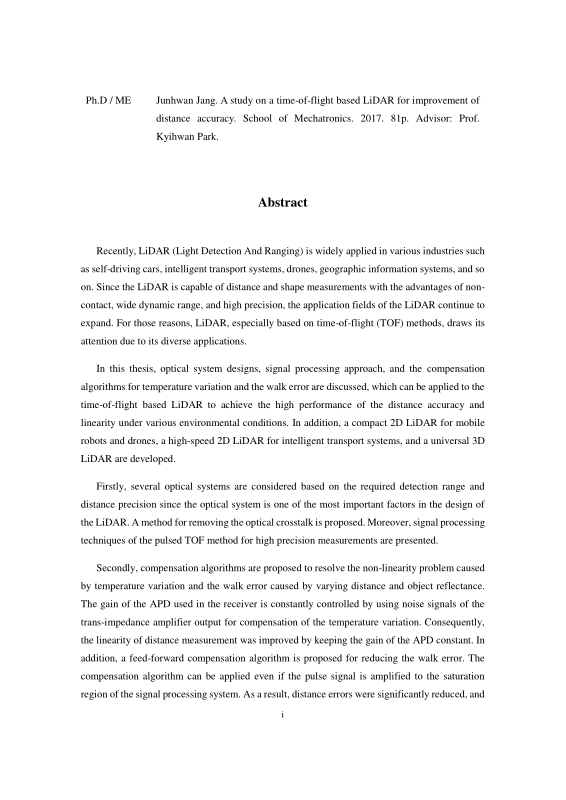
Recently, LiDAR (Light Detection And Ranging) is widely applied in various industries such as self-driving cars, intelligent transport systems, drones, geographic information systems, and so on. Since the LiDAR is capable of distance and shape measurements with the advantages of non-contact, wide dynamic range, and high precision, the application fields of the LiDAR continue to expand. For those reasons, LiDAR, especially based on time-of-flight (TOF) methods, draws its attention due to its diverse applications.
In this thesis, optical system designs, signal processing approach, and the compensation algorithms for temperature variation and the walk error are discussed, which can be applied to the time-of-flight based LiDAR to achieve the high performance of the distance accuracy and linearity under various environmental conditions. In addition, a compact 2D LiDAR for mobile robots and drones, a high-speed 2D LiDAR for intelligent transport systems, and a universal 3D LiDAR are developed.
Firstly, several optical systems are considered based on the required detection range and distance precision since the optical system is one of the most important factors in the design of the LiDAR. A method for removing the optical crosstalk is proposed. Moreover, signal processing techniques of the pulsed TOF method for high precision measurements are presented.
Secondly, compensation algorithms are proposed to resolve the non-linearity problem caused by temperature variation and the walk error caused by varying distance and object reflectance. The gain of the APD used in the receiver is constantly controlled by using noise signals of the trans-impedance amplifier output for compensation of the temperature variation. Consequently, the linearity of distance measurement was improved by keeping the gain of the APD constant. In addition, a feed-forward compensation algorithm is proposed for reducing the walk error. The compensation algorithm can be applied even if the pulse signal is amplified to the saturation region of the signal processing system. As a result, distance errors were significantly reduced, and accurate 2D and 3D images were obtained without shape distortion under various measurement environments.
Additionally, signal processing methods of a phase-shift based LiDAR to improve the measurement performances are briefly discussed and 3D LiDAR prototype based on the phase-shift method is presented with the results of the intensity control algorithm. It can be used as a comparison of the pulsed TOF method to analyze performances and characteristics. Finally, various measurement results using developed time-of-flight based LiDARs are presented to validate the performances.*표시는 필수 입력사항입니다.
| 전화번호 |
|---|
| 기사명 | 저자명 | 페이지 | 원문 | 기사목차 |
|---|
| 번호 | 발행일자 | 권호명 | 제본정보 | 자료실 | 원문 | 신청 페이지 |
|---|
도서위치안내: / 서가번호:

우편복사 목록담기를 완료하였습니다.
*표시는 필수 입력사항입니다.
저장 되었습니다.
