
 대표어
대표어
 한국학술지인용색인(NRF)
권호기사보기
| 기사명 | 저자명 | 페이지 | 원문 | 기사목차 |
|---|
결과 내 검색
동의어 포함
목차
단체급식소 영양사의 종합적 품질경영(TQM) 수행과 조직문화와의 관계 규명에 관한 연구 / 조기원 ; 서의훈 ; 윤지영 1
Abstract 1
I. 서론 1
II. 연구 내용 및 방법 3
1. 조사대상자 및 기간 3
2. 조사내용 및 방법 3
3. 통계분석 방법 4
III. 결과 및 고찰 4
1. 급식소 및 영양사의 일반적 특성 4
2. 영양사의 TQM 중요도·수행도 인식 분석 4
3. 급식소의 조직문화 6
4. TQM 수행도와 조직문화의 관계 7
IV. 요약 및 결론 8
■ 참고문헌 9
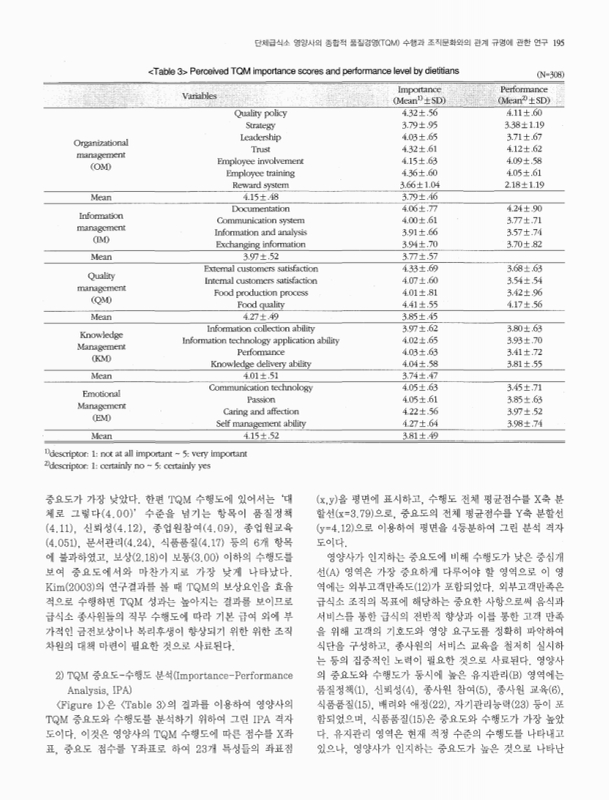
This study was designed to investigate the correlation between perceived TQM performance and organizational culture of dietitians. The objective of the study is to help the management of foodservice by providing a direction which will elevate perceived TQM performance of dietitians and presenting plans which will ensure effective dietitians. Questionnaires handed out to 308 dietitians worked in institutional foodservice operation including elementary, middle and high schools, hospitals, business and industries. In terms of TQM importance and performance, the more important dietitians perceived, the higher their performance level rose. Data form the IPA, external and internal customer satisfaction, executive ability, communication system and technology, information technology and application ability, food process, strategy, and leadership were required further improvement by dietitians.
Of present organizational culture model, human relations model and open systems model were more likely to be adopted by dietitians in middle and high schools. According to the type of foodservice management, the open systems model was more preferred by dietitians from self-operated operations rather than respondents from contracted operations. Canonical correlation analysis between TQM performance and organizational culture showed canonical correlation to be higher (canonical correlations coefficient: .66). In conclusion, TQM performance-organizational culture showed higher canonical correlation. In the organizational culture, foodservice operation is capable of improving the aims for the rational goal model and the open systems model. The results showed that TQM performance and organizational culture had significant relationship, especially positive organizational culture emphasizing on internal process and rational goal model would have influence on TQM performance of dietitians. Foodservice operation, however, should recognize importance of open and development culture to improve dietitians' TQM performance. To apply open system foodservice organization should encourage dietitian and foodservice employees to challenge and compete for the works, Moreover, organizational effort such as information exchange program and support system should be established.| 번호 | 참고문헌 | 국회도서관 소장유무 |
|---|---|---|
| 1 | (2004) 품질경영: TQC·TQM, 박영사. 서울 | 미소장 |
| 2 | (2005) SPSS를 활용한 다변량 통계학, 한경사. 서울 | 미소장 |
| 3 | (2006) 국립병원 간호조직무화 유형과 직무만족, 이직의사간의 인과관계분석, | 미소장 |
| 4 | (2004) 현대 품질경영, 진영사. 서울 | 미소장 |
| 5 | (2000) 종합적 품질경영 도입의 필요성에 관한 이론적 고찰, | 미소장 |
| 6 | (2002) 단체급식관리, 교문사. 서울 | 미소장 |
| 7 | (1994) Management total quality in food service, | 미소장 |
| 8 | (1998) On the application of TQM to libraries, | 미소장 |
| 9 | (2000) Effects of ownership types, geographical locations and leadership types of medical service institutions on TQM performance, | 미소장 |
| 10 | (1998) Evaluation of TQM performance and organizational management effectiveness for foodservice and clinical nutrition service management in hospital settings, | 미소장 |
| 11 | (2001) An empirical study on TQM practices in Korean service industry, | 미소장 |
| 12 | (2003) The assessment of dietitian? performance by general characteristics of employees, | 미소장 |
| 13 | (2001) Foodservice Management, Sinkwang Publishing Co. Seoul | 미소장 |
| 14 | (2005) The study on relationship among patterns of leadership, organization culture and efficiency of sports administrative organization, | 미소장 |
| 15 | (2001) Impacts of the organizational type of hospitals and managerial characteristics of TQM on the performance, | 미소장 |
| 16 | (2003) A Study on the effects of rewards factors on performance of total quality management, | 미소장 |
| 17 | (2002) A study on effect of total quality management on business performance in Korea manufacturing, | 미소장 |
| 18 | (1998) An empirical study on the relationships between cultural type, strength and organizational performance in Korean firms, | 미소장 |
| 19 | (2003) Statistical method for health care research, Koonja Publisher, Seoul | 미소장 |
| 20 | (2001) Analysis of the knowledge-based environment in hospital dietetic departments for the adoption of knowledge management, | 미소장 |
| 21 | (2002) Impact of organizational culture on total quality management strategy in family restaurants, | 미소장 |
| 22 | (2003) A study on total quality management implementation for ??College, | 미소장 |
| 23 | (1999) Analysis on organization performance based on hospital culture, | 미소장 |
| 24 | (2002) A Study on the application of TQM for effective organization management to university libraries, | 미소장 |
| 25 | (2005) The Effect of organizational culture types on job satisfaction and intension of turnover perceived by national hospital employees, | 미소장 |
| 26 | (2001) A study on the relationships between cultural profiles and performances in hospital organizations : an empirical test of competing values model on the Korean hospital organizations, | 미소장 |
| 27 | (1984) guidelines for managerial practice, | 미소장 |
| 28 | (1985) The transformation of organizational cultures, Sage Publications | 미소장 |
| 29 | (1985) Culture and corporate related realities, | 미소장 |
| 30 | (1985) Coming to a new awareness of organizational culture, | 미소장 |
| 31 | (2003) Research on the total quality management of the general hospitals, | 미소장 |
| 32 | (2003) Foodservice Management, Kyomunsa. Seoul | 미소장 |
| 33 | (2001) A conformance rating model for the organizational culture to TQM strategy and tools, | 미소장 |
| 34 | (2006) The effects of organizational communication environment on job satisfaction and commitment: a comparative study on CEO leadership style of service firms, | 미소장 |
| 35 | (2003) A comparative study on total quality management education between manufacturing and service companies in Korea, | 미소장 |
*표시는 필수 입력사항입니다.
| 전화번호 |
|---|
| 기사명 | 저자명 | 페이지 | 원문 | 기사목차 |
|---|
| 번호 | 발행일자 | 권호명 | 제본정보 | 자료실 | 원문 | 신청 페이지 |
|---|
도서위치안내: 정기간행물실(524호) / 서가번호: 국내13
2021년 이전 정기간행물은 온라인 신청(원문 구축 자료는 원문 이용)

우편복사 목록담기를 완료하였습니다.
*표시는 필수 입력사항입니다.
저장 되었습니다.
