
 대표어
대표어
 한국학술지인용색인(NRF)
권호기사보기
| 기사명 | 저자명 | 페이지 | 원문 | 기사목차 |
|---|
결과 내 검색
동의어 포함
목차
사용자 디자인 암묵지(暗默知)의 탐색적 개념과 특성 연구 / 진선태 1
[Title] 1
(요약) 2
(Abstract) 2
1. 선행 연구 및 연구 목적 3
2. 디자인 지식의 암묵지적 특성 3
2.1. 암묵지의 이해 3
2.2. 사용자의 디자인 지식 3
2.2.1. 디자인 지식 3
2.2.2. 사용자 지식 4
3. 사용자 디자인 암묵지의 개념 5
3.1. 개념 정의와 속성 5
3.2. 구성 요소 5
3.3. 학습 과정 6
4. 사용자 디자인 암묵지의 비교 특성 7
4.1. 전문과 비전문 암묵지의 차이 7
4.2. 사용자와 디자이너 암묵지의 차이 8
5. 결론 9
참고 문헌 9
일상생활 속에서 브리컬러(bricoleur), 사용자 디자이너(user designer), 비디자이너(non-designer)로 불리는 소비 사용자들은 사용 행위뿐만 아니라 자발적 디자인 행위를 통해 비전문적 디자인 생산물을 만들어낸다는 사실은 주목되어왔다. 이러한 일반인들의 일상적 창의성 및 사용자의 디자인 능력은 사용자와의 협력적·참여적 디자인 방법론이 중요시되면서 관심을 가지고 연구해야 할 분야이다.
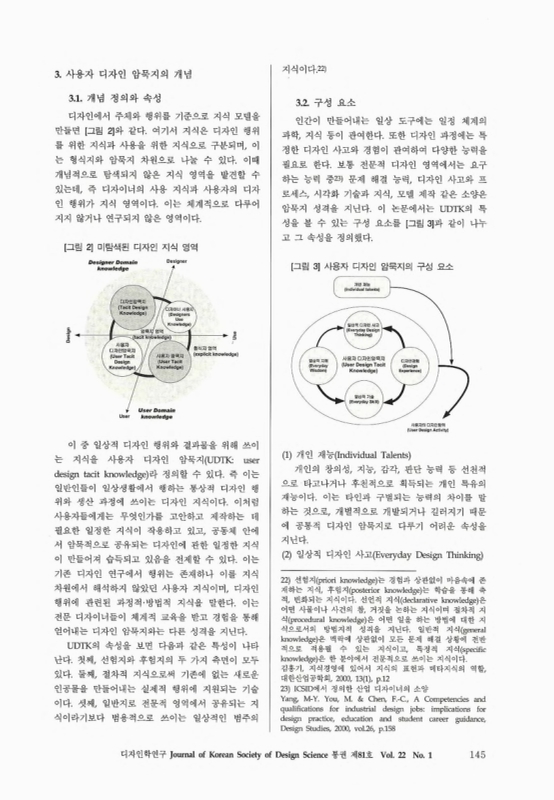
이 연구에서는 디자인 지식 측면에서 접근했는데, 전문 디자이너들은 시스템 기반에서 다양한 디자인 지식을 이용하여 구체적 행위 지식으로 쓰는 사실이 발견된 반면, 사용자들은 자신의 경험적 지식을 맥락 친화적인 지식으로 즉흥적으로 사용하는 경향을 보였다. 이 논문에서는 인지적 행위 차원에서 연구한 사용자 디자인 행위에 관련된 사용자 디자인 암묵지(design tacit knowledge)의 탐색적 개념을 도출했다. 연구 결과 사용자의 디자인 지식은 전문적 디자인 교육에 의해 배양되는 것이 아닌 일상적인 상식의 형성과 암묵적 학습, 오래된 일상 논리의 학습을 통해 얻어 비공식적 디자인을 위해 쓰는 것이라 할 수 있다. 이는 일상적 디자인 사고, 일상적 디자인 경험, 일상적 기술, 일상적 지혜 등의 요소를 가진 암묵적 지식이다. 사용자 디자인 암묵지는 원형적 디자인 방법 지식으로 사용자의 정황 체계를 보여주는 주요한 함축 의미를 지닌다. 이러한 사용자 디자인 암묵지 연구는 사용자 참여가 개입된 참여적 디자인 방법 개발을 위한 기초 연구가 될 것이다.
Consumers or users who are generally called bricoleurs, user-designers, or non-designers havenot only been using but also producing non-commercial products through production and design. With a growing interest incollaborative and participatory design methodology, it has become necessary to explore and study the user creativity used in everyday life. In this paper, we adopt a comparative approach for two types of design knowledge: professional designers who tend to adopt a cultivated and systematic approach toward various types of knowledge for creating elaborative designs and user-designers who derive knowledge from everyday contexts. We adopt a cognitive behavioral approach and deduct the exploratory concept of the user design tacit knowledge between the two types of knowledge utilized for user design activities.
| 번호 | 참고문헌 | 국회도서관 소장유무 |
|---|---|---|
| 1 | 김명소 외, 산업장면에서의 실용적 지능, 능력, 한국 심리학회지, 1996, 9, pp.117~137 | 미소장 |
| 2 | 김홍기, 지식경영에 있어서 지식의 표현과 메타지식의 역할, 대한산업공학회, 2000, 13(1), pp.10~16 | 미소장 |
| 3 | 박철민, 삶과 위기로서의 실업과 일상생활의 재구성, 부산대학교 박사학위 논문, 2006 | 미소장 |
| 4 | A Study on the Classification Framework and Sharing of Tacit Knowledge in the Process of IT Innovation | 소장 |
| 5 | 이순묵 외, 묵시조의 구조: 여자고등학생 자료를 중심으로, 교육학연구, 2002, 40, pp.31~50 | 미소장 |
| 6 | 실용지능과 묵시지의 혼동 : 암묵적 학습을 매개변수로 한 연결 | 소장 |
| 7 | Implicit theory of Everyday Creativity and Eminent Creativity | 소장 |
| 8 | 정은이 , 일상적 창의성과 개별성-관계성 및 심리, 사회적 적응의 관계, 고려대학교 대학원 박사학위 논문, 2002b | 미소장 |
| 9 | Characteristic Trends of Vernacular Design Culture and Products in Post-industrial Society - a case of products: vernacular playing-culture of children and Infants - | 소장 |
| 10 | Protocol analysis of product design assignment based on design information and design process | 소장 |
| 11 | A Case Study of Configuration Strategy and Context in Everyday Artifacts-Concentrated on analysis by Creativity Template Theory and Artifact Context Model- | 소장 |
| 12 | On the process of creativity in puzzles, inventions, and designs  |
미소장 |
| 13 | Bertola, P. & Teiseira, J. C., Design as a knowledge agent: How design as a knowledge process is embedded into organizations to foster innovation, Design Studies, 2003, vol.24, pp.181~194 | 미소장 |
| 14 | Claude L. S., 안정남 역, 야생의 사고, 한길사, 2005 | 미소장 |
| 15 | Cross, N. Design Cognition: Results form protocol and other empirical studies of design activity, in Charles M. E. et al. eds., Design Knowing and Learning: Cognition in Design Education, New York: Elsevier, 2001 | 미소장 |
| 16 | Integration of reasoning systems in architectural modeling activities |
미소장 |
| 17 | Dienes, Z. & Berry. D.C., Implicit learning: below the subjective threshold. Psychonomic bulliten and review, 1997, vol.4, pp.3~23 | 미소장 |
| 18 | Spark Innovation Through Empathic Design |
미소장 |
| 19 | Dorothy& Sensiper, S. The role of tacit knowledge in group innovation in Smith D. E. ed., Knowledge, groupware and the internet, Butterworth- Heinemannk, 2000 | 미소장 |
| 20 | Freidson E. 박호진역. (2007). 프로페셔널리즘-전문직에 대한 사회학적 분석과 전망, 아카넷 | 미소장 |
| 21 | Some phenomena of problem decomposition strategy for design thinking: differences between novices and experts |
미소장 |
| 22 | Hoffman, R. R., How can expertise be defined?: implications of research from cognitive psychology, in Williams, R. et al. eds., Exploring Expertise, Macmilan Press, 1998 | 미소장 |
| 23 | Jin, S. T., Kim, Y. S. & Kim, M. H., Diverse Characteristics in Design Problem Solving: A Case Study of Disciplinary Comparisons, Proceedings of International Design Congress, Yunlin, 2005 | 미소장 |
| 24 | The structure of concurrent cognitive actions: a case study on novice and expert designers |
미소장 |
| 25 | Kruger, C. and Nigel C., Modeling cognitive strategies in creative design, Computational and cognitive models of creative design V, 2001, pp.205~226 | 미소장 |
| 26 | Descriptive models for interpreting design |
미소장 |
| 27 | Miller W. l. & Morris L., 4th Generation R&D: Managing knowledge, technology, and innovation, John wiley & sons, 1999 | 미소장 |
| 28 | Nonaka, I., 박희종 외 역, 히토쓰바시에서 배운다, 시그마프레스, 2006 | 미소장 |
| 29 | Nonaka, I& Takeuchi, H., 장은영 역, 지식창조기업, 세종서적, 1998 | 미소장 |
| 30 | Polanyi, M., The tacit dimension MA: Gloucester, 1996 | 미소장 |
| 31 | Polanyi, M. 표재명·김봉미 역, 개인적 지식, 아카넷, 2001 | 미소장 |
| 32 | Popovic, V., Expertise development in product design-strategic and domain-specific knowledge connections, Design Studies, 2004, vol.25, pp.527~545 | 미소장 |
| 33 | Sanders, E. B. N., Generative tools for codesigning, in Scrivener, Ball and Woodcock Eds. Springer-verlag London Ltd., 2000 | 미소장 |
| 34 | Practical Intelligence in Everyday Life: Robert J. Sternberg, George B. Forsythe, Jennifer Hedlund, Joseph A. Horvath, Richard K. Wagner, Wendy M. Williams, Scott A. Snook, and Elena L. Grigorenko (2000). New York: Cambridge University Press. ISBN 0 521 65056 9 (hbk), 0 521 65958 2 (pbk), pp. xiv+ 288. Hbk price US$54.95, pbk price US$21.95 |
미소장 |
| 35 | Sternberg, R. J., 김민식 외 역, 인지심리학, 박학사, 2005 | 미소장 |
| 36 | Schon, D. A., The Reflective Practitioner: How Professionals Think in Action, Ashgate Publishing, 1995 | 미소장 |
| 37 | Senker, Jacqueline, The contribution of tacit knowledge to innovation, in Williams, R. et al. eds, Exploring Expertise, Macmilan Press, 1998 | 미소장 |
| 38 | Suwa, M, Purcell & Gero, J., Macroscopic analysis of design process based on scheme for coding designers' cognitive actions, Design Studies, 1998, vol.19, pp.455~483 | 미소장 |
| 39 | Suwa, M, Purcell & Tversky, B., What do architect and students perceive in their design sketches?: A protocol analysis, Design Studies, 1997, vol.18, pp.385~403 | 미소장 |
| 40 | Wakkery, R., Exploring the everyday designer, Proceedings of Workshop on Studying Designers, Aix-en-Provence, 2005 | 미소장 |
| 41 | Wenger, E., 손민호·배을규 역, 실천공동체, 학지사, 2007 | 미소장 |
| 42 | Yang, M-Y. You, M. & Chen, F.-C., A Competencies and qualifications for industrial design jobs: implications for design practice, education and student career guidance, Design Studies, 2000, vol.26, pp.155~189 | 미소장 |
*표시는 필수 입력사항입니다.
| 전화번호 |
|---|
| 기사명 | 저자명 | 페이지 | 원문 | 기사목차 |
|---|
| 번호 | 발행일자 | 권호명 | 제본정보 | 자료실 | 원문 | 신청 페이지 |
|---|
도서위치안내: 정기간행물실(524호) / 서가번호: 국내04
2021년 이전 정기간행물은 온라인 신청(원문 구축 자료는 원문 이용)

우편복사 목록담기를 완료하였습니다.
*표시는 필수 입력사항입니다.
저장 되었습니다.
