
 대표어
대표어
 한국학술지인용색인(NRF)
권호기사보기
| 기사명 | 저자명 | 페이지 | 원문 | 기사목차 |
|---|
결과 내 검색
동의어 포함
Purpose :
We estimated the likelihood of breast cancer patients having axillary lymph node metastases (ALNM) based on a variety of clinical and pathologic factors.
Materials and Methods :
Three hundred sixty-one breast cancer patients without distant metastases and who underwent breast conserving surgery and axillary lymph node dissection (ALND) (level I and II) or modified radical mastectomy (MRM) were identified, and we retrospectively reviewed their pathology records and treatment charts.
Results :
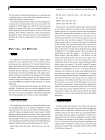
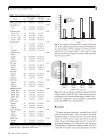
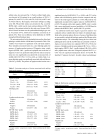
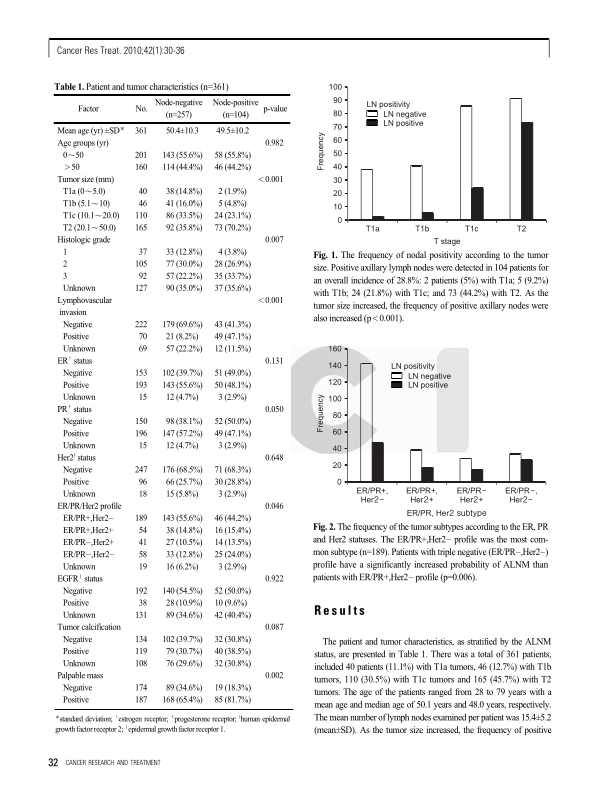
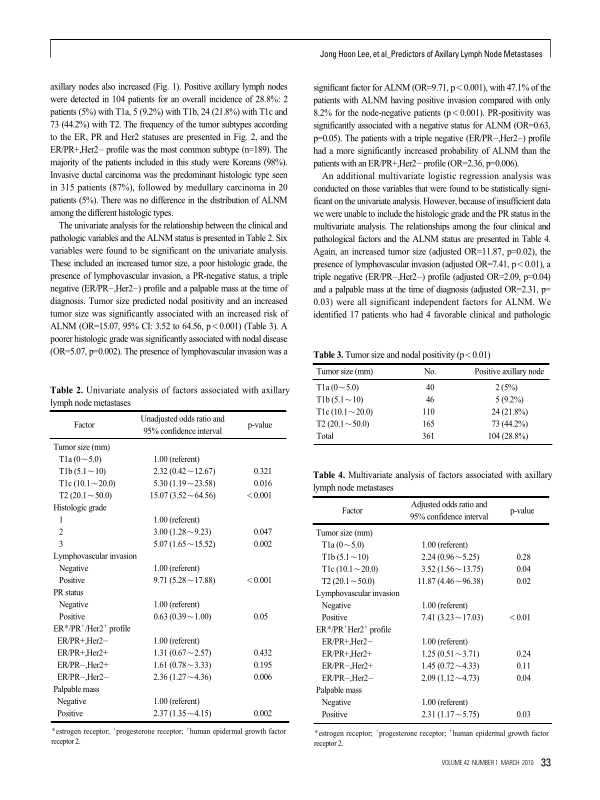
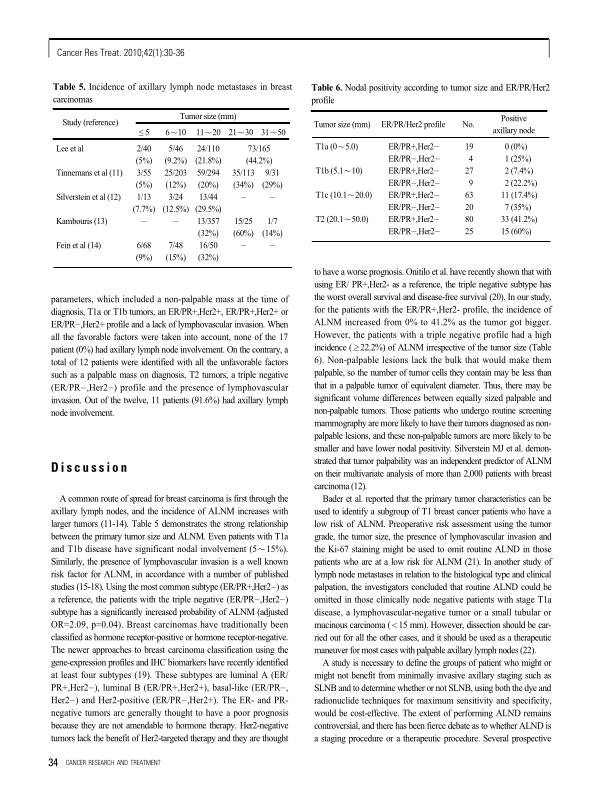
Positive axillary lymph nodes were detected in 104 patients for an overall incidence of 28.8%: 2 patients (5%) with T1a tumor, 5 (9.2%) with T1b tumor, 24 (21.8%) with T1c tumor and 73 (44.2%) with T2 tumor. On the multivariate analysis, an increased tumor size (adjusted OR=11.87, p=0.02), the presence of lymphovascular invasion (adjusted OR=7.41, p<0.01), a triple negative profile (ER/PR-, Her2-) (adjusted OR=2.09, p=0.04) and a palpable mass at the time of diagnosis (adjusted OR=2.31, p=0.03) were all significant independent factors for positive ALNM.
Conclusion :
In our study, the tumor size, the presence of lymphovascular invasion, a triple negative profile and a palpable mass were the independent predictive factors for ALNM. The tumor size was the strongest predictor of ALNM. Thus, the exact estimation of the extent of tumor is necessary for clinicians to optimize the patients’ care. Patients with a triple negative profile have a high incidence of ALNM irrespective of the tumor size.| 번호 | 참고문헌 | 국회도서관 소장유무 |
|---|---|---|
| 1 | Factors influencing prognosis in node-negative breast carcinoma: analysis of 767 T1N0M0/T2N0M0 patients with long-term follow-up.  |
미소장 |
| 2 | Relation of number of positive axillary nodes to the prognosis of patients with primary breast cancer. An NSABP update. |
미소장 |
| 3 | Consensus statement: treatment of early-stage breast cancer. National Institutes of Health Consensus Development Panel. |
미소장 |
| 4 | NIH consensus conference. Treatment of early-stage breast cancer. |
미소장 |
| 5 | Assessment of axillary lymph node status. |
미소장 |
| 6 | The Predictors of Axillary Node Metastasis in 2 cm or Less Breast Cancer : Univariate and Multivaritate Analysis |
미소장 |
| 7 | Management and survival of female breast cancer: results of a national survey by the American College of Surgeons. |
미소장 |
| 8 | Early and late morbidity associated with axillary levels I–III dissection in breast cancer |
미소장 |
| 9 | Randomized Multicenter Trial of Sentinel Node Biopsy Versus Standard Axillary Treatment in Operable Breast Cancer: The ALMANAC Trial |
미소장 |
| 10 | Frederick LG, David LP, Irvin DF, April F, Charles MB, Daniel GH, et al. AJCC Cancer Staging Manual/American Joint Committee on Cancer. Breast. 6th ed. Philadelphia: Lippincott Williams & Wilkins; 2002. p.223-40. | 미소장 |
| 11 | Treatment and survival of female patients with nonpalpable breast carcinoma. |
미소장 |
| 12 | Predicting axillary nodal positivity in 2282 patients with breast carcinoma. |
미소장 |
| 13 | Axillary node metastases in relation to size and location of breast cancers: analysis of 147 patients. |
미소장 |
| 14 | Identification of women with T1‐T2 breast cancer at low risk of positive axillary nodes |
미소장 |
| 15 | Factors influencing axillary node metastasis in breast cancer. |
미소장 |
| 16 | Predicting sentinel lymph node metastases in infiltrating breast carcinoma with vascular invasion. |
미소장 |
| 17 | Bevilacqua J, Cody H 3rd, MacDonald KA, Tan LK, Borgen PI, Van Zee KJ. A prospective validated model for predicting axillary node metastases based on 2000 sentinel node procedures: the role of tumor location [corrected]. Eur J Surg Oncol. 2002;28:490-500. | 미소장 |
| 18 | Prognostic role of the extent of peritumoral vascular invasion in operable breast cancer |
미소장 |
| 19 | Race, breast cancer subtypes, and survival in the Carolina Breast Cancer Study. |
미소장 |
| 20 | Breast cancer subtypes based on ER/PR and Her2 expression: comparison of clinicopathologic features and survival. |
미소장 |
| 21 | T1 Breast Cancer: Identification of Patients at Low Risk of Axillary Lymph Node Metastases |
미소장 |
| 22 | Frequency and predictors of axillary lymph node metastases in invasive breast cancer |
미소장 |
| 23 | A Randomized Trial Comparing Axillary Dissection to No Axillary Dissection in Older Patients With T1N0 Breast Cancer: Results After 5 Years of Follow-up |
미소장 |
| 24 | Result of Sentinel Lymph Node Biopsy Using Radioisotope in Clinically Lymph Node Negative Breast Cancer | 소장 |
| 25 | Predicting axillary lymph node metastases in patients with T 1infiltrating ductal carcinoma of the breast |
미소장 |
*표시는 필수 입력사항입니다.
| 전화번호 |
|---|
| 기사명 | 저자명 | 페이지 | 원문 | 기사목차 |
|---|
| 번호 | 발행일자 | 권호명 | 제본정보 | 자료실 | 원문 | 신청 페이지 |
|---|
도서위치안내: 정기간행물실(524호) / 서가번호: 국내16
2021년 이전 정기간행물은 온라인 신청(원문 구축 자료는 원문 이용)

우편복사 목록담기를 완료하였습니다.
*표시는 필수 입력사항입니다.
저장 되었습니다.
