
 대표어
대표어
 한국학술지인용색인(NRF)
권호기사보기
| 기사명 | 저자명 | 페이지 | 원문 | 기사목차 |
|---|
결과 내 검색
동의어 포함
목차
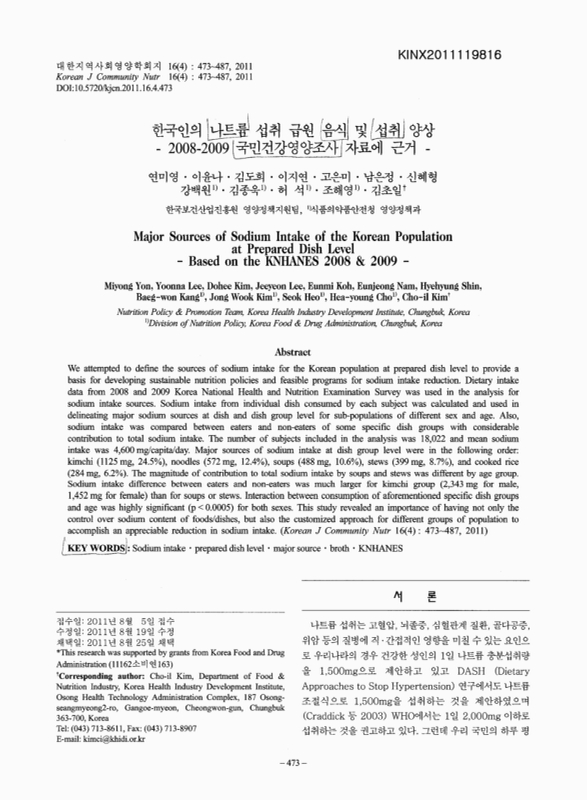
한국인의 나트륨 섭취 급원 음식 및 섭취 양상 : 2008-2009 국민건강영양조사 자료에 근거 / 연미영 ; 이윤나 ; 김도희 ; 이지연 ; 고은미 ; 남은정 ; 신혜형 ; 강백원 ; 김종욱 ; 허석 ; 조해영 ; 김초일 1
Abstract 1
서론 1
연구대상 및 방법 2
1. 연구대상 2
2. 분석 내용 2
3. 통계처리 3
결과 3
1. 대상자 분포 3
2. 대상별 나트륨 섭취량 3
3. 나트륨 섭취에 기여하는 음식군 4
4. 나트륨 섭취량의 주요 급원 음식 5
5. 특정 음식군의 섭취 여부에 따른 나트륨 섭취량 7
고찰 12
요약 및 결론 13
참고문헌 14
| 기사명 | 저자명 | 페이지 | 원문 | 목차 |
|---|---|---|---|---|
| 광주지역 일부 초등학생에서 어린이 식생활실천지침 이행정도에 따른 영양소 섭취수준 비교 | 김복희 ,성미영 ,이윤나 | pp.411-425 |
|
보기 |
| 영양교육과 운동 중재가 일부 비만아동들의 신체활동과 식생활에 미치는 영향 | 김명숙 ,최미숙 ,김기남 | pp.426-438 |
|
보기 |
| 한국 청소년의 고혈압과 관련된 식사 및 생활양식요인 분석 :2005년 국민건강·영양조사 사료에 근거하여 | 김길례 ,손숙미 ,김혜경 | pp.439-453 |
|
보기 |
| 성인 여성의 비만도와 신체구성 성분, 체중조절과 식행동 요인 분석 | 구재옥 ,박서연 | pp.454-465 |
|
보기 |
| 허베이스피릿호 원유유출 사고 이후 태안주민의 식생활 변화 :포커스 그룹 면담 결과 | 박지현 ,권성옥 ,정우철 ,허종일 ,오세영 | pp.466-472 |
|
보기 |
| 한국인의 나트륨 섭취 급원 음식 및 섭취 양상 :2008-2009 국민건강영양조사 사료에 근거 | 연미영 ,이윤나 ,김도희 ,이지연 ,고은미 ,남은정 ,신혜형 ,강백원 ,김종욱 ,허석 ,조해영 ,김초일 | pp.473-487 |
|
보기 |
| 보완대체요법에 대한 당뇨병환자의 인식 및 이용현황 | 김혜령 ,손은주 ,김미경 ,류은순 | pp.488-496 |
|
보기 |
| 보육시설 급식에 대한 부모 만족도 및 요구도 조사 :아산지역을 중심으로 | 송은승 ,김은경 | pp.497-510 |
|
보기 |
| 대전지역 한국대학생과 중국대학생의 커피 유형별 품질 속성에 대한 중요도 및 수행도 분석 | 김혜영 ,정혜경 ,이해영 | pp.511-524 |
|
보기 |
| 번호 | 참고문헌 | 국회도서관 소장유무 |
|---|---|---|
| 1 | Intersalt: an international study of electrolyte excretion and blood pressure. Results for 24 hour urinary sodium and potassium excretion. Intersalt Cooperative Research Group. | 미소장 |
| 2 | Intersalt revisited: further analyses of 24 hour sodium excretion and blood pressure within and across populations | 미소장 |
| 3 | The INTERSALT Study: background, methods, findings, and implications | 미소장 |
| 4 | The relationship between urinary cations obtained from the INTERSALT study and cerebrovascular mortality. | 미소장 |
| 5 | A Comparison of Dietary Behaviors According to Gender and Obesity Status of Middle School Students in Jeonju | 미소장 |
| 6 | Novel genetic variations associated with salt sensitivity in the Korean population | 미소장 |
| 7 | Dietary Sodium Intake and Subsequent Risk of Cardiovascular Disease in Overweight Adults | 미소장 |
| 8 | Implications of the INTERSALT study. | 미소장 |
| 9 | The Metabolic Syndrome | 미소장 |
| 10 | Salt, salted food intake, and risk of gastric cancer: Epidemiologic evidence | 미소장 |
| 11 | Effect of moderate alcoholic beverage consumption on insulin sensitivity in insulin-resistant, nondiabetic individuals | 미소장 |
| 12 | The DASH diet and blood pressure | 미소장 |
| 13 | Sodium Intake and Mortality Follow-Up in the Third National Health and Nutrition Examination Survey (NHANES III) | 미소장 |
| 14 | Dietary Sodium Intake and Mortality | 미소장 |
| 15 | Dietary sodium intake and mortality: the National Health and Nutrition Examination Survey (NHANES I) | 미소장 |
| 16 | Pathogenesis of essential hypertension. A link between dietary salt and high blood pressure. | 미소장 |
| 17 | A Comparison of Food and Nutrient Intakes between Instant Noodle Consumers and Non-Consumers among Korean Children and Adolescents | 미소장 |
| 18 | National Heart, Lung, and Blood Institute Workshop on Sodium and Blood Pressure | 미소장 |
| 19 | Salt intakes around the world: implications for public health | 미소장 |
| 20 | Sodium and Potassium Intake and Mortality Among US Adults | 미소장 |
| 21 | Assessment of food consumption, dietary diversity and dietary pattern during the summer in middle aged adults and older adults living in Gugoksooedam logevity area, Korea. | 미소장 |
| 22 | 농촌 지역 남자 중학생의 라면 섭취실태와 식품가치 인식 및 혈청 지질농도간의 상관관계 | 미소장 |
| 23 | Sodium Intakes of Korean Adults with 24-hour Urine Analysis and Dish Frequency Questionnaire and Comparison of Sodium Intakes According to the Regional Area and Dish Group | 미소장 |
| 24 | Dishes contributing to sodium intake of elderly living in rural areas. | 미소장 |
| 25 | Intersalt: An international study of electrolyte excretion and blood pressure. Results for 24 hour urinary sodium and potassium excretion | 미소장 |
| 26 | The Food and Nutrient Intakes on weekdays and weekends Among High School Girls in Seoul | 미소장 |
| 27 | Changes in Microorganisms and Enzyme Activity of Low Salt Soybean Paste (Doenjang) during Fermentation | 미소장 |
| 28 | A Study on the Eating Behaviors of Self-Purchasing Snack among Elementary School Students | 미소장 |
| 29 | Quality Properties of Yakgwa with Different Types of Frying Oil During Storage | 미소장 |
| 30 | Changes in Physicochemical Properties of Low Salt Soybean Paste (Doenjang) during Fermentation | 미소장 |
| 31 | Food Engineering Progress | 미소장 |
*표시는 필수 입력사항입니다.
| 전화번호 |
|---|
| 기사명 | 저자명 | 페이지 | 원문 | 기사목차 |
|---|
| 번호 | 발행일자 | 권호명 | 제본정보 | 자료실 | 원문 | 신청 페이지 |
|---|
도서위치안내: 정기간행물실(524호) / 서가번호: 국내03
2021년 이전 정기간행물은 온라인 신청(원문 구축 자료는 원문 이용)

우편복사 목록담기를 완료하였습니다.
*표시는 필수 입력사항입니다.
저장 되었습니다.
