Probabilistic bilinear transformation space-based joint maximum a posteriori adaptation / Hwa Jeon Song ; Yunkeun Lee ; Hyung Soon Kim 1
[요약] 1
I. Introduction 1
II. BIT-Based Speaker Adaptation 1
III. Probabilistic BIT 2
IV. Joint Probabilistic BIT-MAP Adaptation 3
V. Experiments and Results 3
VI. Conclusion 4
References 4
초록보기
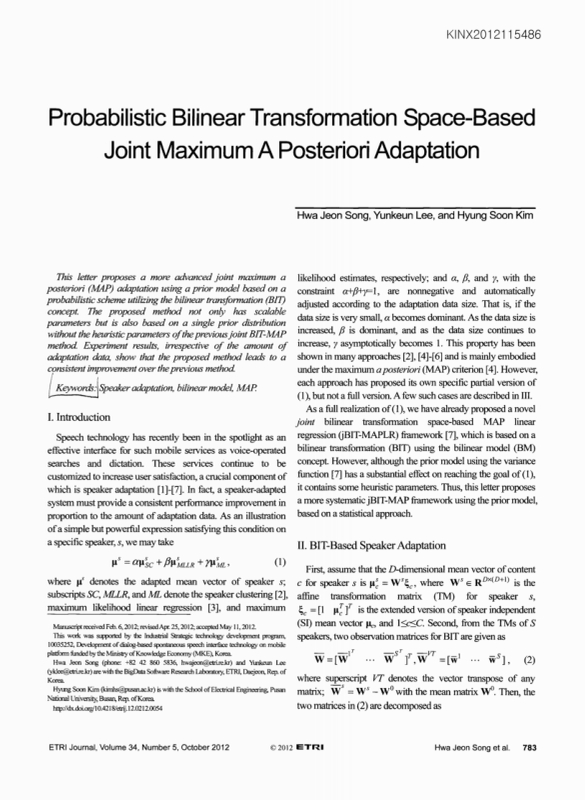
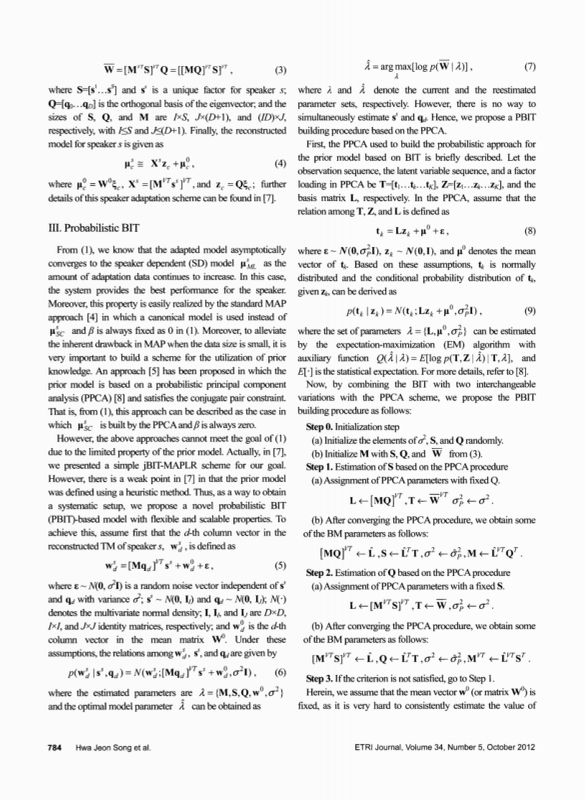
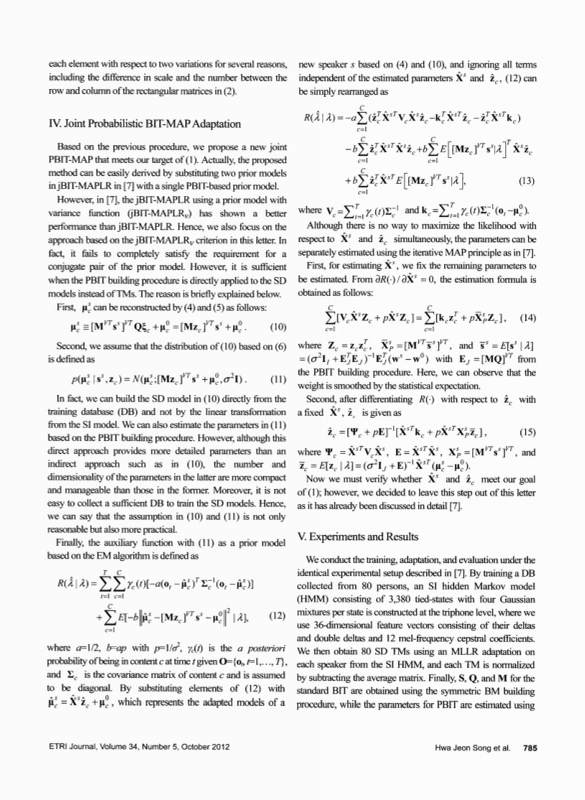
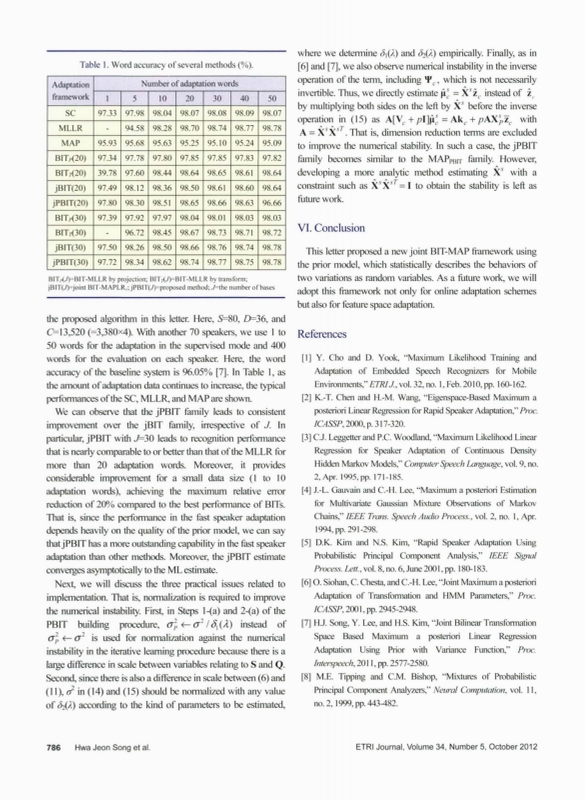
This letter proposes a more advanced joint maximum a posteriori (MAP) adaptation using a prior model based on a probabilistic scheme utilizing the bilinear transformation (BIT) concept. The proposed method not only has scalable parameters but is also bas
K.-T. Chen and H.-M. Wang, “Eigenspace-Based Maximum a posteriori Linear Regression for Rapid Speaker Adaptation,” Proc. ICASSP, 2000, p. 317-320.
미소장
3
Maximum likelihood linear regression for speaker adaptation of continuous density hidden Markov models
미소장
4
J.-L. Gauvain and C.-H. Lee, “Maximum a posteriori Estimation for Multivariate Gaussian Mixture Observations of Markov Chains,” IEEE Trans. Speech Audio Process., vol. 2, no. 1, Apr. 1994, pp. 291-298.
미소장
5
Rapid speaker adaptation using probabilistic principal component analysis
미소장
6
O. Siohan, C. Chesta, and C.-H. Lee, “Joint Maximum a posteriori Adaptation of Transformation and HMM Parameters,” Proc. ICASSP, 2001, pp. 2945-2948.
미소장
7
H.J. Song, Y. Lee, and H.S. Kim, “Joint Bilinear Transformation Space Based Maximum a posteriori Linear Regression Adaptation Using Prior with Variance Function,” Proc. Interspeech, 2011, pp. 2577-2580.
미소장
8
Mixtures of probabilistic principal component analyzers.

 대표어
대표어
 한국학술지인용색인(NRF)