
 대표어
대표어
 한국학술지인용색인(NRF)
권호기사보기
| 기사명 | 저자명 | 페이지 | 원문 | 기사목차 |
|---|
결과 내 검색
동의어 포함
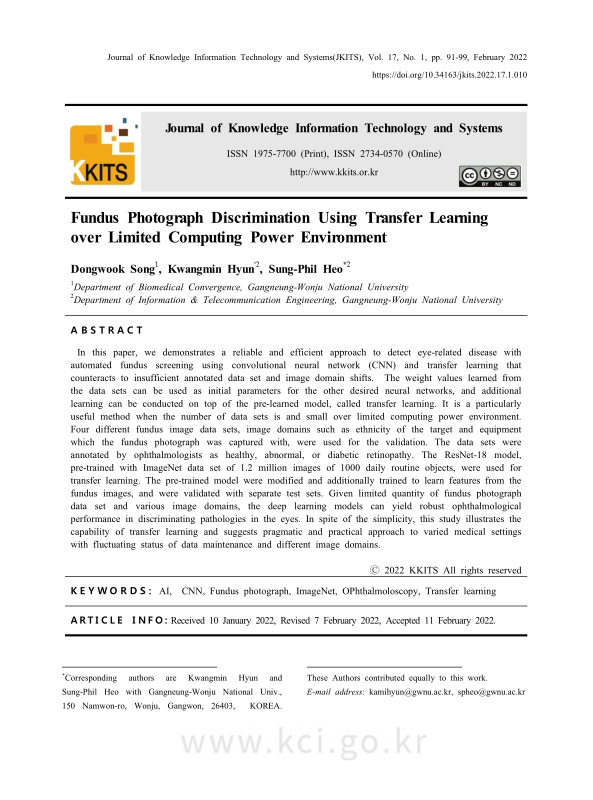
본 연구는 제한된 계산 능력을 갖는 환경에서 CNN 및 전이학습을 활용하여 의료영상 분야의 고질적 문제인 주석처리 데이터의 부족과 이미지 도메인 변화 문제에 대응하는 안정적이고 효율적인 자동 안저 검사 방법을 제안하였다. 데이터 세트를 이용하여 학습된 가중치 값을 다른 신경망의 초기값으로 사용하고, 이 사전 학습 모델을 이용하여 추가적인 학습을 수행한다. 이러한 재 수행을 미세 조정이라고 하고, 이 전과정을 전이학습이라고 한다. 이미지 도메인이 상이한 총 4가지 안저 사진 데이터 세트가 검증을 위해 사용되었다. 데이터 세트는 안과전문의에 의해 각각 정상과 비정상 또는 당뇨성 망막병증으로 진단 및 주석 처리된 자료를 활용하였다. 전이 학습에 있어 120만장의 일상생활 개체 종류 사진으로 구성된 ImageNet 데이터들로 사전 훈련된 ResNet-18 모델을 활용하였다. 사전 학습된 모델은 추가로 안저 사진의 특징을 학습을 하였고, 학습과 분리된 테스트세트로 검증을 하였다. 딥 러닝 모델은 안저 사진 데이터 세트의 제한적 수량과 이미지 도메인의 변화에도 불구하고 강인한 눈 질환 판별 성능을 보였다. 본 연구를 통해 단순하지만 강력한 전이학습의 가능성을 보였으며, 양질의 의료데이터 확보 및 관리의 한계, 이미지 도메인 부적응 등 다양한 의료 환경의 문제에 대응하는 실현 가능하고 실용적 방법을 제안하였다.
In this paper, we demonstrates a reliable and efficient approach to detect eye-related disease with automated fundus screening using convolutional neural network (CNN) and transfer learning that counteracts to insufficient annotated data set and image domain shifts. The weight values learned from the data sets can be used as initial parameters for the other desired neural networks, and additional learning can be conducted on top of the pre-learned model, called transfer learning. It is a particularly useful method when the number of data sets is and small over limited computing power environment. Four different fundus image data sets, image domains such as ethnicity of the target and equipment which the fundus photograph was captured with, were used for the validation. The data sets were annotated by ophthalmologists as healthy, abnormal, or diabetic retinopathy. The ResNet-18 model, pre-trained with ImageNet data set of 1.2 million images of 1000 daily routine objects, were used for transfer learning. The pre-trained model were modified and additionally trained to learn features from the fundus images, and were validated with separate test sets. Given limited quantity of fundus photograph data set and various image domains, the deep learning models can yield robust ophthalmological performance in discriminating pathologies in the eyes. In spite of the simplicity, this study illustrates the capability of transfer learning and suggests pragmatic and practical approach to varied medical settings with fluctuating status of data maintenance and different image domains.| 번호 | 참고문헌 | 국회도서관 소장유무 |
|---|---|---|
| 1 | V. Biousse, B. B. Bruce, and N. J. Newman, Ophthalmoscopy in the 21st century: The 2017 H. Houston merritt lecture, Neurology, Vol. 90, No. 4, pp. 167-175, 2018. | 미소장 |
| 2 | N. Irani, S. Bidot, J. Peragallo, G. J. Esper, N. J. Newman, and V, Biousse, Feasibility of a nonmydriatic ocular fundus camera in an outpatient neurology clinic, The Neurologist, Vol. 25, No. 2, pp. 19-23, 2020. | 미소장 |
| 3 | M. D. Abràmoff, P. T. Lavin, M. Birch, N. Shah, and N. J. C. Folk, Pivotal trial of an autonomous AI-based diagnostic system for detection of diabetic retinopathy in primary care office, NPJ Digital Medicine 1, No. 39. 2018. | 미소장 |
| 4 | A. Grzybowski, P. Brona, G. Lim, P. Guamviboonsuk, G. S. Tan, M. Abramoff, and D. S. Ting, Artificial intelligence for diabetic retinopathy screening: A review, Nature: Eye, Vol. 34, No. 3, pp. 451-460, 2020. | 미소장 |
| 5 | P. Heydon, C. Egan, L. Bolter, R. Chambers, J. Anderson, S. Aldington, and A. Rudnicka, Prospective evaluation of an artificial intelligence-enabled algorithm for automated diabetic retinopathy screening of 30,000patients, British Journal of Ophthalmology, Vol. 105, No. 5, pp. 723-728, 2021. | 미소장 |
| 6 | https://ai.googleblog.com /2016/11/deep-learning-for-detection-of-diabetic. html), Jan. 2022. | 미소장 |
| 7 | Ministry of Food and Drug Safety of Korea, National institute of food and drug safety evaluation: newly developed medical device and outlook analysis report. pp. 12-45, 2020. | 미소장 |
| 8 | P. Keane, and E. Topol, Reinventing the eye exam, The Lancet, Vol. 394, No. 10215. pp. 2141, 2019. | 미소장 |
| 9 | J. D. Fauw, J. R. Ledsam, B. RomeraParedes, S. Nikolov, N. Tomasev, S. Blackwell, and O. Ronneberger, Clinically applicable deep learning for diagnosis and referral in retinal disease, Nature Medicine, Vol. 24, No. 9. pp. 1342-1350, 2018. | 미소장 |
| 10 | S. J. Pan, and Q. Yang, A survey on transfer learning, IEEE Transactions on Knowledge and Data Engineering, Vol. 22, No. 10. pp. 1345-1359, 2009. | 미소장 |
| 11 | A. Kashani, S. Asanad, J. Chen, M. Singer, M. Zhang, M. Sharifi, and J. M. Ringman, Past, present and future role of retinal imaging in neurodegenerative disease, Progress in Retinal and Eye Research, 100938, 2021. | 미소장 |
| 12 | E. Golombievski, M. W. Doerrler, S. D. Ruland, M. A. McCoyd, and J. Biller, Frequency of direct funduscopy upon initial encounters for patients with headaches, altered mental status, and visual changes: a pilot study, Frontiers in Neurology, Vol. 6, No. 233, pp. 233. 2015. | 미소장 |
| 13 | D. D. Mackay, P. S. Garza, B. B. Bruce, N. J. Newman, and V. Biousse, V, The demise of direct ophthalmoscopy: a modern clinical challenge, Neurology: Clinical Practice, Vol. 5, No. 2, pp. 150-157, 2015. | 미소장 |
| 14 | Y. LeCun, Y. Bengio, and G. Hinton, Deep learning, Nature, Vol. 521, No. 7553, pp. 436-444, 2015. | 미소장 |
| 15 | A. G. Schwing, and R. Urtasun, Fully connected deep structured networks, arXiv:1503.02351, 2015. | 미소장 |
| 16 | M. D. Zeiler, and R. Fergus, Visualizing and understanding convolutional networks, 2014European Conference on Computer Vision, pp. 818-833, 2014. | 미소장 |
| 17 | B. Kim. and S. Suh, Comparative study on performance improvement methods in cnn based on time series data, Journal of Knowledge Information Technology and Systems, Vol. 16, No. 5, pp. 935-944, 2021. | 미소장 |
| 18 | S. Shin, H. Kim, and S. Park, Recent trend of biomedical image classification methods, Journal of Knowledge Information Technology and Systems, Vol. 12, No. 5, pp. 765-776, 2017. | 미소장 |
| 19 | K. He, X. Zhang, S. Ren, and J. Sun, Deep residual learning for image recognition, 2016IEEE Conference on Computer Vision and Pattern Recognition, pp. 770-778, 2016. | 미소장 |
| 20 | T. A. Liu, D. S. Ting, H. Y. Paul, J. Wei, H. Zhu, P. Subramanian, and N. R. Miller, Deep learning and transfer learning for optic disc laterality detection: implications for machine learning in neuro-ophthalmology, Journal of Neuro-Ophthalmology, Vol. 40, No. 2. pp. 178-184, 2020. | 미소장 |
| 21 | S. Sengupta, A. Singh, H. A. Leopold, T. Gulati, and V. Lakshminarayanan, Ophthalmic diagnosis using deep learning with fundus images – A critical review, Artificial Intelligence in Medicine, Vol. 102, p. 101758, 2020. | 미소장 |
| 22 | A. Budai, R. Bock, A. Maier, J. Hornegger, and G. Michelson, Robust vessel segmentation in fundus images, International Journal of Biomedical Imaging, Vol. 2013, 2013. | 미소장 |
| 23 | A. D. Hoover, V. Kouznetsova, and M. Goldbaum, M. Locating blood vessels in retinal images by piecewise threshold probing of a matched filter response, IEEE Transactions on Medical Imaging, Vol. 19, No. 3, pp. 203-210, 2000. | 미소장 |
| 24 | G. Quellec, M. Lamard, P. H. Conze, P. Massin, and B. Cochener, Automatic detection of rare pathologies in fundus photographs using few-shot learning, Medical Image Analysis, Vol. 61, 101660. 2020. | 미소장 |
| 25 | https://colab.research.google.com, Jan. 2021. | 미소장 |
*표시는 필수 입력사항입니다.
| 전화번호 |
|---|
| 기사명 | 저자명 | 페이지 | 원문 | 기사목차 |
|---|
| 번호 | 발행일자 | 권호명 | 제본정보 | 자료실 | 원문 | 신청 페이지 |
|---|
도서위치안내: 정기간행물실(524호) / 서가번호: 국내17
2021년 이전 정기간행물은 온라인 신청(원문 구축 자료는 원문 이용)

우편복사 목록담기를 완료하였습니다.
*표시는 필수 입력사항입니다.
저장 되었습니다.
