본문 바로가기 주메뉴 바로가기
국회도서관 홈으로 정보검색 소장정보 검색

결과 내 검색

동의어 포함

목차보기


Acknowledgments
Introduction

1 Understanding the Philosophy of Law
2 Korea’s Modern History
3 Philosophy of Law in a Social Context
4 Reception of Continental and Anglo-American Legal Philosophies
1 Legal Philosophy and Social Change in Korea
1 Introduction
2 Korean Legal Philosophy: Colonization, Liberation, and the Korean War
2.1 Liberation from Japanese Imperialism
2.2 Judicial Practice During the Korean War
3 Korean Legal Philosophy During Authoritarianism
3.1 A History of Oppression and Resistance
3.1.1 Rhee’s Authoritarianism and the April Revolution
3.1.2 Park’s Dictatorship and the Yushin Constitution
3.1.3 Chun’s Military Coup and the 5.18 Gwangju Democratization Movement
3.2 A Dark Age for Natural Law Theory
3.3 Blind or Critical Legal Positivism
3.4 What is a Korean Legal Culture?
3.5 Korean-Style Natural Law Theory: Pungto Theory and Gikbun Ethics
4 Korean Legal Philosophy During Civil Revolution
4.1 Longing for Democracy
4.1.1 The New Resistance Movement
4.1.2 The Civil Revolution of 1987
4.2 For Human Dignity and Democracy
4.3 Abolishing Evil Laws
4.4 Revealing Capitalist Ideology
4.5 Punishing Dictators
5 Korean Legal Philosophy in the Age of Liberalism and Value Pluralism
5.1 New Missions
5.2 Institutionalizing Civil Democracy
5.2.1 The Convergence of Legal Positivism and Natural Law Theory
5.2.2 Institutional Natural Law Theory
5.2.3 Anthropological Natural Law Theory
5.3 A Litigation Society
5.4 Researching Justice
5.5 Rationalizing Judicial Practices
5.6 Researching Applied Legal Philosophy
2 Korea’s Reception of German Philosophy of Law
1 Introduction
2 German Philosophy of Law and Post-War Trends
2.1 Radbruch’s Formula
2.1.1 Statutory Lawlessness and Supra-Statutory Law
2.1.2 The Tension Between Justice and Legal Stability
2.1.3 The Radbruch Formula: An Appraisal
2.2 Resurrecting Natural Law
2.3 The Existential Philosophy of Law
2.4 The Border Guard Case and the Issue of Legal Effect
2.4.1 The Border Guard Case (Mauerschützfall)
2.4.2 The Legal Philosophical Basis
2.5 Methodology and Legal Interpretation
2.6 Prospects for German Legal Philosophy in the Twenty-First Century
3 Acceptance of German Legal Philosophy in Korea
3.1 The Study of the Philosophy of Law Begins (1945–1950s)
3.2 The Influence of Radbruch’s Thought
3.3 Natural Law Theory
3.4 Methodologies of Jurisprudence and Legal Interpretation
3.5 The Development of Legal Systems for Biotechnology Research
3.5.1 Introduction
3.5.2 The Development of Biotechnological Studies
3.5.3 The Development of Embryonic Stem Cell Studies
3.5.4 Problems with Human Cloning
3.5.5 Germany’s Bioethics Law
3.5.6 Korea’s Bioethics Law
4 Evaluation
3 Acceptance of Anglo-American Jurisprudence
1 Introduction
2 Culture and Science
2.1 Paul K. Ryu (1915–1998)
2.2 Pyong-Choon Hahm (1932–1983)
3 Anglo-American Jurisprudential Wave
3.1 British Jurisprudence
3.2 American Jurisprudence
3.3 Intersection
4 Concluding Remarks
Conclusion
Index

이용현황보기

Philosophy of law in Korea : acceptance, engagement and social change 이용현황 표 - 등록번호, 청구기호, 권별정보, 자료실, 이용여부로 구성 되어있습니다.
등록번호 청구기호 권별정보 자료실 이용여부
0002980244 LM 340.1 -A23-21 서울관 법률정보센터(206호) 이용중

출판사 책소개

알라딘제공

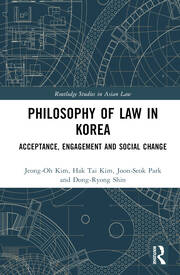
When Korea began as a newly independent state in 1948, its economy was very underdeveloped and the rule of law was just established. The journey of democratization in Korea was not without challenges. This book traces the history of the legal philosophy development in Korea and highlights Korea's unique experience. This book shows how Western legal philosophy has been accepted in Korea, a non-Western country that has newly introduced the Western legal system and what role the legal philosophy has played in social context.

The book also examines academic scholars' intellectual activities in a historical context and how their intellectual products are yielded through their continuous response to the circumstances of the time. It specifically looks at the many challenging tasks legal philosophers had to overcome in a society when the rule of law and democracy had not yet settled. The book explores how Korean legal philosophers coped during such unique historical situations. It also illustrates how Korean scholars accepted German and Anglo-American legal philosophies and integrated them to change social realities of Korea.

Through Korea’s experience, this book will provide insights into how modern legal philosophy develops in a new state and what legal philosophers' responses would be like during such a process. The developing process of legal philosophy in Korean society will interest not only readers in countries who have had similar experiences to Korea, but also readers in the West. 


This book shows how Western legal philosophy has been accepted in Korea, a non-Western country that has newly introduced the Western legal system and what role the legal philosophy has played in social context.


