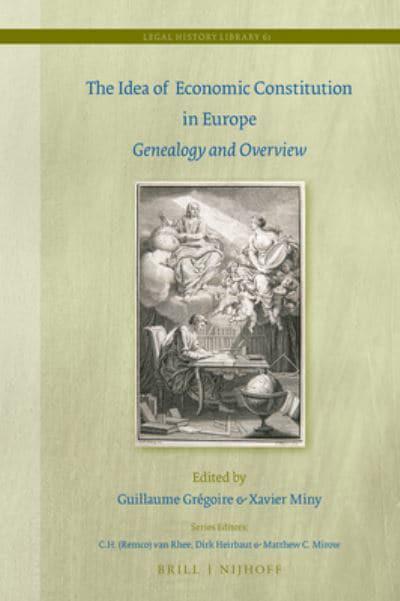
Acknowledgment Notes on Contributors Introduction La "Constitution e conomique": Approche contextuelle et perspectives interdisciplinaires Guillaume Gr e goire and Xavier Miny part 1 Genealogy of the Concept Historical and Theoretical Perspectives section 1 The Emergence of the Concept From the Physiocrats to the Weimar Republic Les Physiocrates, l'economie politique et l'Europe Philippe Steiner The Economic Constitution under Weimar Doctrinal Controversies and Ideological Struggles Guillaume Gr e goire Discussion Le Concept de Constitution e conomique : e mergence et fonctions Hugues Rabault Discussion The Concept and Politics of the Economic Constitution Peter C. Caldwell section 2 The (Neo)Lib e ral Recapture of the Concept An Economic Constitution Neoliberal Lineages Thomas Biebricher Economic Constitution and Authoritarian Liberalism Carl Schmitt and the Idea of a Sound Economy Werner Bonefeld Discussion Le n e olib e ralisme : Un "lib e ralisme autoritaire" n e o-schmittien ? Serge Audier Discussion L'id e e de constitution e conomique et l'hypoth e se du lib e ralisme autoritaire Vincent Valentin part 2 The European Economic Constitution From Micro to Macro section 3 The Microeconomic Constitution of the European Union Fundamental Economic Freedoms and Competition Law The Fundamental Economic Freedoms Constitutionalizing the Internal Market Pieter Van Cleynenbreugel and Xavier Miny Evolution des politiques de concurrence en droit de l'UE de la Wettbewerbsordnung ordolib e rale a la More Economic Approach n e olib e rale? Fr e d e ric Marty Discussion Les difficult e s d'une interpr e tation ordolib e rale de la constitution micro- e conomique de l'union europ e enne Claire Mongouachon Discussion Society, Private Law and Economic Constitution in the EU Hans-Wolfgang Micklitz section 4 The macroeconomic constitution of the European Union The advent of Economic and Monetary Union Les racines historiques et theoriques de l'union economique et monetaire Francesco Martucci The European Economic Constitution in Crisis A Conservative Transformation? Hjalte Lokdam and Michael A. Wilkinson Discussion The Evolving Economic Constitution of the European Union: Eulogy to Stability? Susanna Cafaro Discussion The Eurozone Crisis, the Coronavirus Response, and the Limits of European Economic Governance Peter Lindseth and Cristina Fasone part 3 National Economic Constitutions and Global Governance section 5 National Economic Constitutions A Legal Analysis Constitution et economie en Belgique Pierre Nihoul La constitution economique de la France et la jurisprudence economique du Conseil constitutionnel Fran c ois Colly The Idea of an Economic Constitution (Wirtschaftsverfassung ) in German Law Peter-Christian M u ller-Graff The United Kingdom's Economic Constitution Tony Prosser section 6 Global Governance and New (Economic) Constitutionalism Federalism and Competition between Jurisdictions The Special Financing Law Tax Competition and Fiscal Consolidation at the Heart of Belgium's Material Economic Constitution Damien Piron La mise en concurrence des systemes juridiques nationaux et l'idee de Constitution economique M. Mahmoud Mohamed Salah Discussion Three Dialectics of Global Governance and the Future of New Constitutionalism Thibault Biscahie and Stephen Gill Discussion De la constitution economique a la constitution ecologique : l'avenement de la 'meta-politique' S e bastien Adalid Overall Conclusions Economic Constitutionalism and "The Political" of "The Economic" Christian Joerges Index of Subjects Index of Names
이용현황보기
The idea of Economic Constitution in Europe : genealogy and overview 이용현황 표 - 등록번호, 청구기호, 권별정보, 자료실, 이용여부로 구성 되어있습니다.
등록번호
청구기호
권별정보
자료실
이용여부
0003008836
LM 342.24 -A23-6
서울관 법률정보센터(206호)
북큐레이션 (자료실내 이용)
출판사 책소개
Behind the controversies that have marked the history of the idea of Economic Constitution emerges the highly political issue of the room for manoeuvre left to public authorities in the economic sphere. The notion thus encapsulates a fundamental tension: between democracy and rule of law, which model of legal ordering of the economy should prevail?
From physiocrats to neo-liberals, from the Weimar Republic to European integration, from national constitutions to Global Governance, this collective book invites us to explore the genealogy of the controversial concept of Economic Constitution. The result of this interdisciplinary dialogue is a comprehensive reflection on the legal and political issues at stake in the current constitutionalization of the market order in Europe.
Contributors are: Philippe Steiner, Guillaume Gr?goire, Hugues Rabault, Peter C. Caldwell, Thomas Biebricher, Werner Bonefeld, Serge Audier, Vincent Valentin, Pieter van Cleynenbreugel, Xavier Miny, Fr?d?ric Marty, Claire Mongouachon, Hans-Wolfgang Micklitz, Francesco Martucci, Michael Wilkinson, Hjalte Lokdam, Susanna Maria Cafaro, Peter Lindseth, Cristina Fasone, Pierre Nihoul, Fran?ois Colly, Peter-Christian M?ller-Graff, Tony Prosser, Damien Piron, Mahmoud Mohamed Salah, Stephen Gill, Thibault Biscahie, Sebastien Adalid, and Christian Joerges.
Derri?re les controverses qui jalonnent l'histoire de l'id?e de Constitution ?conomique ?merge la question ?minemment politique de la marge de manoeuvre laiss?e aux autorit?s publiques dans la sph?re ?conomique. La notion cristallise ainsi une tension fondamentale: entre d?mocratie et ?tat de droit, quel doit ?tre mod?le d'organisation et d'ordonnancement juridique de l'?conomie?
Des physiocrates aux n?olib?raux, de la R?publique de Weimar ? l'int?gration europ?enne, des constitutions nationales ? la Global Governance, cet ouvrage collectif nous invite d?s lors ? explorer la g?n?alogie du concept pol?mique de Constitution ?conomique. Les auteurs ouvrent alors, ? travers un dialogue interdisciplinaire constant, une r?flexion globale autour des enjeux juridiques et politiques du processus actuel de constitutionnalisation de l'ordre de march? en Europe.