
 대표어
대표어
 https://www.wto.org/english/res_e/publications_e/wtr23_e.htm

권호기사보기
| 기사명 | 저자명 | 페이지 | 원문 | 기사목차 |
|---|
결과 내 검색
동의어 포함
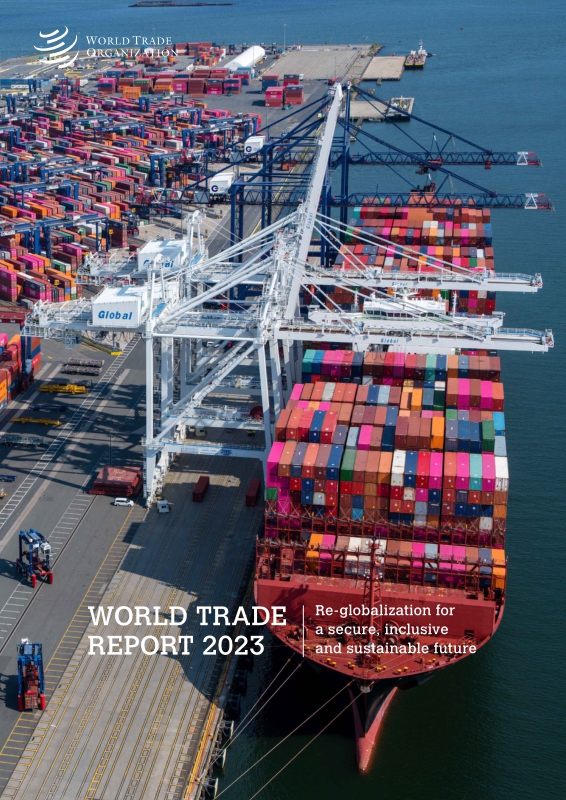
Title page
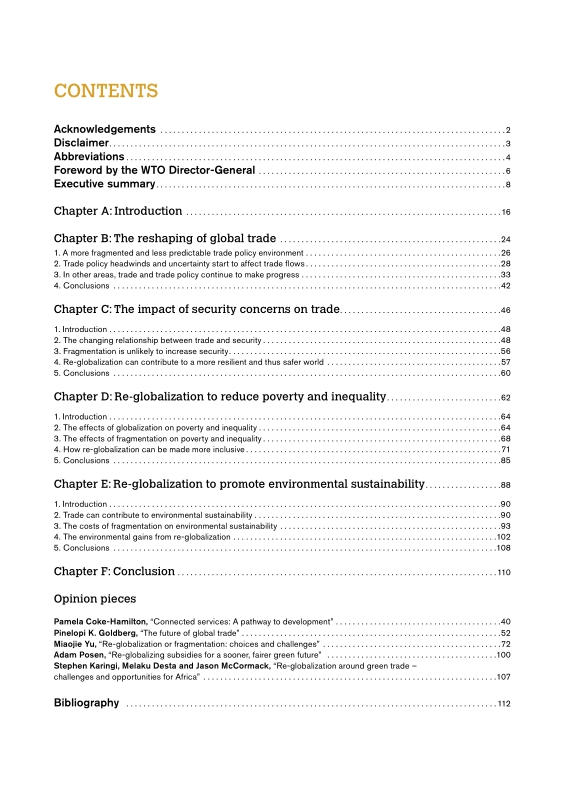
Contents
Acknowledgements 4
Disclaimer 5
Abbreviations 6
Foreword By The WTO Director-General 8
Executive Summary 10
A. Introduction 18
B. The reshaping of global trade 26
1. A more fragmented and less predictable trade policy environment 28
2. Trade policy headwinds and uncertainty start to affect trade flows 30
3. In other areas, trade and trade policy continue to make progress 35
4. Conclusions 46
C. The impact of security concerns on trade 48
1. Introduction 50
2. The changing relationship between trade and security 50
3. Fragmentation is unlikely to increase security 58
4. Re-globalization can contribute to a more resilient and thus safer world 59
5. Conclusions 62
D. Re-globalization to reduce poverty and inequality 64
1. Introduction 66
2. The effects of globalization on poverty and inequality 66
3. The effects of fragmentation on poverty and inequality 70
4. How re-globalization can be made more inclusive 73
5. Conclusions 87
E. Re-globalization to promote environmental sustainability 90
1. Introduction 92
2. Trade can contribute to environmental sustainability 92
3. The costs of fragmentation on environmental sustainability 95
4. The environmental gains from re-globalization 104
5. Conclusions 110
F. Conclusion 112
Bibliography 114
Figure 1. The great collapse of world trade, 1929-32 19
Figure 2. The rise and fall and rise again of global economic integration, 1830-2020 21
Figure B.1. Trade concerns raised in the Market Access, SPS and TBT Committees, 1996-2022 (left), and the number of trade concerns raised in the Council for Trade... 28
Figure B.2. The number of newly imposed countervailing measures, 1995-2022 29
Figure B.3. Trade policy uncertainty index, 2003-21 30
Figure B.4. Global trade as a share of GDP, 1970-2021 31
Figure B.5. Trade as a share of GDP in selected economies, 1970-2021 31
Figure B.6. Ratio of value-added exports to gross exports, 1970-2018 32
Figure B.7. Growth decomposition of global trade as a share of GDP, 2000-08 and 2010-18 33
Figure B.8. US imports of products affected by 25 per cent import tariffs (left), and products not affected by tariffs (right) 34
Figure B.9. Trade within and between hypothetical geopolitical blocs, January 2019 to December 2022 35
Figure B.10. Share of potential bottleneck products in global exports, 2000-21 36
Figure B.11. Evolution of trade costs 1996-2018 (left) and the level of trade costs in 2018 (right), by income group 37
Figure B.12. Evolution of trade costs 1996-2018 (left) and the level of trade costs in 2018 (right), by broad sector 38
Figure B.13. Growth in global imports of environmental goods, 2000-21 39
Figure B.14. Decline of trade costs in digitally deliverable services, 1996-2018 39
Figure B.15. Growth of digitally delivered services exports, 2005-22 40
Figure B.16. Share of global merchandise exports volume by income group, 2001-21 40
Figure B.17. Average annual growth in merchandise trade volume of selected economies, 2010-21 41
Figure B.18. Average annual growth in GVC participation of selected economies, 2010-20 43
Figure B.19. Exports of digitally delivered services by income level, 2015 and 2022 44
Figure B.20. Growth in digitally delivered services exports of LDCs 44
Figure B.21. Bangladesh's exports of computer services by subsector, fiscal year 2017-18 to 2020-21 45
Figure B.22. Exports of intermediate services by income group, 2015 and 2021 46
Figure C.1. Quantitative restrictions in force notified under GATT 1994 Article XXI are increasing 50
Figure C.2. National security-related trade concerns raised in WTO committees are rising 51
Figure C.3. The share of trade affected by trade sanctions is increasing 52
Figure C.4. Economic policy uncertainty is on the rise 52
Figure C.5. The world is becoming less peaceful 53
Figure C.6. Trade substitution across products eased export shortfalls 55
Figure C.7. Imports were critical to respond to the infant formula shortage in the United States 56
Figure C.8. There is a strong correlation between trade openness and lower conflict probability 57
Figure D.1. The pace of economic convergence has slowed down in recent years 66
Figure D.2. Trade openness can go hand in hand with economic inclusion 67
Figure D.3. International trade has contributed to reducing extreme poverty 68
Figure D.4. Fragmentation may slow down or prevent economic convergence 72
Figure D.5. Greater international trade cooperation supports economic convergence 76
Figure D.6.1. Ad valorem equivalents of services restrictions (by sector) 79
Figure D.6.2. GVC participation and ad valorem equivalents of services restrictions (by region) 79
Figure D.7. Improving digital infrastructure and regulation reduces trade costs 81
Figure E.1. High-income economies tend to be net importers of carbon emissions 93
Figure E.2. Technology improvements had a strong impact in reducing CO₂ emissions between 1995 and 2018 95
Figure E.3. Trade-related environmental policies have increased in recent years 98
Figure E.4. Some environmental measures have raised concerns in the WTO 99
Figure E.5. There is potential to diversify the supply of EV battery materials 103
Figure E.6. Carbon emissions intensity for digitally delivered services is relatively low 104
Figure E.7. There is no correlation between renewable energy share and exports of energy-intensive products 105
Figure E.8. Green comparative advantage enables substantial global emissions reduction with limited economic costs 106
Boxes
Box B.1. The expansion of global value chains and the measurement of international trade 32
Box B.2. The impact of China-United States trade tensions 34
Box B.3. The nascent digital services sector in Bangladesh 45
Box D.1. Services trade-opening and manufacturing GVC participation in the Middle East and North Africa region 79
Box D.2. Ongoing activities at the WTO related to e-commerce regulation 80
Box D.3. International cooperation on skills, infrastructure, and regulatory gap is diverse 82
Box E.1. Fragmentation can hinder access to raw materials in the green transition 103
Box E.2. Trade policies to address plastics pollution 107
Opinion pieces
Connected services: A pathway to development 42
The Future of Global Trade 54
Re-globalization or fragmentation: choices and challenges 74
Re-globalizing subsidies for a sooner, fairer green future 102
Re-globalization around green trade: challenges and opportunities for Africa 109

The COVID-19 pandemic and the prospect of increasingly frequent and more intense natural and man-made disasters raise important questions about the resilience of the global economy to such shocks. The World Trade Report 2022 explores the basic, binary assumption driving much of the current debate about economic resilience, namely the inherent trade-off between global trade interdependence and national economic security, and suggests that this can be a false dilemma. Due to its interconnected nature, international trade can increase an economy's exposure to risks and contribute to the transmission of shockwaves. At the same time, it can bolster economic resilience, particularly when backed by domestic policies and effective global cooperation. As a driver of economic growth, trade can generate the resources and knowledge needed to prepare for crises. It can also help countries recover by facilitating the provision of goods and services needed to cope with a crisis. Policies aimed at increasing economic resilience by re-shoring production and unwinding trade integration ultimately reduce economic resilience. Conversely, trade diversification can contribute to economic resilience by allowing countries to be less dependent on a limited number of importers, exporters and sectors. The World Trade Report 2022 shows that a more open, inclusive and predictable trade environment is needed to promote diversification and contribute to economic resilience. The WTO already plays a key role in making economies more resilient by promoting lower trade barriers and greater transparency in trade policies. Further international cooperation at the WTO can strengthen the mutual supportiveness of trade openness and economic resilience so that the world is better prepared to deal with future crises.
*표시는 필수 입력사항입니다.
| 전화번호 |
|---|
| 기사명 | 저자명 | 페이지 | 원문 | 기사목차 |
|---|
| 번호 | 발행일자 | 권호명 | 제본정보 | 자료실 | 원문 | 신청 페이지 |
|---|
도서위치안내: / 서가번호:

우편복사 목록담기를 완료하였습니다.
*표시는 필수 입력사항입니다.
저장 되었습니다.
