Acknowledgements Introducing The Consumer Welfare Hypothesis 1 Canvassing a realistic Cathedral with efficiency amongst its pillars 1 Total welfare maximisation and the twentieth-century synthesis 2 Some pieces that do not quite fit 3 How the total welfare standard harms antitrust and consumer law scholarship 4 Making the Samuels-Calabresi Theorem explicit 4.1 Pars Destruens: a unilateral view of the Cathedral is not enough 4.2 Pars Construens: entering the Cathedral 5 The rest of the book in a nutshell PART I ALLOCATIVE EFFICIENCY CAN BE ABOUT CONSUMER WELFARE 2 A triangle is not a crown 1 Introduction 2 Perfect competition and allocative efficiency 3 Allocative efficiency, total welfare, and the deadweight loss triangle 4 Economists can be concerned with monopoly exploiting and distorting consumers 5 Principals and shareholders, yes; but consumers, no? 6 The consumer is sovereign, the producer is servant 7 Market failures overthrow the sovereign consumer 8 Consumer sovereignty between welfare and independence 9 Beyond consumer sovereignty there can be pretty much anything 3 The giants before us 1 Introduction 2 The pioneers of economic market analysis: Adam Smith, Marshall, and Pigou 2.1 Adam Smith 2.2 Alfred Marshall 2.3 Arthur Cecile Pigou 3 Efficiency-label economists: Pareto, Kaldor, and Hicks 3.1 Vilfredo Pareto 3.2 John Richard Hicks 3.3 Nicholas Kaldor 4 The pillars of the Chicago school: Knight, Stigler, and Coase 4.1 Frank Hyneman Knight 4.2 George Joseph Stigler 4.3 Ronald Harry Coase 5 Consumer sovereignty in Austrian economics 6 Allocative efficiency, consumer welfare, and equality PART II ALLOCATIVE EFFICIENCY IS ABOUT CONSUMER WELFARE IN EU ANTITRUST AND CONSUMER LAW 4 How to search for allocative efficiency in law 1 Back to the future: taking Posner's efficiency hypothesis seriously 2 The efficiency hypothesis revisited 3 Reverse engineering legal reasoning 3.1 Three shades of explanation 3.2 The anatomy of the dataset 4 Reasoning with total and consumer welfare 4.1 Harm: all instrumentally relevant or not? 4.2 Defences and exceptions: internal fuzziness and external clarity or vice versa? 4.3 Sanctions: to deter and redress harm or to internalise social costs? 4.4 Deadweight loss, elasticity, and productive efficiency: quantity-effects over price-effects or vice versa? 4.5 Concise exposition of the disagreements 5 The dataset: overview 5.1 Antitrust law 5.2 Consumer law 5.3 Case selection 5.4 The subdivision of the dataset 5 Allocative efficiency in EU antitrust law 1 Introduction 2 Explaining Article 101 TFEU with "efficiency" 2.1 The prohibition of Article 101(1) and harm 2.2 Defences and exceptions in Article 101 2.3 Article 101, deadweight loss, elasticity, and productive efficiency 3 Explaining Article 102 TFEU with "efficiency" 3.1 The prohibition of Article 102 and harm 3.2 Defences and exceptions in Article 102 3.3 Article 102, deadweight loss, elasticity, and productive efficiency 4 EU antitrust law and sanctions 4.1 Pecuniary sanctions--fines and damages 4.2 Non-pecuniary sanctions--nullity and injunction 5 Findings 6 Allocative efficiency in EU consumer law 1 Introduction 2 Explaining EU consumer empowerment law with "efficiency" 2.1 Consumer empowerment and harm 2.2 Defences and exceptions in consumer empowerment 2.3 Sanctions in consumer empowerment 3 Explaining EU consumer protection law with "efficiency" 3.1 Consumer protection and harm 3.2 Defences and exceptions in consumer protection 3.3 Sanctions in consumer protection 4 Findings Conclusions on The Consumer Welfare Hypothesis 1 The consumer welfare hypothesis fits with EU antitrust and consumer law 2 A partial view of the legal-economic nexus 3 The way ahead: working towards a synthesis for the twenty-first century Legislation and cases Bibliography Index
이용현황보기
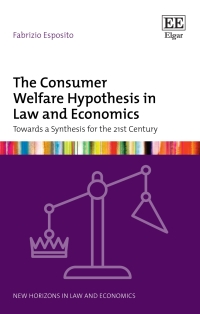
The consumer welfare hypothesis in law and economics : towards a synthesis for the 21st century 이용현황 표 - 등록번호, 청구기호, 권별정보, 자료실, 이용여부로 구성 되어있습니다.