
 대표어
대표어
 https://openknowledge.worldbank.org/entities/publication/3a99a4d6-76b5-4c2a-8a57-a4019d090157


권호기사보기
| 기사명 | 저자명 | 페이지 | 원문 | 기사목차 |
|---|
결과 내 검색
동의어 포함
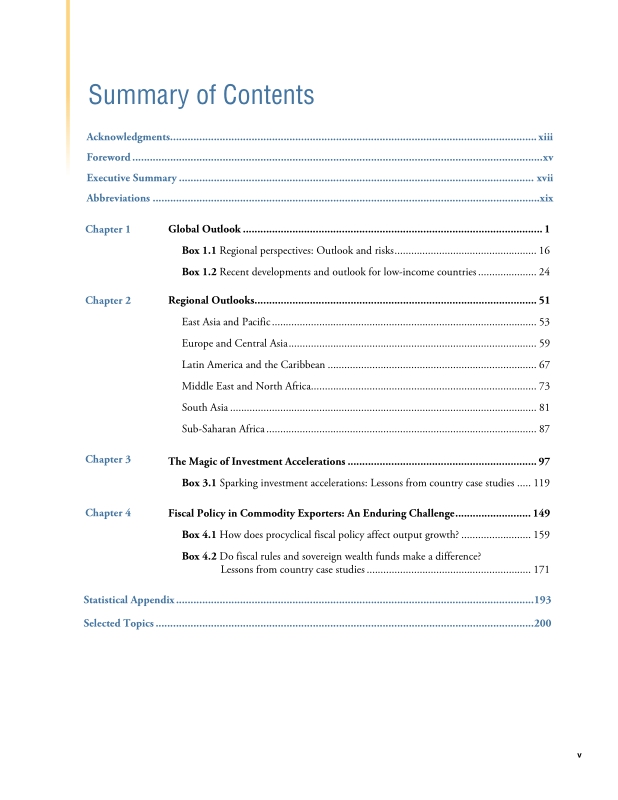
Title page
Contents
Acknowledgments 12
Foreword 13
Executive Summary 15
Abbreviations 17
CHAPTER 1. GLOBAL OUTLOOK 18
Summary 19
Global context 24
Global trade 25
Commodity markets 26
Global inflation 27
Global financial developments 28
Major economies: Recent developments and outlook 29
Advanced economies 29
China 31
Emerging market and developing economies 31
Recent developments 36
EMDE outlook 36
LICs outlook 39
Per capita income growth 39
Global outlook and risks 39
Summary of global outlook 39
Risks to the outlook 45
Policy challenges 52
Key global challenges 52
Challenges in emerging market and developing economies 55
References 61
CHAPTER 2. REGIONAL OUTLOOKS 67
East Asia and Pacific 68
Recent developments 68
Outlook 69
Risks 71
Europe and Central Asia 74
Recent developments 74
Outlook 75
Risks 77
Latin America and the Caribbean 81
Recent developments 81
Outlook 81
Risks 84
Middle East and North Africa 87
Recent developments 87
Outlook 88
Risks 90
South Asia 94
Recent developments 94
Outlook 95
Risks 97
Sub-Saharan Africa 100
Recent developments 100
Outlook 101
Risks 103
References 107
CHAPTER 3. THE MAGIC OF INVESTMENT ACCELERATIONS 109
Introduction 110
Contributions 111
Main findings 112
Database and identification methodology 113
Database 113
Identification methodology 113
Features of investment accelerations 114
Number of accelerations 114
Distribution of accelerations over time and across countries 114
Amplitude and duration of accelerations 115
Correlates of investment accelerations 116
Output growth and its underlying channels 116
Other macroeconomic and financial correlates 118
Development outcomes 121
Drivers of investment accelerations 121
Initial conditions 122
Macroeconomic policies and structural reforms 123
Institutional quality 124
Robustness 124
Policies to start investment accelerations 125
Fiscal and monetary policies 125
Structural policies 126
Institutional quality 127
Interventions at the micro level 128
Designing a policy package 128
Conclusion 129
ANNEX 3.1. Identification of investment accelerations 143
ANNEX 3.2. Methodological annex 146
ANNEX 3.3. Investment accelerations using different filtering algorithms 149
ANNEX 3.4. Robustness exercises 150
References 153
CHAPTER 4. FISCAL POLICY IN COMMODITY EXPORTERS: An Enduring Challenge 159
Introduction 160
Fiscal policy procyclicality 163
Conceptual definitions 163
Determinants of fiscal procyclicality 165
Fiscal policy volatility 171
Conceptual definitions 171
Basic features of fiscal policy volatility 171
Determinants of fiscal volatility 173
Implications of fiscal policy volatility for growth 174
Links between procyclicality and volatility 175
Fiscal institutions and frameworks 176
Fiscal rules 176
Sovereign wealth funds 177
Medium-term expenditure frameworks 177
Institutional quality and governance 178
Conclusions 179
ANNEX 4.1. Determinants of fiscal procyclicality 188
ANNEX 4.2. Linkages between fiscal policy volatility and economic growth 190
ANNEX 4.3. Additional tables 193
References 196
STATISTICAL APPENDIX 202
Data and Forecast Conventions 207
Selected Topics 208
FIGURE 1.1. Global economic prospects 21
FIGURE 1.2. Global economic prospects (continued) 23
FIGURE 1.3. Global trade 25
FIGURE 1.4. Commodity markets 26
FIGURE 1.5. Global inflation 27
FIGURE 1.6. Global financial developments 28
FIGURE 1.7. Major economies: Recent developments and outlook 30
FIGURE 1.8. Recent developments in emerging market and developing economies 37
FIGURE 1.9. Outlook in emerging market and developing economies 38
FIGURE 1.10. Per capita income growth 45
FIGURE 1.11. Global outlook 46
FIGURE 1.12. Risks to the outlook 47
FIGURE 1.13. Risks to the outlook (continued) 48
FIGURE 1.14. Growth outcomes under alternative scenarios 51
FIGURE 1.15. Global policy challenges 53
FIGURE 1.16. EMDE monetary policy challenges 54
FIGURE 1.17. EMDE fiscal policy challenges 56
FIGURE 1.18. EMDE structural policy challenges 58
FIGURE 2.1.1. China: Recent developments 69
FIGURE 2.1.2. EAP excluding China: Recent developments 70
FIGURE 2.1.3. EAP: Outlook 71
FIGURE 2.1.4. EAP: Risks 72
FIGURE 2.2.1. ECA: Recent developments 75
FIGURE 2.2.2. ECA: Outlook 76
FIGURE 2.2.3. ECA: Risks 78
FIGURE 2.3.1. LAC: Recent developments 82
FIGURE 2.3.2. LAC: Outlook 83
FIGURE 2.3.3. LAC: Risks 84
FIGURE 2.4.1. MNA: Recent developments 88
FIGURE 2.4.2. MNA: Outlook 89
FIGURE 2.4.3. MNA: Risks 90
FIGURE 2.5.1. SAR: Recent developments 95
FIGURE 2.5.2. SAR: Outlook 96
FIGURE 2.5.3. SAR: Risks 98
FIGURE 2.6.1. SSA: Recent developments 101
FIGURE 2.6.2. SSA: Outlook 102
FIGURE 2.6.3. SSA: Risks 104
FIGURE 3.1. Evolution of investment growth 111
FIGURE 3.2. Frequency of investment accelerations 115
FIGURE 3.3. Investment growth during accelerations 116
FIGURE 3.4. Public versus private investment during investment accelerations 117
FIGURE 3.5. Growth of output during investment accelerations 118
FIGURE 3.6. Contributions to GDP growth during investment accelerations 119
FIGURE 3.7. Total factor productivity growth, employment growth, and sectoral shifts around investment accelerations 120
FIGURE 3.8. Macroeconomic indicators around investment accelerations 121
FIGURE 3.9. Development outcomes during investment accelerations 122
FIGURE 3.10. Initial conditions and the start of investment accelerations 123
FIGURE 3.11. Policy improvements and the start of investment accelerations 124
FIGURE 3.12. Enabling factors for investment accelerations 125
FIGURE 3.13. Policy packages and potential growth 128
FIGURE 4.1. Commodities: Price volatility and importance for exports and revenues 161
FIGURE 4.2. Procyclicality of government expenditures 164
FIGURE 4.3. Fiscal procyclicality and macroeconomic factors in commodity exporters 165
FIGURE 4.4. Fiscal procyclicality, fiscal rules, and institutional factors 167
FIGURE 4.5. Fiscal policy volatility 172
FIGURE 4.6. Exchange rate regimes and capital account openness 174
FIGURE 4.7. Fiscal policy volatility and procyclicality 175
FIGURE 4.8. Fiscal volatility, growth, and fiscal frameworks 176
Boxes
BOX 1.1. Regional perspectives: Outlook and risks 32
BOX 1.2. Recent developments and outlook for low-income countries 40
BOX 3.1. Sparking investment accelerations: Lessons from country case studies 130
BOX 4.1. How does procyclical fiscal policy affect output growth? 168
BOX 4.2. Do fiscal rules and sovereign wealth funds make a difference? Lessons from country case studies 180
Box Tables
TABLE B1.2.1. Low-income country forecasts 43
TABLE B3.1.1. Investment and output growth during and outside investment accelerations 140
TABLE B3.1.2. Economic indicators during and outside investment accelerations 140
TABLE B3.1.3. Policy changes and reforms during investment accelerations 141
Box Figures
FIGURE B1.1.1. Regional outlooks 33
FIGURE B1.1.2. Regional risks 34
FIGURE B1.2.1. LICs: Recent developments 41
FIGURE B1.2.2. LICs: Outlook and risks 42
FIGURE B3.1.1. Investment accelerations in the Republic of Korea and Malaysia 131
FIGURE B3.1.2. Investment accelerations in Poland and Türkiye 133
FIGURE B3.1.3. Investment accelerations in Colombia and Uruguay 135
FIGURE B3.1.4. Investment accelerations in Chile and Morocco 137
FIGURE B3.1.5. Investment accelerations in India and Uganda 138
FIGURE B4.1.1. The amplification effect of procyclical fiscal policy on output 169
FIGURE B4.2.1. Fiscal rules, fiscal expenditures, and SWFs in commodity exporters 181
FIGURE B4.2.2. Fiscal expenditures and SWFs in Chile, Botswana, and Timor-Leste 183
FIGURE B4.2.3. Institutional quality and fiscal procyclicality 185
Annex Tables
TABLE A3.1.1. Investment accelerations: Distribution over country groups 144
TABLE A3.1.2. List of investment accelerations in EMDEs 145
TABLE A3.2.1. Institutional quality and initial conditions as drivers of the likelihood of investment accelerations 147
TABLE A3.2.2. Institutional quality and policies as drivers of the likelihood of investment accelerations 148
TABLE A3.3.1. Investment accelerations using different filtering algorithms 149
TABLE A3.4.1. Investment accelerations using different duration parameters 150
TABLE A3.4.2. Investment accelerations using different duration and growth parameters 151
TABLE A3.4.3. Baseline regressions with additional controls 152
TABLE A3.4.4. Baseline regressions based on investment growth (not in per capita terms) 153
TABLE A4.1.1. Drivers of fiscal procyclicality 189
TABLE A4.1.2. Institutional drivers of fiscal procyclicality 189
TABLE A4.1.3. Output growth and commodity prices 189
TABLE A4.1.4. Government spending and commodity prices 190
TABLE A4.2.1. Determinants of fiscal policy volatility: Cross-sectional regressions 191
TABLE A4.2.2. Determinants of fiscal policy volatility; by type of commodity 192
TABLE A4.2.3. Effects of fiscal policy volatility on GDP per capita growth 192
TABLE A4.3.1. List of economies for analysis of fiscal procyclicality and volatility 193
TABLE A4.3.2. Variables for analysis of fiscal procyclicality 194
TABLE A4.3.3. Variables for analysis of fiscal policy volatility 195

*표시는 필수 입력사항입니다.
| 전화번호 |
|---|
| 기사명 | 저자명 | 페이지 | 원문 | 기사목차 |
|---|
| 번호 | 발행일자 | 권호명 | 제본정보 | 자료실 | 원문 | 신청 페이지 |
|---|
도서위치안내: / 서가번호:

우편복사 목록담기를 완료하였습니다.
*표시는 필수 입력사항입니다.
저장 되었습니다.
