
 대표어
대표어
권호기사보기
| 기사명 | 저자명 | 페이지 | 원문 | 기사목차 |
|---|
결과 내 검색
동의어 포함
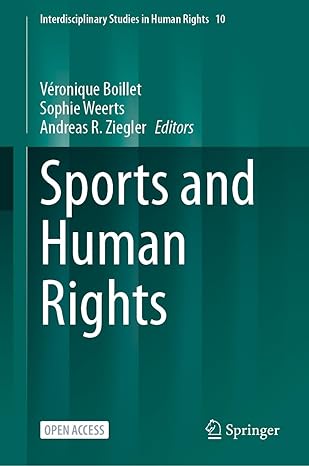
Based on a series of themes and case studies, this book aims to illustrate the impact of sports policies and practices on individuals and their identities, and to analyze the potential solutions offered by International human rights law (IHRL) for these infringements. It bridges the gap between IHRL and sports studies, and will be useful to scholars in both fields, especially those unfamiliar with each other’s work.
Furthermore, by investigating the context of sport and its governance, this collection offers a series of valuable insights, enabling the development of an interpretation of ‘law in context’ for legal scholars in the field of human rights. As the governance and regulation of sport are seen as illustrations of other forms of normativity, this book also contributes to the conversation about the transnational dimension of law and legal orders.
In this respect, it illustrates that normative autonomy in the field of sport, associated with the idea of lex sportiva, tends to be relative regarding IHRL. The sporting environment is not disconnected from major contemporary social issues: it constitutes a public space in which injustices can be denounced, but also the theater in which prejudices are perpetuated against various parties, such as athletes or workers. IHRL commonly addresses attacks on individual dignity and social justice issues by guaranteeing rights to individuals and offering them protection mechanisms. In this context, can IHRL solve the problems encountered in the sporting environment? This is the question that animates this volume. This is an open access book.
| 등록번호 | 청구기호 | 권별정보 | 자료실 | 이용여부 |
|---|---|---|---|---|
| 0003170378 | LM 344.099 -A25-2 | 서울관 법률정보센터(206호) | 북큐레이션 (자료실내 이용) |

Based on a series of themes and case studies, this book aims to illustrate the impact of sports policies and practices on individuals and their identities, and to analyze the potential solutions offered by International human rights law (IHRL) for these infringements. It bridges the gap between IHRL and sports studies, and will be useful to scholars in both fields, especially those unfamiliar with each other's work. Furthermore, by investigating the context of sport and its governance, this collection offers a series of valuable insights, enabling the development of an interpretation of 'law in context' for legal scholars in the field of human rights. As the governance and regulation of sport are seen as illustrations of other forms of normativity, this book also contributes to the conversation about the transnational dimension of law and legal orders. In this respect, it illustrates that normative autonomy in the field of sport, associated with the idea of lex sportiva, tends to be relative regarding IHRL. The sporting environment is not disconnected from major contemporary social issues: it constitutes a public space in which injustices can be denounced, but also the theater in which prejudices are perpetuated against various parties, such as athletes or workers. IHRL commonly addresses attacks on individual dignity and social justice issues by guaranteeing rights to individuals and offering them protection mechanisms. In this context, can IHRL solve the problems encountered in the sporting environment? This is the question that animates this volume. This is an open access book.
*표시는 필수 입력사항입니다.
| 전화번호 |
|---|
| 기사명 | 저자명 | 페이지 | 원문 | 기사목차 |
|---|
| 번호 | 발행일자 | 권호명 | 제본정보 | 자료실 | 원문 | 신청 페이지 |
|---|
도서위치안내: 법률정보센터(206호) / 서가번호: 5

우편복사 목록담기를 완료하였습니다.
*표시는 필수 입력사항입니다.
저장 되었습니다.
