본문 바로가기 주메뉴 바로가기
국회도서관 홈으로 정보검색 소장정보 검색

결과 내 검색

동의어 포함

목차보기


Preface
Abbreviations
Table of cases
Table of statutes
Table of statutory instruments
1 Introduction to family law
What is family law?
Rights and obligations
Evolving definitions of the family
Excluded relationships
Challenges to family law
Divorce
Financial matters
Domestic abuse
Children
Child protection
The international family
Human rights
International conventions
Challenges to the operation of family justice
Judging judges and justice
Accountability
The Future and the new Labour government
Organisation of the text
2 State intervention in personal relationships
Form v function
Which relationships should be recognised?
A dual approach
Civil partnerships and same-sex marriage
Engagement to marry or enter into a civil partnership
Relationships exempt from legal intervention
Definitions and formation of relationships
Engagement
Agreements to enter into a civil partnership
Marriage
History and background to marriage
The right to marry
Capacity to marry
Age
Prohibited degrees of relationship
Already married or in a registered civil partnership
Mental capacity
Formalities of marriage
Civil ceremonies
Preliminary requirements
The marriage ceremony
Religious ceremonies
Marriage in the Anglican Church
The marriage ceremony
Quaker and Jewish marriages
Other religious marriages
Marriages of the sick, the housebound or prisoners
Informal marriage
The concept of common law marriage has no validity
Presumption of marriage by cohabitation and repute
Non-qualifying marriages (also referred to as non-marriages) and void marriages
Civil partners
Capacity to register a civil partnership (CPA 2004, ss 3, 4)
Age
Already a civil partner or married
Mental capacity
Formalities of civil partnership
Cohabitation
Self-test questions
3 Nullity and its consequences
Nullity: an important concept
Void or voidable relationships
Void relationships
Overseas marriages
Marriage by cohabitation and repute
Forced marriages
Mistake
Sham marriages
Unsound mind
Or otherwise
Bars to relief where a marriage is voidable
Knowledge of the petitioner and injustice to the respondent
Delay
Grounds on which a civil partnership will be voidable
Bars to relief where a civil partnership is voidable knowledge of the applicant and injustice to the respondent
Delay
Consequences of ity for married couples and civil partners
Relationship status
Revocation of wills
Financial orders
Religious decrees of ity
Self-test questions
4 Acquisition and protection of rights in the family home
The family home: an overview
Problems of home ownership
The Law Commission proposals – home sharing
Cohabitants and the family home
Sharing the family home
Background
Buying a house: legal ownership
Buying a house: the equitable title
Joint tenancy
Tenants in common
Informal trusts
There are two types of informal trust also referred to as implied trusts: the constructive trust and the resulting trust
Resulting trusts
The presumption of advancement
Gifts or loans or monies attributable to some other motive
Constructive trusts
Agreements to share the property where the property is in the sole name of one of the partners or family member
A more familial approach to agreements
Detrimental reliance
Financial detriment
Non-financial detriment
Quantification of the beneficial interest
The move to pragmatism
Property purchased in joint names – the high point of pragmatism in the quantification of beneficial interests – Stack v Dowden (2007); Jones v Kernott (2011)
Proprietary estoppel
Nature of the representation
Explicit representations
Implied representations
Detriment
Reliance
Wide range of remedies
Fee simple
An estoppel licence
Compensation
A problematic remedy
Matrimonial Proceedings and Property Act 1970, s 37
Civil Partnership Act 2004, s 65
The Law Reform (Miscellaneous Provisions) Act 1970, ss 2, 3; Civil Partnership Act 2004, s 74(5)
Family Law Act 1996, Part IV
Statutory right of occupation for spouses and civil partners
The family home
Effect of the statutory right on third parties
Potential for manipulation
Trusts of Land and the Appointment of Trustees Act 1996; rights of beneficiaries, creditors and the effect of bankruptcy
Beneficiaries
Creditors and bankruptcy
Exceptional circumstances
Self-test questions
5 Protecting adults from domestic abuse – the civil remedies
Contemporary definitions and very public cases
Domestic abuse may also include sexual abuse
Domestic abuse is also a pattern of abuse
History: challenging the common law
Legal landmarks
1970s reform measures
Explanations of domestic abuse
Post 1970s – feminist jurisprudential challenges
Domestic abuse incidence and the criminal law
Assault and coercive control
Protection from Harassment Act 1997
Civil remedies for domestic violence and abuse
Family Law Act 1996, Part IV ss 33–41, 43–49: occupation rights
Entitled persons
Types of occupation orders for entitled persons
Exercise of the court’s discretion for entitled persons – the harm test
Duration of occupation orders for entitled persons
Non-entitled persons
Exercise of the court’s discretion for former spouses or civil partners
Exercise of the court’s discretion for cohabitants and former cohabitants
Circumstances where neither of the spouses, civil partners, former spouses, former civil partners or cohabitants have rights to occupy the property
Enforcement of occupation orders for both entitled and non-entitled persons
Number of occupation and non-molestation order applications and orders granted
Family Law Act 1996, Part IV: ss 42–42A, 43–49: non-molestation orders
What constitutes non-molestation?
Who may apply?
The court’s discretion
Enforcement
Undertakings
Ex parte orders (without notice) occupation and non-molestation s 45(1)
Return hearings
Other forms of abuse and legal protections
Forced marriage
The Forced Marriage (Civil Protection) Act 2007
Dowry abuse
Female genital mutilation protection orders
Domestic violence/abuse protection orders and domestic violence/abuse protection notices
More protection needed: closing remarks
Self-test questions
6 Ending relationships
Divorce
Statistical evidence of divorce
Reasons for divorce and its consequences
Background to divorce
Matrimonial Causes Act 1973
The five facts under the MCA 1973, s 1(2)
The five facts
Adultery and intolerability (MCA 1973, s 1(2)(a))
Definition of adultery
Intolerability
Behaviour (MCA 1973, s 1(2)(b))
Continuing cohabitation
Desertion (MCA 1973, s 1(2)(c))
Resumption of cohabitation
Two years living apart and consent to the decree (MCA 1973, s 1(2)(d))
Resumption of cohabitation
Five years living apart (MCA 1973, s 1(2)(e))
The defence of grave hardship (MCA 1973, s 5)
No divorce proceedings within a year of marriage
A two-part process
The new procedure
Divorce under the Divorce, Dissolution and Separation Act 2020
Divorce based on irretrievable breakdown of marriage
Proof of irretrievable breakdown
Procedure for divorce
Critique of the law leading to the Divorce, Dissolution and Separation Act 2020
The road to reform
Family Law Act 1996
Family Justice Review 2011
The Government’s response
Problems with the law of the MCA 1973
Alternative divorce models
Judicial separation
Grounds for the decree
Effect of a judicial separation order
Civil partnerships
Dissolution (CPA 2004)
Divorce in the religious courts
Consequences of divorce
Self-test questions
7 Financial consequences of relationships
Part I ownership of personal property and rights to maintenance during a relationship
Personal property
Trusts
Express trusts
Informal trusts
Rights to maintenance during the relationship
The abolition of a wife’s right to be maintained at common law
Contracts for maintenance
Statutory rights to maintenance
Matrimonial Causes Act 1973, s 27, Civil Partnership Act 2004, Sch 5, Part 9
Domestic Proceedings and Magistrates’ Courts Act 1978
The court’s discretion
Conduct
Part II financial consequences of ending the relationship
A general overview
Reaching a financial settlement under the Matrimonial Causes Act 1973 (as amended by later legislation)
Step one
Step two
Step three
Step four
Orders available to the court
Financial awards
Variation of periodical payments
Transfer of property
Mesher orders
Martin orders
Leave to appeal
Looking afresh
A lack of overall guiding objective
Judicial intervention
Guidance from case law
A return to the statutory guidelines
Attempts to marry the guidelines with the principle of fairness
‘Non-relationship assets’
Post-separation assets
Increase in earning capacity
Reform of the guidelines
Potential reform for the award of financial remedies
Relationship or pre-nuptial agreements
Problematic nature of agreements
The Law Commission – Matrimonial Property, Needs and Agreements Project
Judicial approaches to agreements
Agreements made on relationship breakdown
Pre-nuptial or pre-civil partnership agreements
The dissent in Radmacher
The aftermath of Radmacher
Cohabitants
The current debate
Contract
Indirect maintenance
Fiancées and prospective civil partners
Self-test questions
8 The elderly, their rights in family life and death and its consequences
Mental capacity amongst older people
The four different ways under the Mental Capacity Act 2005 that a substitute decision can be made on another’s behalf
a)Advance decisions or ‘living wills’
b)Lasting powers of attorney
c)Deputies
d) The court
Social care of the elderly
On whom should the burden of care fall?
Adult children
Abuse of the elderly
Addressing elder abuse
The impact of death on family life
Presumption of death
Common law
The Presumption of Death Act 2013
Funeral arrangements
Rights and duties to deal with the deceased’s body
Testate succession
Intestate succession: Administration of Estates Act 1925, s 46
Bona vacantia
The Inheritance (Provision for Family and Dependants) Act 1975 – applications for financial maintenance
Time bar
Applicants
Living together in the same household as if a spouse or civil partner
Proof of maintenance (s 1(3))
Assumption of responsibility (s 3(3)(4))
Reasonable financial provision
Applications by adult children
Family life after death
Re the Cremated Remains of AA [2018] ECC 7
Self-test questions
9 Family life – parents and carers: from parental rights to responsibilities
Parenting histories – the exclusive father
The biological father’s rights are ‘sacred’
Demise of paternal authority and rise of parental responsibility
Iterating the meaning of ‘in the custody of the parent’ – Hewer
Deciding in favour of non-biological over natural parents – J v C
Mothers over fathers – Re K
Kidnapping and child abduction – R v D
Today – who is a parent in fact?
The unfit parent
Genetic – biological parents and the natural parent presumption
Biological heterosexual family
Statutory exceptions to the natural parent presumption
Gestational – parentage
Reproductive technology and the legal parent
Transgender parentage and IVF
Three parents
Reproductive technology reform
Surrogacy
Surrogacy – international arrangements
Social and psychological parentage – the importance of attachment
Sexual orientation and parentage, gender reassignment and parentage
The limits of language
The transgender father
Legal parents and parental responsibility
‘Parental responsibility’ and its responsibilities
Responsibility to care for the child
Responsibility to ensure the child’s education
Responsibility for the child’s religion – now of little relevance
Responsibility to protect the child and not to inflict punishment or physical discipline
Responsibility to consent to medical treatment of

이용현황보기

Contemporary family law : principles and practice 이용현황 표 - 등록번호, 청구기호, 권별정보, 자료실, 이용여부로 구성 되어있습니다.
등록번호 청구기호 권별정보 자료실 이용여부
0003199493 LM 346.015 -A25-4 서울관 법률정보센터(206호) 이용가능

출판사 책소개

알라딘제공

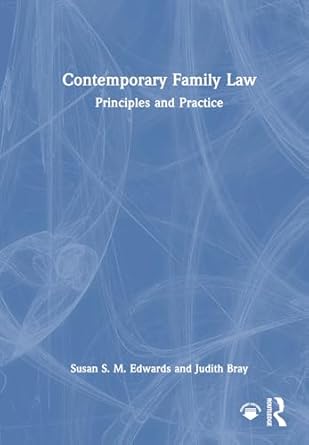
Taking a fresh and modern approach, Contemporary Family Law: Principles and Practice gives students all the information they need to develop a clear understanding of this fascinating area of the law. Covering the very latest developments in family law, each chapter uses contemporary cases as a window to introducing core legal concepts, principles and developments, emphasising the dynamism and evolving nature of family law, in which practitioners, campaigners, law reformers and students all play their part.

Key features include:

? Developments in family law are considered not only from a vantage point of judicial decision making, but also from the perspective of the contribution made by solicitors, barristers and experts. This encourages students to develop a sense of their own potential agency when as future practitioners they represent their clients and engage in law reform;

? In considering legal argument and case determination, the book places equality front and centre, including access to justice;

? Each chapter provides further reading with online links and URLs and a set of self-test questions, including problem scenarios and discursive essay questions. Each form of assessment reflects the levels of educational attainment and mirrors testing techniques relevant to academic examination and legal professional and vocational practice courses.

This uniquely contemporary textbook will be essential reading for all students of family law.


Taking a fresh and modern approach, Contemporary Family Law?gives students all the information they need to develop a clear understanding of the very latest developments in family law. Each chapter uses contemporary cases as a window to introducing core legal concepts, principles and developments.


