List of Contributors Introduction I. Marriage and Civil Partnership II. Divorce III. Cohabitation IV. Children V. Becoming a Parent VI. What is a Family, what is Family Law? VII. Outline of the Collection 1. A Review of Children's Rights when Parents Live Apart I. Introduction II. What Does the UNCRC Provide? III. Reforming the Children Act IV. The Welfare Principle V. Parental Responsibility VI. Parental Involvement VII. Separate Representation for Children VIII. Conclusion Response by Helen Stalford 2. Legal Parenthood and Birth Registration: Time to Respond to Diversity in Family Formation? I. Introduction II. The Personal, Political and Cultural Significance of Birth Registration III. Social and Scientific Change and the Birth-Registration System IV. Exploring the Possible Deficiencies of the Core Principles of Birth Registration V. Should the Core Principles Underpinning Birth Registration be Expanded? VI. A New Birth Registration System VII. Conclusion Response by Julie McCandless 3. Reform of the Legal Framework for Origin Information in Assisted Reproduction I. Introduction II. Origin Information in Assisted Reproduction III. Children's Rights and Origin Information IV. The Current Law V. Proposals for Reform VI. Novel Reproductive Technologies VII. Conclusion Response by Kirsty Horsey 4. Grandparents and Kinship Carers Act or Granny 'Annex'? Waiting for the Government I. Introduction II. The Twenty-First-Century Shift in Family Patterns: The Increasing Role of Grandparents in Childr III. Consensus on the Need to Protect Children's Relationships with their Grandparents IV. The Proposal: A Holistic Approach to Reform through Minor Changes to the Children Act 1989 V. Conclusion Appendix: Grandparents and Kinship Carers Bill Response by Felicity Kaganas 5. The Case for a Legal Support for Children Bill, to Swiftly Reinstate Legal Aid for those at Risk I. Introduction II. The Issue: Eligibility for Legal Aid and the Complex Relationship between Public and Private Chi III. The Background IV. The Way Ahead from Desirability to Feasibility: The Potential Impact of Emerging Evidence V. How are the Cross-over Cases Becoming More Visible to Practitioners and Researchers? VI. What Might We Expect in the Future? VII. Conclusion: An Example Response by Mandeep Dyal 6. A New Law of Family Property I. Introduction II. The Need for Reform III. A New Law of Family Property IV. Family Property and the Law Commission V. Bringing the Bill into the Twenty-First Century VI. Conclusion Appendix: Relationship Property Bill Response by Alison Diduck 7. Reform of Financial Provision on Divorce I. Introduction II. Why Reform? III. What Happens in Practice? IV. A Better Model V. The Solution: A New Basis VI. Conclusion Response by Sir Nicholas Mostyn 8. The Adult Intimate Relationships Bill I. Introduction II. The Current Law III. A Way Ahead IV. Conclusion Response by Simran Kalra 9. Cohabitation Reform in England and Wales: Time for Action I. Introduction II. Making the Case for Cohabitation Reform in England and Wales III. The Reform Proposal and Justification IV. Securing Reform V. Conclusion Response by Rob George 10. Nullity Reform: Redefining Marriage I. Introduction II. The Context of Nullity III. Void Marriages IV. Voidable Marriage V. Suggested Amendments to Legislation VI. Conclusion Response by Gillian Black Conclusion I. The Importance of Family Reform II. The Role of Practitioners to Reform III. Taking Inspiration from Innovators IV. Current Conversations V. A Case Study: 'No Fault Divorce' VI. Conclusion Index
이용현황보기
Family law reform now : proposals and critique 이용현황 표 - 등록번호, 청구기호, 권별정보, 자료실, 이용여부로 구성 되어있습니다.
등록번호
청구기호
권별정보
자료실
이용여부
0003198210
LM 346.42015 -A25-1
서울관 법률정보센터(206호)
북큐레이션 (자료실내 이용)
출판사 책소개
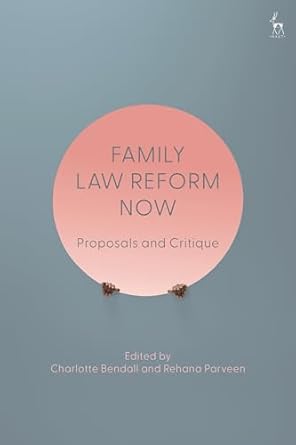
This collection provides a snapshot of big ideas in family law reform.
The book asks: if you could change one part of family law, what would it be? This deceptively simple question is answered by 10 family law experts and debated within the volume by expert respondents.
The book puts the proposal first, forcing authors (and their respondents) to critically engage with what family law should look like, and where the development of law is needed to address the changing landscape of family life. Cultural and religious plurality, the use of technology, and changes in societal attitudes have all had an impact on the continuing evolution of families. As a consequence, the law has some complex challenges to address in its attempt to regulate familial diversity.
This book is an invaluable resource for scholars of family law, practitioners, policymakers, or anyone more broadly interested in family law reform, and serves as a companion to Hart Publishing's landmark Criminal Law Reform Now.

 대표어
대표어