1 Introduction to the Research Handbook on Health, AI and the Law: a framework for health, AI and the law 1 Barry Solaiman and I. Glenn Cohen
PART I THE USES OF AI IN HEALTH 2 AI in hospital administration and management: ethical and legal implications 21 Abeer Malik and Barry Solaiman 3 Facial recognition AI technology in healthcare and the law 41 Vera Lúcia Raposo 4 Cybersecurity of AI medical devices: risks, legislation, and challenges 57 Elisabetta Biasin, Erik Kamenjašević and Kaspar Rosager Ludvigsen 5 Regulating smart healthcare robots: the European approach 75 Tom Goffin and Sofia Palmieri
PART II THE LEGAL CONSIDERATIONS OF AI IN HEALTH 6 Algorithmic discrimination and health equity 93 Jessica L. Roberts and Peter Salib 7 AI and data protection law in health 111 Craig Konnoth 8 The legal considerations of AI-blockchain for securing health data 130 Barry Solaiman and Georgios Dimitropoulos 9 Liability for use of artificial intelligence in medicine 150 W. Nicholson Price II, Sara Gerke and I. Glenn Cohen 10 Artificial intelligence and the law of informed consent 168 I. Glenn Cohen and Andrew Slottje 11 Artificial intelligence and intellectual property in healthcare technologies 184 Charlotte A. Tschider and Cynthia M. Ho
PART III THE ETHICAL PERSPECTIVES OF AI IN HEALTH 12 Idealism, realism, pragmatism: three modes of theorising within secular AI ethics 203 Rune Nyrup and Beba Cibralic 13 AI, medicine and Christian ethics 219 Zachary R. Calo 14 Islamic ethico-legal perspectives on medical accountability in the age of artificial intelligence 234 Mohammed Ghaly
PART IV THE LEGAL GOVERNANCE OF AI AROUND THE WORLD 15 International organisations and the global governance of AI in health 255 Sara Kijewski, Elettra Ronchi and Effy Vayena 16 US regulation of medical artificial intelligence and machine learning (AI/ML) research and development 272 Vasiliki Rahimzadeh 17 The state and values of AI governance in UK healthcare 290 Colm Peter McGrath 18 Governing AI in the European Union: emerging infrastructures and regulatory ecosystems in health 309 Timo Minssen, Barry Solaiman, Lea Köttering, Jakob Wested and Abeer Malik 19 Regulating AI in health in the Middle East: case studies from Qatar, Saudi Arabia and the United Arab Emirates 329 Barry Solaiman, Ayesha Bashir and Fama Dieng 20 Convergence in the regulation of artificial intelligence software as medical device in the Guangdong–Hong Kong–Macao Greater Bay Area of China 351 Calvin Wai Loon Ho 21 Legal governance of artificial intelligence in healthcare devices and services in Singapore 369 Warren B. Chik and Haran Sugumaran 22 Regulating artificial intelligence in medical care in South Korea 388 Won Bok Lee
Index
이용현황보기
Research handbook on health, AI and the law 이용현황 표 - 등록번호, 청구기호, 권별정보, 자료실, 이용여부로 구성 되어있습니다.
등록번호
청구기호
권별정보
자료실
이용여부
0003215793
610.28563 -A25-7
서울관 인문자연과학자료실(314호)
이용가능
출판사 책소개
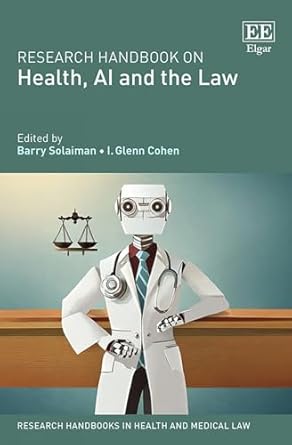
The Research Handbook on Health, AI and the Law explores the use of AI in healthcare, identifying the important laws and ethical issues that arise from its use. Adopting an international approach, it analyses the varying responses of multiple jurisdictions to the use of AI and examines the influence of major religious and secular ethical traditions.
Bringing together a diverse range of carefully selected legal experts, the Research Handbook critically assesses the different uses of AI in healthcare and its promise to provide greater accuracy for healthcare professionals and patients by diagnosing diseases and detecting illness earlier and helping hospitals run more efficiently. It also highlights a series of legal and ethical challenges AI raises relating to bias, privacy, data security, medical liability, informed consent and intellectual property. AI governance is rigorously examined in countries across the globe spanning Asia, Europe and the US while different responses from international organisations towards AI in healthcare are also evaluated.
This Research Handbook is a key resource for scholars and law students and for those interested in current and developing legal paradigms. Its legal and practical dimensions will also be beneficial to lawyers practising in health law and internet and technology law, policymakers and medical professionals.

 대표어
대표어