본문 바로가기 주메뉴 바로가기
국회도서관 홈으로 정보검색 소장정보 검색

결과 내 검색

동의어 포함

목차보기


1 Semiconductor Supply Chain Management 1
1.1 Supply Chains and Supply Chain Management 1
1.2 Some Existing Supply Chain Management Methods 3
1.2.1 Problems with Existing Methods 6
1.3 Semiconductor Supply Chains 7
1.3.1 Taiwan Semiconductor Supply Chains 9
1.4 Semiconductor Supply Chain Management 10
1.5 Semiconductor Supply Chain Localization 13
1.6 Organization of This Book 14
References 17
2 Localization of Semiconductor Supply Chains—Driving Forces
and Challenges 23
2.1 Supply Chain Stability and Supply Chain Localization 23
2.2 Localization of Semiconductor Supply Chains—Driving
Forces 25
2.2.1 U.S.-China Trade War 27
2.2.2 Geopolitics 28
2.2.3 COVID-19 Pandemic 31
2.2.4 Ukrainian-Russian War 33
2.2.5 Environmental Awareness 34
2.2.6 Need for Semiconductor Supply Chain Transparency 34
2.3 Challenges to Overcome in Semiconductor Supply Chain
Localization 35
2.4 Prioritizing Possible Measures to Overcome the Challenges 37
2.5 Procedure for Semiconductor Supply Chain Localization 38
2.6 Future Development of Semiconductor Supply Chain
Localization 38
2.6.1 IDM 2.0 vs. Foundry 2.0 40
References 41
3 Issues in Managing Localized Semiconductor Supply Chains 45
3.1 Supply Chain Localization 45
3.2 Facility Location Selection 47
3.2.1 Supplier and Facility Location Selection
for Traditional Supply Chains 47
3.2.2 Facility Location Selection for Localized Supply
Chains 49
3.3 Difficulties in Supply Chain Localization 51
3.3.1 Mitigating the Impact of Cultural Differences 53
3.3.2 Systemic Measures 55
3.3.3 Implication for the Practice 57
3.3.4 Making Good Use of Workers’ Domain Knowledge 58
3.3.5 Automation 62
3.4 Flexible Long-Term Localization 63
3.5 Wafer Technology Node 65
References 68
4 Qualitative and Quantitative Analysis of Semiconductor
Supply Chain Localization 73
4.1 Qualitative Analysis of Semiconductor Supply Chain
Localization 73
4.1.1 SWOT Analysis 73
4.1.2 SWOT Analysis for Semiconductor Supply Chain
Localization 75
4.1.3 Comparative Analysis 77
4.2 Quantitative Analysis of Semiconductor Supply Chain
Localization 79
4.2.1 The AHP-TOPSIS Approach 79
4.2.2 Visualizing the Evaluation Results 85
4.2.3 Implication for the Practice 87
4.2.4 Accounting for Uncertainty Using Fuzzy Logic 88
4.2.5 The FMACBETH-FVIKOR Approach 106
4.2.6 Visualizing the Evaluation Results
in FMACBETH-FVIKOR 115
4.3 Qualitative Analysis in Conjunction with Quantitative
Methods for Semiconductor Supply Chain Localization 116
4.3.1 Application of SWOT Analysis in Conjunction
with Quantitative Methods 116
4.3.2 Embedding SWOT into AHP 117
4.3.3 Application of the SWOT-AHP-TOPSIS Approach
for Semiconductor Supply Chain Localization 117
References 122
5 Rebuilding Semiconductor Manufacturing Competitiveness
and Sustainability Through Supply Chain Localization 127
5.1 Competitiveness and Influencing Factors 127
5.2 Supply Chain Competitiveness 129
5.3 Semiconductor Manufacturing Competitiveness 132
5.3.1 Qualitative Assessment Methods 133
5.3.2 Quantitative Assessment Methods: Analytic
Hierarchy Process (AHP) Method 135
5.3.3 Quantitative Assessment Methods: Fuzzy Yield
Learning Method 141
5.3.4 Competitiveness of Semiconductor Manufacturers
in Various Countries 149
5.4 Sustainability and Influencing Factors 151
5.4.1 Sustainability Versus Competitiveness 152
5.5 Competitiveness and Sustainability of Semiconductor
Manufacturing Through Supply Chain Localization 153
5.5.1 TSMC Case 153
5.5.2 Comparison Between TSMC and Samsung 154
References 157

이용현황보기

Supply chain localization in the semiconductor industry : rebuilding the competitiveness and sustainability of semiconductor manufacturers 이용현황 표 - 등록번호, 청구기호, 권별정보, 자료실, 이용여부로 구성 되어있습니다.
등록번호 청구기호 권별정보 자료실 이용여부
0003223418 338.4762138152 -A25-1 서울관 국가전략정보센터(107호) 이용중

출판사 책소개

알라딘제공

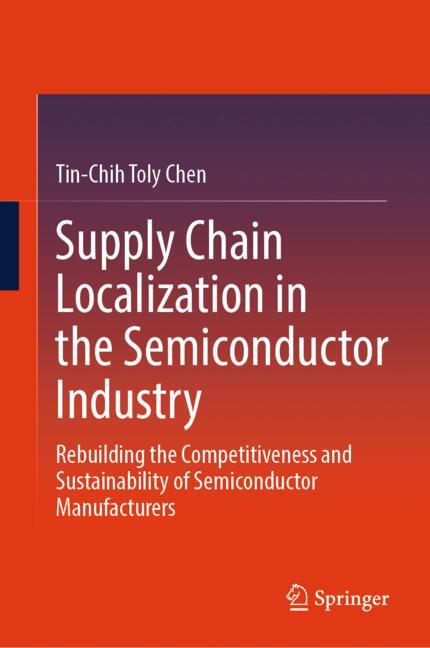
This book provides a comprehensive exploration of semiconductor supply chain localization, offering insights into the formulation of effective strategies and ways to enhance the competitiveness and sustainability of semiconductor manufacturers through supply chain localization.

The semiconductor industry is currently witnessing a significant localization wave, with a growing trend of wafer foundries relocating their production capacity closer to chip designers. This shift is primarily driven by factors such as the US-China trade war, geopolitical considerations, the impact of Covid-19, the Russia-Ukraine conflict, and the increasing importance of environmental awareness. By localizing semiconductor supply chains, companies can effectively address these challenges while also improving their competitive edge and ensuring long-term sustainability in the face of political and war risks.

However, achieving supply chain localization in the semiconductor industry is a complex endeavor, as traditional factors considered in semiconductor supply chain management may no longer be decisive. Moreover, existing research on the subject is often scattered across various journal issues and conference proceedings, necessitating a systematic integration of these findings. Furthermore, most of the available supply chain management-related books do not specifically focus on this topic. This book aims to bridge these gaps by providing a comprehensive resource that combines relevant references, real-world cases, and supporting evidence.

?


