본문 바로가기 주메뉴 바로가기
국회도서관 홈으로 정보검색 소장정보 검색

결과 내 검색

동의어 포함

목차보기


Contributors
Abbreviations
Foreword
Introduction: Sustainability in Transition
1 Sustainability and the Green Deal
2 Basic parameters: ecological sustainability as a policy and legal objective
3 Redefining the balancing exercise: ecological sustainability and sustainable development
4 The structure and findings of the inquiry
4.1 The agri-food transition
4.2 The energy transition
4.3 The ecological transition
4.4 The digital transition
4.5 The economic transition
5 Sustainability in transition: four interpretative keys
5.1 Regulatory entanglement
5.2 Resistance: the enduring relevance of sustainable development
5.3 Innovation: the penetration capacity of ecological sustainability
5.4 The significance of ecological sustainability for the Green Deal
Part 1: The Agri-Food Transition
1. Sustainability in the Agri-Food Sector: The Tortuous Path of Common Agricultural Policy Towards a Food System Approach
1 Introduction
2 «Mountains of milk and butter»: the overproduction of the first two decades of the CAP
3 Reforming the CAP in the light of sustainable development (1980-1999)
4 The need for a fairer and environmentally-sound CAP: multi-functionality, rural development and eco-conditionality
5 A further attempt for a “greener” CAP: the 2014-2020 reform
6 Assembling the pieces: channelling sustainability into the agri-food sector through a food system approach
7 The bumpy road of the EU agri-food sustainability: the new “Green” CAP
8 The tortuous path for the reform of the CAP 2021–2027
9 Enhanced subsidiarity at the service of sustainability targets: the new CAP delivery model
10 Policy strategies and sustainability objectives
11 The sustainable food system transition in the hands of Member States
12 The interrupted evolution of the CAP and the unfulfilled promises of a food system approach
2. The New Common Agricultural Policy Approach Towards the Livestock Sector and Food Waste. Lying at Which Point of the Sustainability Continuum?
1 The new CAP: understanding its relationship with the multi-faceted sustainability concept
2 Addressing the livestock sector
2.1 Animal farming and its environmental impact
2.2 Livestock regulation at the EU level – the Farm to Fork Strategy
2.3 Which sustainability approach from the new CAP?
3. Addressing food waste
3.1 Food waste and its environmental impact
3.2 Food waste regulation at the EU level: the role of the Green Deal
3.3 Which sustainability approach from the new CAP?
4. Conclusions: ecosystem sustainability is still so far away, so far I just can't see
Part 2: The Energy Transition
3. The Quest for a Sustainable Energy Transition: The Case of Bioenergy
1 Integrating ecological sustainability in the energy regulatory framework
2 Bioenergy: on the edge of two environmental crises
3 Sustainability criteria: a gradual juridification of ecological sustainability?
4 Conclusions: avoiding conflicts between transitions
4. Reshaping Administrative Proceedings and Discretion for a Fast-Forwarded Energy Transition
1 Energy transition and the issue of streamlined administrative proceedings
2 How to address administrative barriers?
3 The impacts of a fast-forwarded energy transition
3.1 False friends? Reconciling renewable energy and environmental protection
3.2 The components of the energy transition through the lens of the ongoing process of (re)definition of sustainability
3.3 Reshaping administrative discretion
4 Towards a re-articulation of public power for the achievement of climate neutrality?
5. Energy Transition and Sustainability Before Courts: The Evolution of the Case-Law of Italian Administrative Courts
1 Energy transition and sustainability before Italian courts
2 The principle of “widest distribution” of renewable energy and the other interests at stake
2.1 A traditional concept of sustainability
2.2 A new concept of sustainability? The prioritization of green energy production
2.3 Step back? The rescue of balancing
3 Conclusions
6. Powering The Smart City: Sustainable Energy In The New Smart City
1 Cities and climate change
2 Introducing the European Smart City
3 Energizing the European city: four illustrations
4 Energy Efficiency Directive: a tale of two goals
5 Covenant of mayors: the three pillars of Smart Cities
6 Horizon project: an urban sustainability blueprint
7 The general framework: REPowerEU
8 Sustainability in the Smart City
9 Conclusion
Part 3: The Ecological Transition
7. From Natura to Nature Restoration. The Ecological Objective of the Green Deal at the Legal Litmus Test
1 Which sustainability in the European Green Deal?
2 Ecological sustainability in Natura 2000
2.1 Tracing Natura's perimeter
2.2 Which room for development activities?
2.3 Old limits and unexplored potential
3 Nature Restoration Law, Europe's “best hope”
3.1 The contents: mending and strengthening
3.2 The NRL's governance
4 Conclusion
8. Nature Restoration Law: Reshaping Sustainable Development?
1 Introduction
2 Situating the Nature Restoration Law
3 The legal construction of sustainability in the Nature Restoration Law
4 Conclusions
9. Serving Sustainability Through Criminal Law: The Italian Case
1 Introduction
2 Penetrating Criminal Law
3 Environment and sustainability: two different approaches
4 Legislative choices
5 The EU criminal framework: a paradigm shift?
6 Structural tensions
Part 4 The Digital Transition
10. Data-Driven Ecosystems: Competition Law as a Way to Link Sustainability and Digitalisation
1 The liaison between sustainability and digitalisation in datadriven ecosystems
2 Facing the challenges of sustainable data-driven ecosystems: a shift towards polycentric competition law
2.1 Revised relevant market definition
2.2 The concepts of sustainability evolving from data-driven ecosystems
3 The direction of digital analytical shortcuts
4 Final considerations
11. Sustainable Smart Cities
1 Smart City and sustainability
2 A gradual move away from the technology-driven approach
3 Orienting Smart Cities towards climate neutrality
4 Green areas and infrastructures for the restoration of urban ecosystems
5 Urban sustainability after the Green Deal
Part 5: The Economic Transition
12. Towards a Green Deal-Oriented Intellectual Property Law? Tackling Remedies Against Abuses
1 Introduction
2 A Green Deal-oriented IP policy
3 IP delimiting clauses within the TRIPS Agreement
4 Implementing Article 8(2)
4.1 US: misuse and inequitable conduct
4.2 EU: stretching boundaries of good faith
5 Implementing Article 31(k)
5.1 US: the evolution of the essential facilities doctrine
5.2 EU: the pathway of the essential facilities doctrine from a procompetitive to a regulatory tool
6 How to apply IP delimiting rules within a Green Deal-oriented framework: three examples
6.1 Clean hydrogen
6.2 Lithium-ion batteries
6.3 Carbon capture, utilization and storage
7 Conclusion
13. Sustainable Finance and Biodiversity Protection
1 Introduction
2 Sustainable finance as a policy objective
3 Climate finance: reshaping the field?
4 Regulatory tools: the EU taxonomy
5 Strategic goals: the sustainable finance agenda
6 An evolving approach?
14. Corporate Governance and Sustainability: Something New Under the Sun?
1 The European Green Deal and the economic transition
2 The Finance Package and the role of corporations
3 The Corporate Sustainability Reporting Directive as an information tool
3.1 An already existing mechanism: the Non-financial Reporting Directive
3.2 Reporting now: the key role of the CSRD
3.3 Sustainability reporting: indicators and standardization
4 The connection with the Corporate Sustainability Due Diligence Directive (CS3D)
5 Sustainability and corporate governance
15. ‘Sustainable Profit’? The Green Deal Economic Transition Between Criminal Law and Corporate Social Responsibility
1 Introduction
2 The complementary system of environmental protection: unlawful and lawful ‘systemic’ corporate harm
3 A paradigmatic example of ‘sustainability law’: the criminalisation duties of the ECD
4 The CSDDD and corporate governance
5 Conclusions: supporting the transition globally?
Index

이용현황보기

Ecological sustainability and the law : the European green deal and the new frontiers of sustainability 이용현황 표 - 등록번호, 청구기호, 권별정보, 자료실, 이용여부로 구성 되어있습니다.
등록번호 청구기호 권별정보 자료실 이용여부
0003234714 LM 344.4046 -A25-1 서울관 법률정보센터(206호) 이용가능

출판사 책소개

알라딘제공

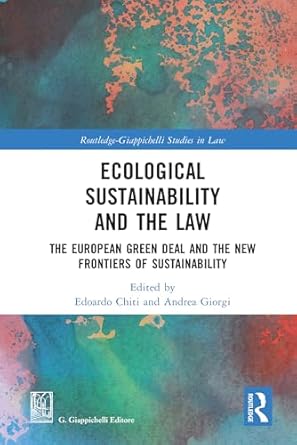
This book explores the emergence of ecological sustainability as a new EU policy and legal objective, distinct and autonomous from sustainable development. It argues that sustainability can no longer be conflated into sustainable development only, but should rather be represented as a plural construction, in which ecological sustainability coexists next to sustainable development. While the latter orientates most of the regulatory measures stemming from the Green Deal, the former is playing an increasingly relevant role in a number of legislative initiatives. The volume considers whether and how the EU legislator is exploiting the new opportunities brought forth by the redefinition of sustainability. To do so, a thematic approach is adopted and the inquiry is organized in five different parts, each devoted to one specific transition triggered by the European Green Deal. Navigating the dynamics of the many transitions occurring in the horizon of European climate neutrality, key chapters shed light on the EU regulatory schemes through which ecological sustainability is in the process of being operationalized and critically discuss their points of strength, weaknesses and underlying tensions. In doing so, they provide an overview of the legal changes occurring in areas of topical interest such as agri-food, energy, digitalization, corporate governance and intellectual property, as well as a number of insights on the relevance of ecological sustainability for the internal dynamism of the European Green Deal.?This extensive and innovative appraisal of the field will prove a stimulating read for academics, researchers and advanced students interested in the new ecological law stemming from the Green Deal, the changing features of sustainability and the relevance of the Green Deal as a regulatory project.


This book explores the emergence of ecological sustainability as a new EU policy and legal objective, distinct and autonomous from sustainable development. It?provides an overview of the legal changes occurring in topical areas such as agri-food, energy, digitalization, corporate governance and intellectual property.


