본문 바로가기 주메뉴 바로가기
국회도서관 홈으로 정보검색 소장정보 검색

결과 내 검색

동의어 포함

목차보기


Series Editors’ Preface xiii
List of Figures, Tables, and Boxes xiv
Table of Cases xvi
Table of Statutes xx
Notes on Contributors xxii
1 Introduction 1
Elizabeth Chloe Romanis, Sabrina Germain, and Jonathan Herring
Why diverse voices? 2
Some key theories and methods 4
Socio-legal approaches 14
On language 15
Synopsis 17
Bibliography 20
PART I General Principles of Health Law and Ethics
2 Ethical Principles in Health 27
Marisha Wickremsinhe
Introducing the four-principles approach 28
Critiques of the four-principles approach 35
Applying principles in practice: caring for people who use 38
heroin in hospital
Avoiding pitfalls through reflexivity 44
Summary 45
Questions for reflection 45
Recommended resources 45
Bibliography 46
3 Defining and Understanding ‘Health’ in Health Law 49
Anna Nelson
Why bother defining health at all? 49
The WHO definition of health: contested and confusing? 51
Exploring the definition of health: setting some parameters 52
The ‘binary norm’: intersex infants and gender-‘normalising’ surgery 57
The ‘menstrual norm’: pain and ‘hysterical’ women 59
The ‘white norm’: medical textbooks and systemic racism 61
Western understandings of health should not be assumed to 62
be universal
Summary 63
Questions for reflection 63
Recommended resources 64
Bibliography 64
4 Health Inequalities, Law, and Society 69
John Coggon and Beth W. Kamunge-Kpodo
What is health? 70
What are health inequalities? 72
Doesn’t a legal right to equal healthcare secure 76
health equality?
How might a diverse range of voices contribute to fairness? 83
Summary 85
Questions for reflection 85
Recommended resources 86
Bibliography 86
5 Health Disparities, Equity, and Pandemic Ethics 91
Harleen Kaur Johal and Sabrina Germain
Healthcare law and policy development 92
and implementation
Intersectionality in healthcare law and policy 94
Health disparities unmasked by COVID-19 95
The impact of COVID-19 public health measures on 96
vulnerable groups
Indirect discrimination in triage guidance 99
Critiquing utilitarian approaches to pandemic ethics 102
Future delivery of healthcare services in England 105
Summary 108
Questions for reflection 108
Recommended resources 108
Bibliography 109
6 Ethics, Health(care), and Climate Change 115
Joshua Parker
The Red Queen problem 117
Three normative questions arising from the Red 119
Queen problem
Summary 129
Questions for reflection 129
Recommended resources 129
Bibliography 130
PART II The Body of Health Law
7 Medical Negligence 135
Zoe L. Tongue, Elizabeth Chloe Romanis, and Sabrina Germain
NI IS complaints 136
The basis of negligence 138
Understanding damage 139
Standards of care in medicine 142
Risk and causation 148
Problems with litigation 149
Summary 152
Questions for reflection 153
Recommended resources 153
Bibliography 154
8 Medical Manslaughter 157
Amel Alghrani and Hannah Saad
Evolution of language and semantics in discussions of‘race’ and ‘ethnicity’ 158
Gross negligence manslaughter 159
The BAME doctor 163
Unexplored ground: why BAME doctors may be more 164
disproportionately impacted
Individualisation and blame: the wrong approach 170
Summary 172
Questions for reflection 173
Recommended resources 173
Bibliography 173
9 Consent to Treatment 177
Caterina Milo and Thana C. de Campos-Rudinsky
Gradual recognition of informed consent and its effects on 178
doctor-patient relationships
Ethics of love: moving beyond consumerism towards a more 187
holistic account of patient care
Redefining patients’ voices: going beyond (but not against) 188
autonomy and efficiency
Practical guidance to operationalising core Ethics of Love 189
elements in the context of informed consent
Summary 191
Questions for reflection 192
Recommended resources 192
Bibliography 193
10 Mental Capacity and Decision-Making 195
Beverley Clough
Introducing a disability perspective 196
Placing the MCA in context 198
The MCA through a disability lens 201
Capacity 201
Best interests 207
The CRPD as a route forward? 211
Summary 213
Questions for reflection 213
Recommended resources 213
Bibliography 214
¡1 Mental Health: Inpatient Care 217
Magdalena Furgalska
Medical model of the Mental Health Act 1983 218
Human rights-based approaches and perspectives 223
Inpatient mental healthcare: the capabilities perspective 226
Conclusion 230
Summary 231
Questions for reflection 231
Recommended resources 231
Bibliography 232
12 Confidentiality 235
Elizabeth Chloe Romanis, Jordan A. Parsons, and Naomi Jones
Confidentiality matters 236
Principles of confidentiality 237
Disclosing personal information 239
Disclosure case study: safeguarding 243
Data protection 249
Data case study: abortion-reporting requirements 250
Summary 255
Questions for reflection 255
Recommended resources 255
Bibliography 256
PART III Applied Health Law and Ethics
13 Assisted Reproduction 261
Rita D" Alton-Harrison, Philip Bremner, and Cynthia Mbugua
Ethnicity 263
Sexual orientation 266
Age 271
Summary 276
Questions for reflection 276
Recommended resources 277
Bibliography 277
14 Abortion and Contraception 281
Zoe L. Tongue Feminist ethical perspectives on abortion 282
and contraception Access to abortion and contraception in the UK 284
Contraception 289
Key issues in abortion 290
Reproductive justice 294
Summary 295
Questions for reflection 296
Recommended resources 296
Bibliography 297
15 Pregnancy and Birth Elizabeth Chloe Romanis and Zaina Mahmoud 301
Obstetric violence 302
Choice and birth 307
Controlling behaviour in pregnancy 313
Summary 315
Questions for reflection 316
Recommended resources 316
Bibliography 316
16 Capable Children s Medical Treatment Rebecca Limb 323
Consenting to medical treatment 323
Concurrent and equal powers to consent 332
Capable children’s refusals of medical treatment 335
The asymmetry between consent and refusal 338
Summary 340
Questions for reflection 341
Recommended resources 341
Bibliography 342
17 Organ Donation: Deceased Donation Aileen Editha 343
The opt-out framework: background and application 345
The law 346
Organ scarcity and ethnic minorities 349
Looking to the future 353
Summary 358
Questions for reflection 359
Recommended resources 359
Bibliography 359
18 Clinical Research Ethics 363
Zarecn Bhcekhun and Silvia Camporesi
Three foundational concepts in clinical research ethics 363
Adaptive trials: a possible solution to the problem of TM? 375
Summary 379
Questions for reflection 379
Recommended resources 380
Bibliography 380
19 Death and Dying 385
Dunja Bcgovit, Yakubu Salifu, and Sheila Payne
End-of-life issues in health law and ethics 386
Thinking beyond assisted death and withdrawing treatment 391
Summary 398
Questions for reflection 398
Recommended resources 399
Bibliography 399
Index 403

이용현황보기

Diverse voices in health law and ethics : important perspectives 이용현황 표 - 등록번호, 청구기호, 권별정보, 자료실, 이용여부로 구성 되어있습니다.
등록번호 청구기호 권별정보 자료실 이용여부
0003239571 LM 344.041 -A25-1 서울관 법률정보센터(206호) 북큐레이션
(자료실내 이용)

출판사 책소개

알라딘제공

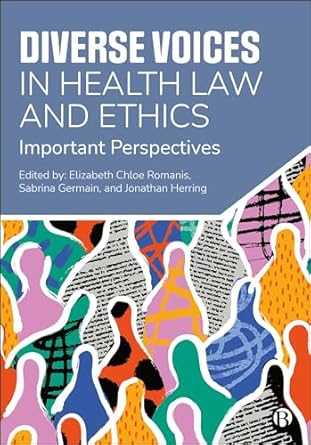
Illuminating the often-overlooked perspectives of marginalised groups, this essential textbook offers a transformative exploration of health law and ethics.

Designed as a replacement for (or complement to) foundational health law texts, the book amplifies the voices of those frequently silenced in teaching materials: racialised communities, ethnic minorities, women, disabled individuals, LGBTQI+ people and those disadvantaged by socio-economic and structural factors.

Chapters cover key topics such as abortion, medical negligence, and public health, scrutinising how traditional legal narratives can neglect the nuanced impacts on these diverse groups. Contributors challenge readers to reflect on the production and perpetuation of health inequalities, enriching the curriculum with critical viewpoints.

Teaching tools include:

- accessible summaries throughout the chapters;

- critical reflection questions at the end of each chapter for students and teachers;

- further reading lists and links to external resources..

This is an invaluable text that encourages students and academics to engage deeply with the intersections of law, health(care) and social justice. It is an indispensable companion for any health law course, fostering a more inclusive and well-rounded approach to legal and medical education and practice.


