
 대표어
대표어
 https://www.iza.org/publications/dp/16777/lets-roll-back-the-challenging-task-of-regulating-temporary-contracts
권호기사보기
| 기사명 | 저자명 | 페이지 | 원문 | 기사목차 |
|---|
결과 내 검색
동의어 포함
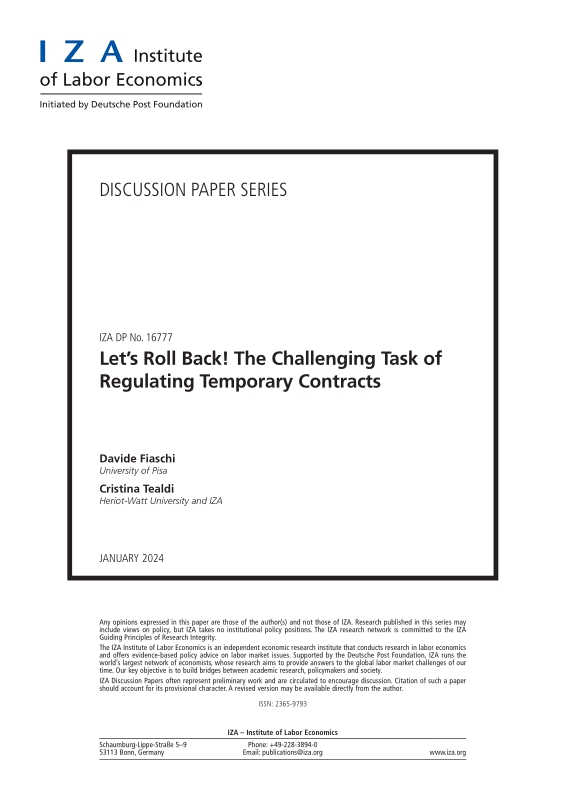
Title page
Contents
Abstract 3
1. Introduction 4
2. Methodology 5
2.1. The estimate of transitions with K states 6
2.2. The causal-ARIMA approach 7
3. The 2018 labour market reform Decreto Dignità 8
3.1. The Italian labour market 9
3.2. The content of the reform 10
3.3. The timing of the reform 10
4. Data 11
5. An empirical evaluation of Decreto Dignità 12
5.1. The casual evaluation of Decreto Dignità 12
5.2. Labour market shares 13
5.3. Transition probabilities 14
5.4. Quantifying the cumulative impact of the reform 16
5.5. Heterogeneous effects 17
6. Concluding remarks 21
References 23
Appendix 25
A. Bootstrap procedure for labour shares and transition probabilities 25
B. Heterogeneity 28
C. Composition effect in the transitions between labour market states driven by a Markovian process 31
Figure 1. Observed shares of individuals in different labour market states (% of working age population) 14
Figure 2. Transition probabilities across labour market states 15
*표시는 필수 입력사항입니다.
| 전화번호 |
|---|
| 기사명 | 저자명 | 페이지 | 원문 | 기사목차 |
|---|
| 번호 | 발행일자 | 권호명 | 제본정보 | 자료실 | 원문 | 신청 페이지 |
|---|
도서위치안내: / 서가번호:

우편복사 목록담기를 완료하였습니다.
*표시는 필수 입력사항입니다.
저장 되었습니다.
