
 대표어
대표어
 https://www.health.gov.au/resources/publications/a-new-aged-care-act-exposure-draft-consultation-feedback-report?language=en

권호기사보기
| 기사명 | 저자명 | 페이지 | 원문 | 기사목차 |
|---|
결과 내 검색
동의어 포함
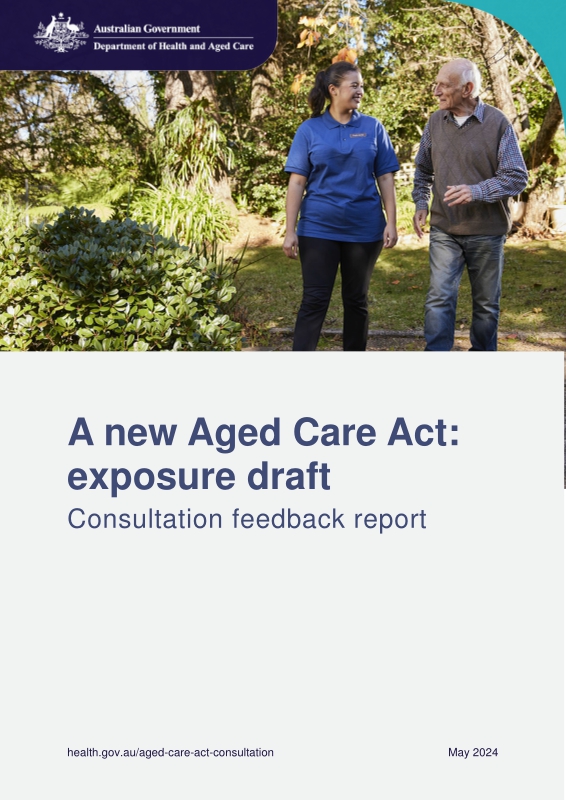
Title page
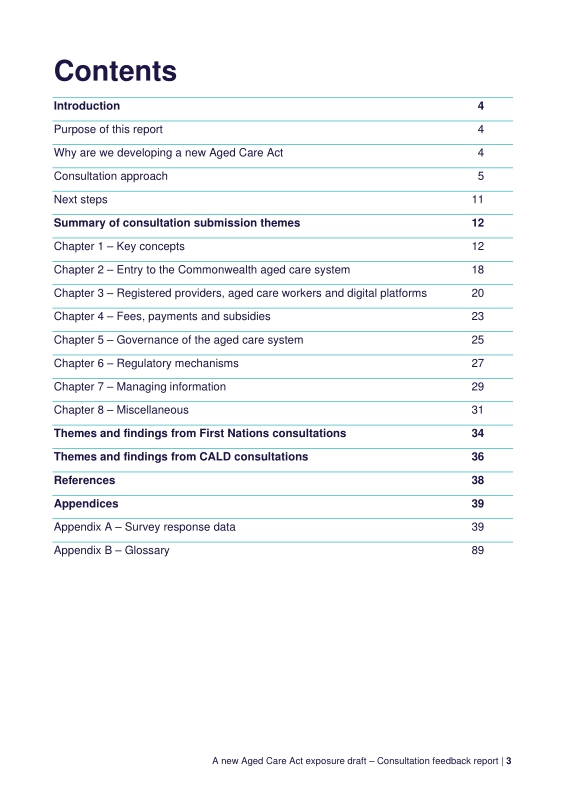
Contents
Acknowledgement of Country 2
Acknowledgement of participation 2
Introduction 4
Purpose of this report 4
Why are we developing a new Aged Care Act 4
Consultation approach 5
Next steps 11
Summary of consultation submission themes 12
Chapter 1. Key concepts 12
Chapter 2. Entry to the Commonwealth aged care system 18
Chapter 3. Registered providers, aged care workers and digital platforms 20
Chapter 4. Fees, payments and subsidies 23
Chapter 5. Governance of the aged care system 25
Chapter 6. Regulatory mechanisms 27
Chapter 7. Managing information 29
Chapter 8. Miscellaneous 31
Themes and findings from First Nations consultations 34
Themes and findings from CALD consultations 36
References 38
Appendix A - Survey response data 39
Appendix B - Glossary 89
Figure 1. Total number of stakeholder by consultation type 6
Figure 2. Stakeholders who participated in the survey 7
Figure 3. Stakeholders who participated in the face-to-face workshops 8
Figure 4. Stakeholders who provided written submissions 9
Figure 5. Stakeholders engaged 10
Figure 6. Type of respondent 40
Figure 7. Current circumstances 40
Figure 8. What have you read about the Exposure Draft of the new Aged Care Act? 41
Figure 9. Place of residence 42
Figure 10. Aboriginal or Torres Strait Islander heritage 42
Figure 11. Place of birth 43
Figure 12. Do you speak a language other than English at home? 43
Figure 13. The Objects, Statement of Rights and Statement of Principles are clear 44
Figure 14. The Objects, Statement of Rights and Statement of Principles will help to build a better aged care system 45
Figure 15. The definition of high quality care matches what I want aged care to look like in the future 46
Figure 16. I feel confident that the definition of high quality care will encourage providers to do better 47
Figure 17. Having a single list of services in the new Act will make it easier to know what the Government funded aged care system provides 48
Figure 18. The actions and duties of supporters and representatives should promote the will and preferences of older people 49
Figure 19. An older person does not need to have a supporter and representative at the same time 50
Figure 20. An older person should be able to appoint different people to be a supporter and a representative at the same time 51
Figure 21. An older person should be able to appoint a representative at a time when they can still make their own decisions about their aged care,... 52
Figure 22. Who will be eligible to undergo a needs assessment 53
Figure 23. How personal needs will be assessed for government funded aged care services 54
Figure 24. How a person will be approved for funded aged care services 55
Figure 25. How personal needs can be re-assessed where their circumstances change 56
Figure 26. The process for determining who is eligible to undergo a needs assessment 57
Figure 27. The needs assessment process for government-funded aged care services 58
Figure 28. The decision-making process for approving funded aged care services 59
Figure 29. The reassessment process when someone's circumstances change 60
Figure 30. The proposed statutory duties on registered providers will deter them from performing harmful actions 61
Figure 31. The proposed statutory duty on responsible persons will ensure accountability when death, serious illness or injury, to an older person... 62
Figure 32. The aged care system will be safer for older people with an additional duty on the operators of aged care digital platforms 63
Figure 33. What information should aged care digital platforms (websites and apps) share to help protect older people? 64
Figure 34. What information should registered providers share about their aged care workers? 65
Figure 35. The new subsidy framework will better address the costs of caring for older people 66
Figure 36. The individual needs of older people will be better supported by the new subsidy framework 67
Figure 37. The difference between a person-centred subsidy and provider-based subsidy is clear to me 68
Figure 38. The different activities that the Commissioner is responsible for 69
Figure 39. The difference between the System Governor (the department), the Aged Care Quality and Safety Commissioner and the Inspector-General... 70
Figure 40. The intent of the System Governor, the Aged Care Quality and Safety Commissioner and the Complaints Commissioner to provide for effective oversight... 72
Figure 41. The Complaints Commissioner and complaints staff have appropriate powers and responsibilities to investigate and resolve complaints with... 73
Figure 42. I feel confident that if I make a complaint to the Complaints Commissioner, I will get an appropriate outcome 74
Figure 43. It is appropriate to have one Commissioner as the head of the Aged Care Quality and Safety Commission, and the Complaints Commissioner as a Senior... 75
Figure 44. Having principles for best practice complaint handling in legislation would reassure me that the Commission is held accountable for its complaints handling 76
Figure 45. In which of the following circumstances do you think the Commissioner should be able to enter an approved residential care home? 77
Figure 46. In which of the following circumstances do you think the Commissioner should be able to appoint an external manager to a registered provider who... 79
Figure 47. I feel confident that personal information will be properly protected under the new Act 80
Figure 48. I would feel comfortable disclosing information under the proposed whistleblower framework 81
Figure 49. The proposed whistleblower framework will protect me from potential repercussions that could arise if I disclosed information 82
Figure 50. All aged care workers should be able to receive whistleblower disclosures 83
Figure 51. The protections that are available to whistleblowers 84
Figure 52. The process for disclosing information under the proposed whistleblower framework 85
Figure 53. The difference between making a whistleblower disclosure and the complaints process 86
Figure 54. What types of information about providers collected under the new Act should officials be limited in recording, sharing or disclosing? 87
Figure 55. Annual reporting on the operation of the new Act will provide additional transparency for the aged care system 88
*표시는 필수 입력사항입니다.
| 전화번호 |
|---|
| 기사명 | 저자명 | 페이지 | 원문 | 기사목차 |
|---|
| 번호 | 발행일자 | 권호명 | 제본정보 | 자료실 | 원문 | 신청 페이지 |
|---|
도서위치안내: / 서가번호:

우편복사 목록담기를 완료하였습니다.
*표시는 필수 입력사항입니다.
저장 되었습니다.
