
 대표어
대표어
 https://www.wto.org/english/res_e/reser_e/ersd202502_e.htm
권호기사보기
| 기사명 | 저자명 | 페이지 | 원문 | 기사목차 |
|---|
결과 내 검색
동의어 포함
Title page 1
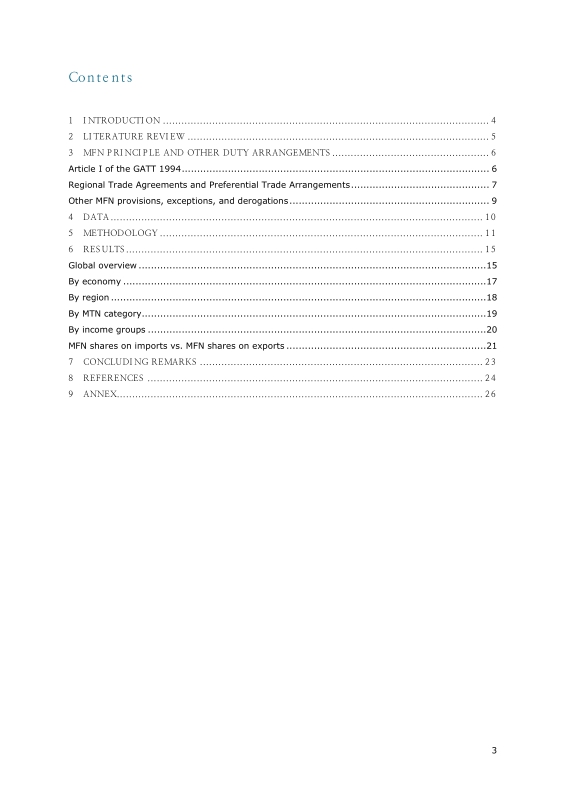
Contents 3
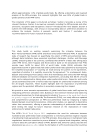
ABSTRACT 2
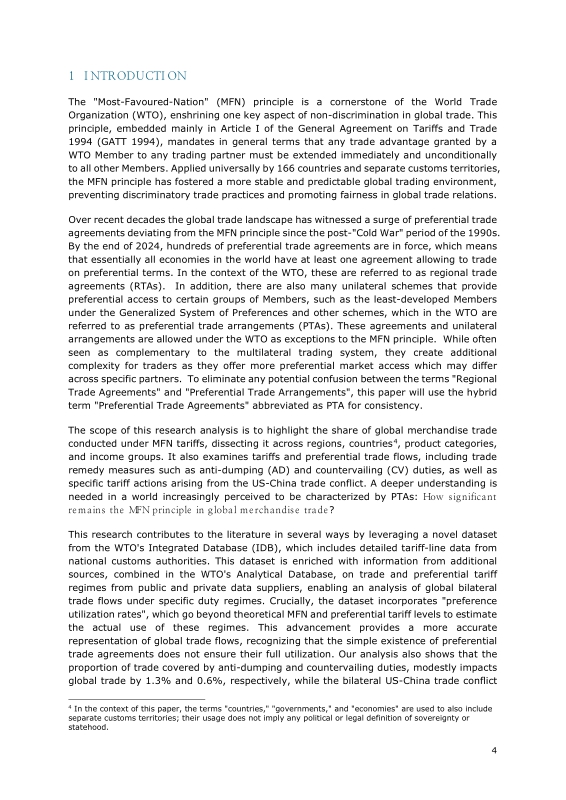
1. INTRODUCTION 4
2. LITERATURE REVIEW 5
3. MFN PRINCIPLE AND OTHER DUTY ARRANGEMENTS 6
Article I of the GATT 1994 6
Regional Trade Agreements and Preferential Trade Arrangements 7
Other MFN provisions, exceptions, and derogations 9
4. DATA 10
5. METHODOLOGY 11
6. RESULTS 15
Global overview 15
By economy 17
By region 18
By MTN category 19
By income groups 20
MFN shares on imports vs. MFN shares on exports 21
7. CONCLUDING REMARKS 23
8. REFERENCES 24
9. ANNEX 26
Tables 16
Table 1. Global trade shares 16
Table 2. Shares by geographical regions 19
Figures 14
Figure 1. Range of preference utilization across MTN categories 14
Figure 2. Preferential and MFN trade by tariff bands 17
Figure 3. Imports by MFN and preferential tariff regimes, top 20 importers 18
Figure 4. Import by MFN and preferential trade regimes by MTN category 20
Figure 5. Trade by duty schemes and "income group" 21
Figure 6. Difference in MFN trade shares between Imports and Exports, top 20 importers 22
Annex Tables 26
Annex Table 1. Data availability of detailed imports by duty schemes 26
Annex Table 2. Preference utilization by MTN category, 2017-2022 26
Annex Table 3. Global Trade Shares 27
Annex Table 4. Regions and economies, 2022 28
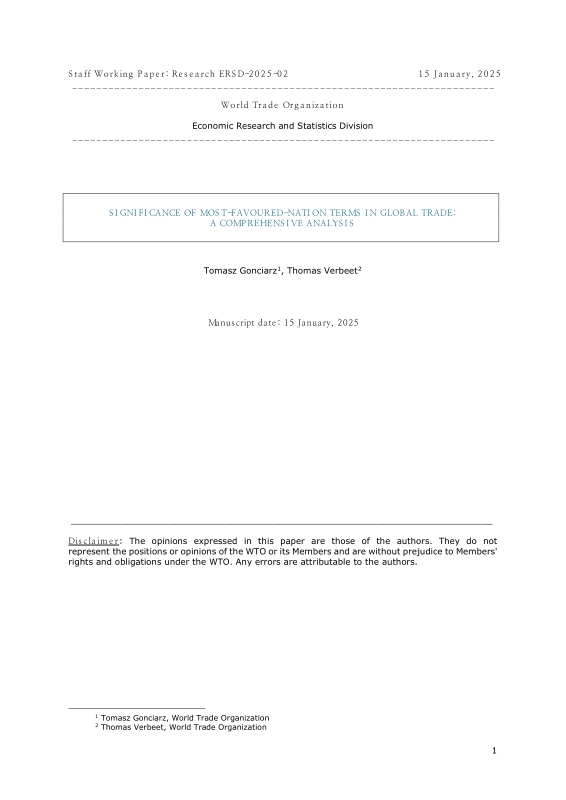
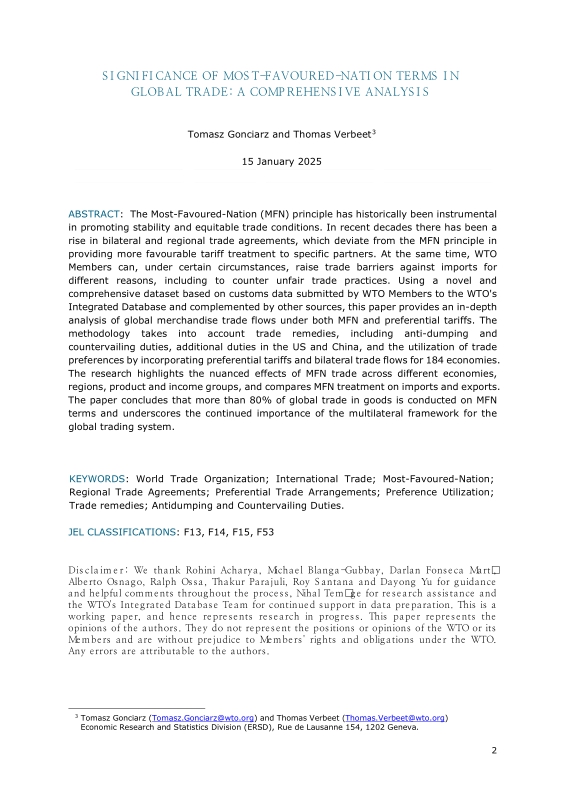
The Most-Favoured-Nation (MFN) principle has historically been instrumental in promoting stability and equitable trade conditions. In recent decades, there has been a rise in bilateral and regional trade agreements, which deviate from the MFN principle by providing more favourable tariff treatment to specific partners. At the same time, WTO Members can, under certain circumstances, raise trade barriers against imports for different reasons, including to counter unfair trade practices.
Using a novel and comprehensive dataset based on customs data submitted by WTO Members to the WTO's Integrated Database and complemented by other sources, this paper provides an in-depth analysis of global merchandise trade flows under both MFN and preferential tariffs. The methodology takes into account trade remedies, including anti-dumping and countervailing duties, additional duties in the US and China, and the utilization of trade preferences by incorporating preferential tariffs and bilateral trade flows for 184 economies.
The research highlights the nuanced effects of MFN trade across different economies, regions, product and income groups, and compares MFN treatment on imports and exports. The paper concludes that more than 80% of global trade in goods is conducted on MFN terms and underscores the continued importance of the multilateral framework for the global trading system.*표시는 필수 입력사항입니다.
| 전화번호 |
|---|
| 기사명 | 저자명 | 페이지 | 원문 | 기사목차 |
|---|
| 번호 | 발행일자 | 권호명 | 제본정보 | 자료실 | 원문 | 신청 페이지 |
|---|
도서위치안내: / 서가번호:

우편복사 목록담기를 완료하였습니다.
*표시는 필수 입력사항입니다.
저장 되었습니다.
