
 대표어
대표어
 https://www.ceew.in/publications/how-can-viksit-bharat-drive-india-green-economy-by-2047
권호기사보기
| 기사명 | 저자명 | 페이지 | 원문 | 기사목차 |
|---|
결과 내 검색
동의어 포함
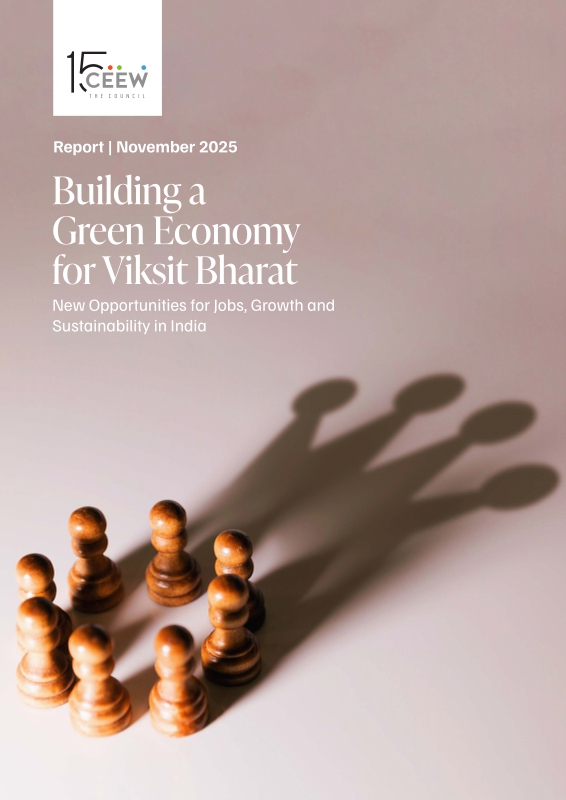
Title page 1
Contents 6
Acknowledgments 4
Executive summary 8
1. Balancing growth with sustainability: A 'green economy' paradigm 18
1.1. Defining a 'green economy' for India 19
1.2. The need for a green economic paradigm in India 20
1.3. Foreseeable advantages of harnessing the green economy potential in India 20
1.4. The scope of this report 21
2. Research methodology 23
2.1. Identifying key green economic sectors and value chains 24
2.2. Estimating the size of the JMI opportunities for each value chain 27
2.3. Identifying key challenges, risks and recommendations to scaling the value chains, and methodological approach to assessing... 31
2.4. Considerations for carbon emissions reduction 32
2.5. Key methodological considerations and limitations 34
3. Green economic value chains 36
3.1. Energy transition 37
Utility-scale solar deployment 39
Onshore wind deployment 44
Small hydropower deployment 49
Biomass power 53
Rooftop Solar 57
Floating solar photovoltaic 61
Offshore wind deployment 66
AgriPV 71
Manufacturing of solar PV modules 75
Battery manufacturing 79
Wind turbine manufacturing 84
Pumped storage hydropower deployment 89
Deployment of battery energy storage systems 94
Decentralised renewable energy based livelihood technologies 98
Electrolyser manufacturing and green hydrogen deployment 103
Manufacturing of electric vehicles 108
3.2. Circular economy 112
Electronic waste recycling 114
End-of-life vehicle management 119
Lithium-ion battery recycling 124
Plastic waste recycling 129
Resource recovery from organic fraction of municipal solid waste 134
Used cooking oil to biodiesel 139
Used water treatment and reuse 144
3.3. Bio economy and nature-based solutions 149
Agroforestry 151
Bamboo-based products 155
Bio-based packaging from renewable sources 160
Biofibre manufacturing 165
Generating biofuels from agricultural residues (2G) 170
Bio-inputs 174
Chemical-free agriculture 180
Compound cattle feed (CCF) 184
Nutraceuticals 188
Seaweed cultivation 192
Sustainable forest management (SFM) 197
Sustainable tourism 202
Wetland management 207
4. The inclusion of women in India's green economy 212
4.1. Introduction 212
4.2. Nature of women’s work in the energy transition sector 214
4.3. Nature of women's work in the circular economy sector 216
4.4. Nature of women's work in the bio-economy and nature-based solutions sector 219
4.5. Recommendations 222
5. Recommendations to scale-up India's green economy 225
Acronyms 230
References 237
Figures 25
Figure 1. Value chain selection framework 25
Boxes 31
Box 2.1. What are the centralised and decentralised components of a value chain? 31
Box 2.2.a. Key methodological considerations 34
Box 2.2.b. Limitations 35
*표시는 필수 입력사항입니다.
| 전화번호 |
|---|
| 기사명 | 저자명 | 페이지 | 원문 | 기사목차 |
|---|
| 번호 | 발행일자 | 권호명 | 제본정보 | 자료실 | 원문 | 신청 페이지 |
|---|
도서위치안내: / 서가번호:

우편복사 목록담기를 완료하였습니다.
*표시는 필수 입력사항입니다.
저장 되었습니다.
