
 대표어
대표어
 https://www.ilo.org/publications/impact-labour-laws-labour-share-national-income-productivity-unemployment



권호기사보기
| 기사명 | 저자명 | 페이지 | 원문 | 기사목차 |
|---|
결과 내 검색
동의어 포함
Title page 1
Contents 6
Abstract 4
About the authors 4
Introduction 11
1. Theorising the impact of labour laws on the economy 13
2. Constructing the CBR-LRI dataset 16
3. Trends in labour protection around the world 22
4. The economic impacts of labour laws: a review of recent studies using leximetric data 30
5. Econometric analysis: methods and data 33
6. Results 35
6.1. Summary of trends 35
6.2. Country level analysis 36
6.2.1. Liberal market/common law origin economies 37
6.2.2. Coordinated market/EU economies 42
6.2.3. Latin American countries 51
6.2.4. African countries 57
6.2.5. Countries in South Asia 60
6.2.6. Countries in East Asia 64
6.3. A closer look at country trends by sub-categories of labour law rules 68
7. Assessment 75
Conclusions 76
Appendix 1. Summary of empirical papers using the CBR-LRI 78
Appendix 2. Econometric model 94
References 95
Acknowledgements 98
Tables 10
Table 1. Elements of a composite index 16
Table 2. CBR-LRI sub-indices and indicators 16
Table 3. Example of coding (UK law, variable 1) 19
Table 4. The impact of aggregate labour law changes on the labour share, productivity, unemployment and employment in selected countries 35
Table 5. Impacts of changes of labour laws in Brazil 69
Table 6. Impacts of changes of labour laws in China 70
Table 7. Impacts of changes of labour laws in South Africa 71
Table 8. Impacts of changes of labour laws in Spain 72
Table 9. Impacts of changes of labour laws in Sweden 73
Table 10. Impacts of changes of labour laws in the UK 74
Figures 8
Figure 1. Strength of worker protection, all countries, all years 22
Figure 2. Neoliberal experiments 23
Figure 3. Outliers 24
Figure 4. Democratic transitions 24
Figure 5. East Asian Countries 25
Figure 6a. Laws on different forms of employment, UK and Europe 27
Figure 6b. Laws on working time, UK and Europe 27
Figure 6c. Laws on dismissal, UK and Europe 28
Figure 6d. Laws on employee representation, UK and Europe 28
Figure 6e. Laws on industrial action, UK and Europe 29
Figure 7. Impacts of changes in labour law in the United Kingdom 37
Figure 8. Impacts of changes in labour laws in Ireland 38
Figure 9. Impacts of changes in labour law in the USA 39
Figure 10. Impacts of changes in labour law in Canada 40
Figure 11. Impacts of changes in labour laws in Australia 41
Figure 12. Impacts of changes in labour law in New Zealand 42
Figure 13. Impact of changes in labour law in France 43
Figure 14. Impacts of changes in labour law in Germany 44
Figure 15. Impact of changes in labour law in the Netherlands 45
Figure 16. Impacts of changes in labour law in Italy 46
Figure 17. Impact of changes in labour law in Portugal 46
Figure 18. Impacts of changes in labour laws in Spain 47
Figure 19. Impacts of changes in labour laws in Romania 48
Figure 20. Impacts of changes in labour law in Finland 49
Figure 21. Impacts of changes in labour law in Sweden 50
Figure 22. Impacts of changes in labour law in Argentina 51
Figure 23. Impacts of changes in labour law in Brazil 52
Figure 24. Impacts of changes in labour law in Chile 53
Figure 25. Impacts of changes in labour law in Ecuador 54
Figure 26. Impacts of changes in labour law in Peru 55
Figure 27. Impacts of changes in labour law in Uruguay 56
Figure 28. Impact of changes in labour law in Kenya 57
Figure 29. Impact of changes in labour law in Nigeria 58
Figure 30. Impacts of changes in labour law in South Africa 59
Figure 31. Impacts of changes in labour law in India 60
Figure 32. Impacts of changes in labour laws in Indonesia 61
Figure 33. Impacts of changes in labour law in Malaysia 62
Figure 34. Impacts of change in labour law in the Philippines 63
Figure 35. Impacts of changes in labour law in China 64
Figure 36. Impacts of changes in labour laws in Japan 65
Figure 37. Impacts of changes in labour laws in Korea 66
Figure 38. Impacts of changes in labour laws in Vietnam 67
Figure 39. Changes in labour laws in Brazil, 1970-2022 68
Figure 40/Figure 39. Changes in labour laws in China, 1986-2022 69
Figure 41/Figure 40. Changes in labour laws in South Africa, 1970-2022 70
Figure 42/Figure 41. Changes in labour laws in Spain, 1970-2022 71
Figure 43/Figure 42. Changes in labour laws in Sweden, 1970-2022 72
Figure 44/Figure 43. Changes in labour laws in the UK, 1970-2022 74
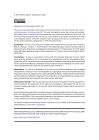
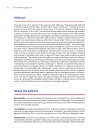
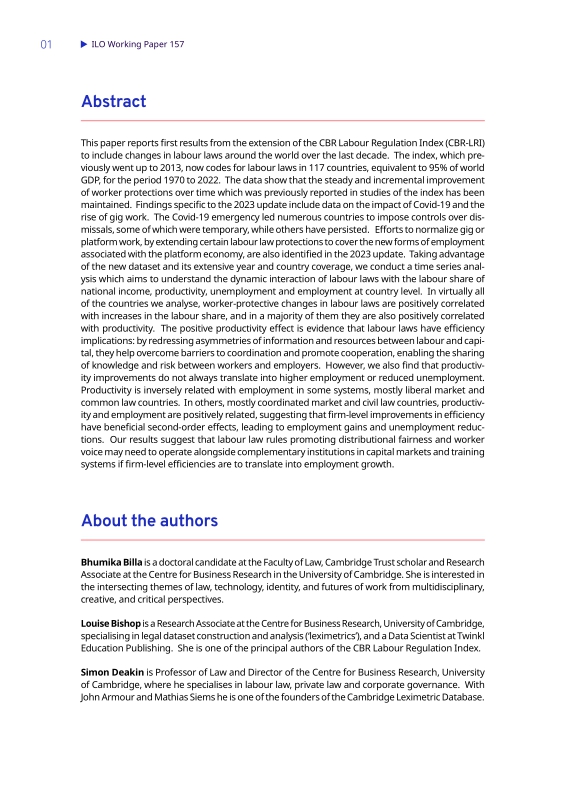
This paper reports first results from the extension of the CBR Labour Regulation Index (CBR-LRI) to include changes in labour laws around the world over the last decade.
The index, which previously went up to 2013, now codes for labour laws in 117 countries, equivalent to 95% of world GDP, for the period 1970 to 2022. The data show that the steady and incremental improvement of worker protections over time which was previously reported in studies of the index has been maintained.
Findings specific to the 2023 update include data on the impact of Covid-19 and the rise of gig work. The Covid-19 emergency led numerous countries to impose controls over dismissals, some of which were temporary, while others have persisted.
Efforts to normalize gig or platform work, by extending certain labour law protections to cover the new forms of employment associated with the platform economy, are also identified in the 2023 update.
Taking advantage of the new dataset and its extensive year and country coverage, we conduct a time series analysis which aims to understand the dynamic interaction of labour laws with the labour share of national income, productivity, unemployment and employment at country level.
In virtually all of the countries we analyse, worker-protective changes in labour laws are positively correlated with increases in the labour share, and in a majority of them they are also positively correlated with productivity.
The positive productivity effect is evidence that labour laws have efficiency implications: by redressing asymmetries of information and resources between labour and capital, they help overcome barriers to coordination and promote cooperation, enabling the sharing of knowledge and risk between workers and employers.
However, we also find that productivity improvements do not always translate into higher employment or reduced unemployment. Productivity is inversely related with employment in some systems, mostly liberal market and common law countries.
In others, mostly coordinated market and civil law countries, productivity and employment are positively related, suggesting that firm-level improvements in efficiency have beneficial second-order effects, leading to employment gains and unemployment reductions.
Our results suggest that labour law rules promoting distributional fairness and worker voice may need to operate alongside complementary institutions in capital markets and training systems if firm-level efficiencies are to translate into employment growth.*표시는 필수 입력사항입니다.
| 전화번호 |
|---|
| 기사명 | 저자명 | 페이지 | 원문 | 기사목차 |
|---|
| 번호 | 발행일자 | 권호명 | 제본정보 | 자료실 | 원문 | 신청 페이지 |
|---|
도서위치안내: / 서가번호:

우편복사 목록담기를 완료하였습니다.
*표시는 필수 입력사항입니다.
저장 되었습니다.
