
 대표어
대표어
 https://www.ifans.go.kr/knda/ifans/kor/pblct/PblctView.do?csrfPreventionSalt=null&pblctDtaSn=14732&menuCl=P18&clCode=P18&koreanEngSe=KOR&pclCode=&chcodeId=&searchCondition=searchAll&searchKeyword=&pageIndex=1
권호기사보기
| 기사명 | 저자명 | 페이지 | 원문 | 기사목차 |
|---|
결과 내 검색
동의어 포함
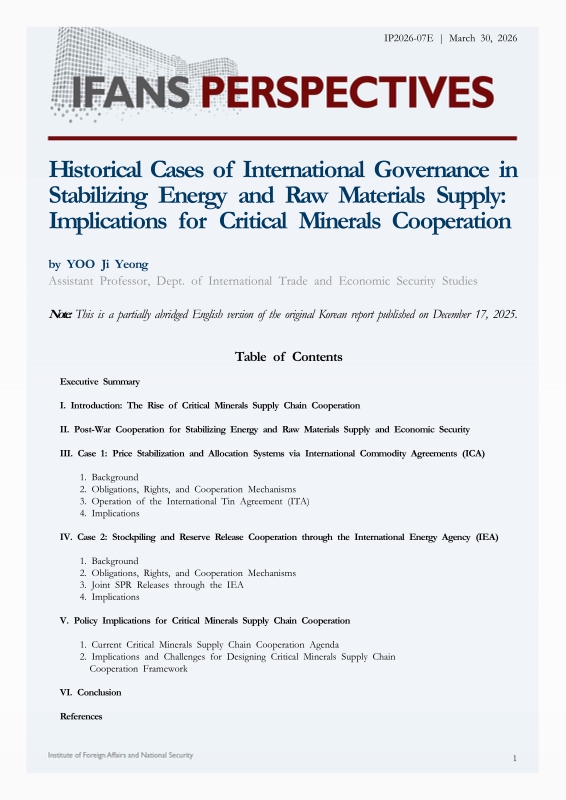
Title page 1
Contents 1
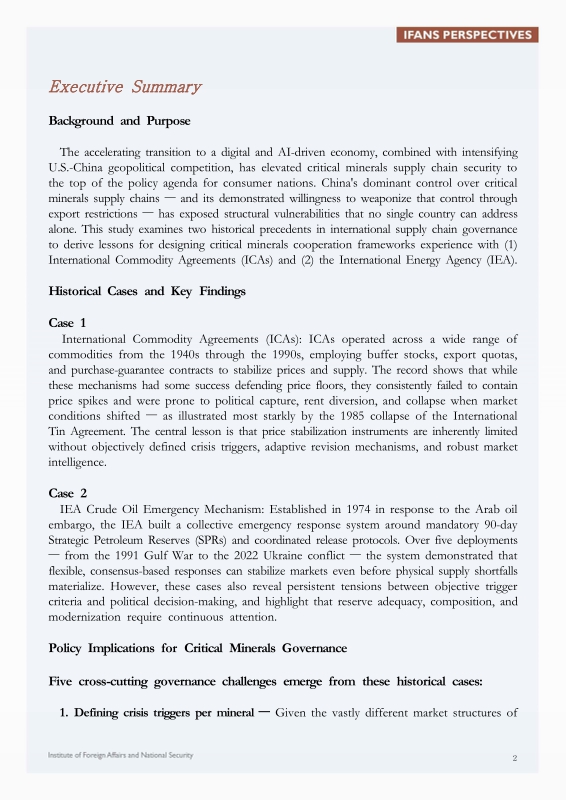
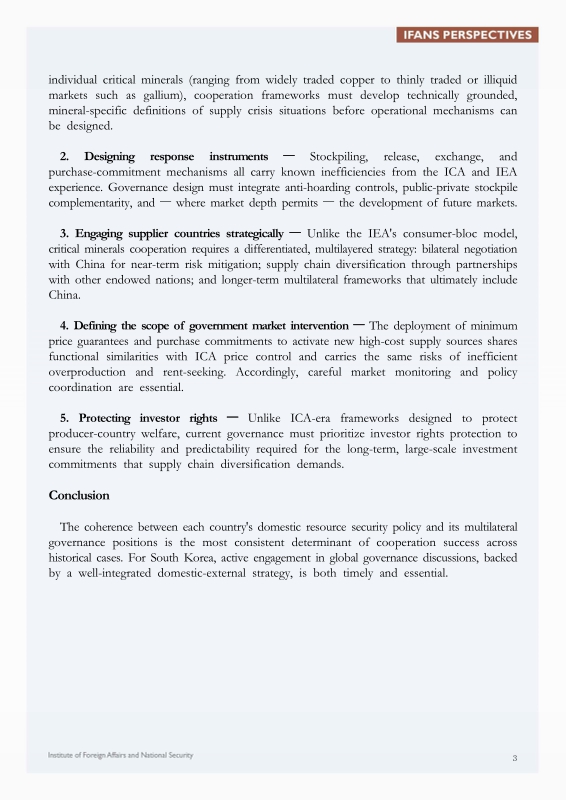
Executive Summary 2
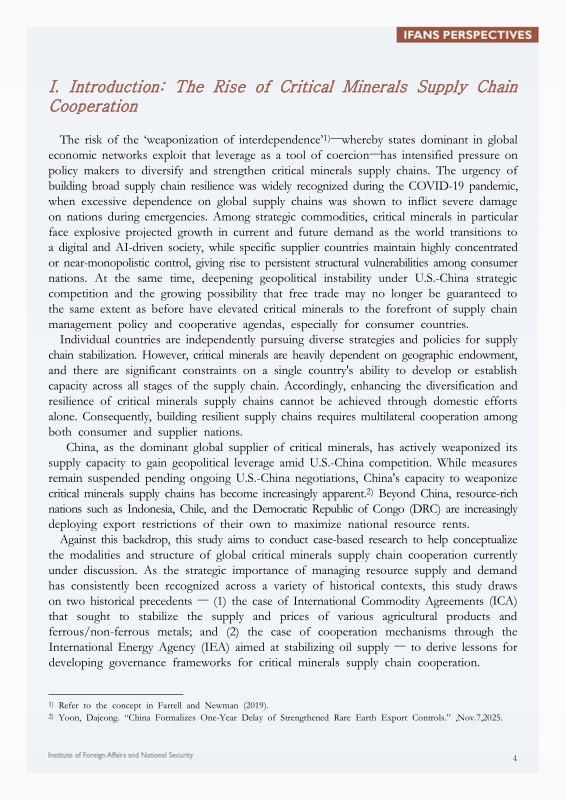
I. Introduction: The Rise of Critical Minerals Supply Chain Cooperation 4
II. Post-War Cooperation for Stabilizing Energy and Raw Materials Supply and Economic Security 5
III. Case 1: Price Stabilization and Allocation Systems via International Commodity Agreements (ICA) 7
1. Background 7
2. Obligations, Rights, and Cooperation Mechanisms 8
3. Operation of the International Tin Agreement (ITA) 8
4. Implications 9
a. Limited Price Stabilization Effect; Partial Success in Defending Price Floors 9
b. Inefficiency of Price Stabilization Instruments 10
c. Potential for Rent Transfer and Impossibility of Price Adjustment When Substitutes Exist 10
IV. Case 2: Stockpiling and Reserve Release Cooperation through the International Energy Agency (IEA) 11
1. Background 11
2. Obligations, Rights, and Cooperation Mechanisms 11
a. Core Principles of the Initial Emergency Crude Oil Supply System (1970s) 11
b. Market Changes and Mechanism Adjustments from the 1980s Onward 12
3. Experience with Joint SPR Releases through the IEA 12
a. 1990 Gulf War Response 12
b. 2005 Hurricane Katrina 13
c. 2011 Libya Crisis 13
d. 2022 Ukraine War (Two Releases) 13
4. Implications 14
a. Difficulty in Setting Emergency Reserve Release Thresholds 14
b. Ambiguity Between Market Facilitation and Political Use of SPR Releases 14
c. Challenges of National SPR Scale, Composition, and Modernization 14
V. Policy Implications for Critical Minerals Supply Chain Cooperation 16
1. Current Critical Minerals Supply Chain Cooperation Agenda 16
a. IEA Working Party on Critical Minerals (CMWP) 16
b. IRENA Collaborative Framework on Critical Materials (CFCM) 16
c. Minerals Security Partnership (MSP) 17
d. CCMM and U.S.-Australia Framework for Critical Minerals and Rare Earths 17
e. Summary: Composition and Characteristics of the Current Critical Minerals Supply Chain Cooperation Agenda 18
2. Implications and Challenges for Designing Critical Minerals Supply Chain Cooperation Governance 19
a. Establishing Benchmarks and Response Objectives for Defining Per-Mineral Supply Crisis Situations 19
b. Reviewing Available Response Measures 20
c. Exploring Strategies for Deepening Cooperation with Supplier Countries 21
d. Defining the Scope and Modality of Government Intervention in Markets for Supply Chain Diversification 22
e. Establishing Institutional Mechanisms to Promote and Facilitate Investment 23
VI. Conclusion 24
References 25
Tables 7
Table 1. Types of Energy and Raw Materials Supply Chain Stabilization Cooperation in the Post-War World 7
Table 2. Implications from the Operation of International Commodity Agreements 10
Table 3. Implications from IEA Operations for Crude Oil Supply Management 15
Table 4. Current Critical Minerals Supply Chain Stabilization Cooperation Agenda 19
Table 5. Implications and Challenges for Designing Critical Minerals Supply Chain Cooperation Governance 23
*표시는 필수 입력사항입니다.
| 전화번호 |
|---|
| 기사명 | 저자명 | 페이지 | 원문 | 기사목차 |
|---|
| 번호 | 발행일자 | 권호명 | 제본정보 | 자료실 | 원문 | 신청 페이지 |
|---|
도서위치안내: / 서가번호:

우편복사 목록담기를 완료하였습니다.
*표시는 필수 입력사항입니다.
저장 되었습니다.
