
 대표어
대표어
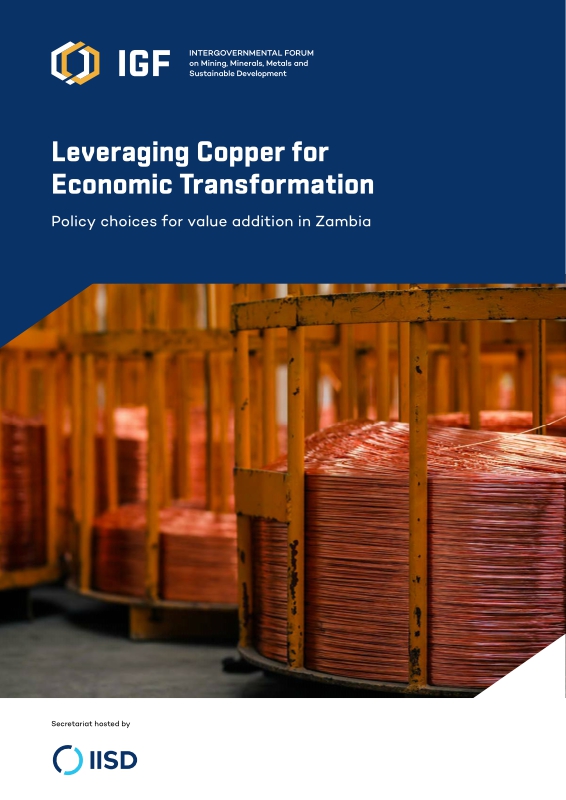
 https://www.iisd.org/publications/report/leveraging-copper-economic-transformation-zambia
권호기사보기
| 기사명 | 저자명 | 페이지 | 원문 | 기사목차 |
|---|
결과 내 검색
동의어 포함
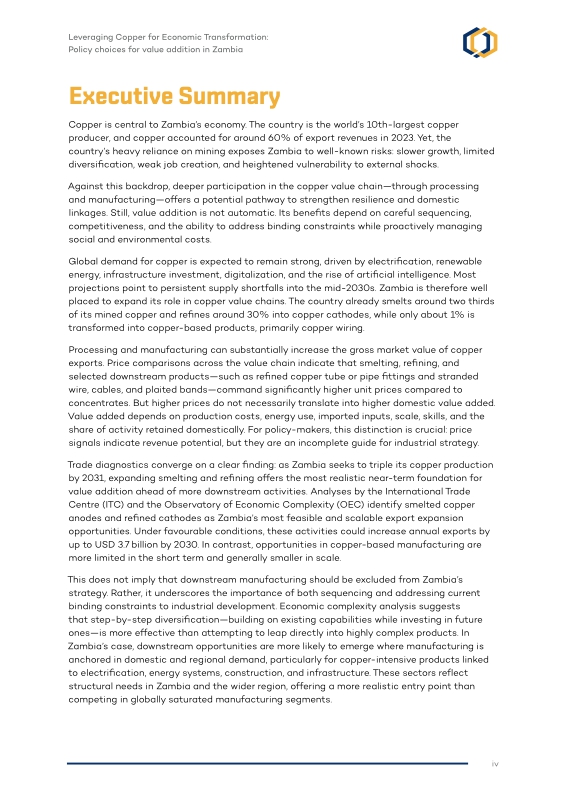
Title page 1
Contents 7
Acknowledgements 3
Executive Summary 4
1.0. Introduction 10
2.0. What Is Value Addition? 12
3.0. Mapping the Copper Value Chain 14
3.1. Explaining the Copper Supply Value Chain 14
3.1.1/3.1.2. Copper Beneficiation 15
3.1.2/3.1.3. The Future of Copper Supply and Demand 16
3.2. The Copper Value Chain in Zambia 17
3.2.1. Revenue Potential Along the Copper Value Chain: What prices do and do not reveal 21
4.0. Key Opportunities for Increased Copper Value Addition in Zambia 25
4.1. Expansion of Midstream Mineral Processing: What the evidence shows 25
4.1.1. Product Complexity, Sequencing, and Enabling Conditions 27
4.1.2. Import Substitution: Limited scope 28
4.2. Expansion of Copper Manufacturing: Limited near-term scope and longer-term potential 28
4.3. Discussion: Sequencing, constraints, and policy choice 29
5.0. Challenges for Further Copper Value Addition in Zambia 31
5.1. Factors Hampering Industrial Development 31
5.1.1. Electricity: The critical binding constraint 31
5.1.2. Finance Constraints Are Structural But Solvable With Targeted Levers 32
5.1.3. Feedstock and Input Availability Undermine Downstream Feasibility 32
5.1.4. Trade Logistics and Market Access Constraints Raise Costs and Reduce Competitiveness 33
5.1.5. Demand Constraints, Low Margins, and Intense Competition 34
5.1.6. Low Margins and Global Competition Pressure 34
5.1.7. Skills and Capabilities: A structural constraint on scaling value addition 35
5.1.8. Policy Coherence and Consistency: Aligning ambitions with delivery capacity 35
5.1.9. Summary and Priority Areas for Action 36
5.2. Environmental and Social Risks 36
5.2.1. Local Environmental and Social Impacts: Cumulative risks are rising 36
6.0. Assessment of Zambia's Policies for Copper Value Addition 39
6.1. Mineral Development Policies: From mining to processing 39
6.2. Industrialization Policies: Value addition through diversification 40
6.3. Local Content Policies: Value retention 41
6.4. Policies on Access to Finance: Unlocking the collateral framework 42
6.5. Policies on Electricity Supply to Enable Industrial Development 43
6.6. Policies in Support of Skills Development: Aligning education systems with industrial needs 44
6.7. Trade Policies: Enhancing value addition through export taxes and tariffs 44
6.8. Policies on Environmental and Social Management of Artisanal Mining 45
7.0. Conclusion and Recommendations 47
7.1. Conclusion 47
7.2. Recommendations to the Government of Zambia 48
7.3. Recommendations to Technical and Financial Partners 52
References 54
Appendix A. Overview of Value-Addition Measurements and Methodologies for Trade Diagnostics Used in the Report 63
FIGURE 1. The top five African producers' share of copper production and exports in 2023 10
FIGURE 2. Simplified copper supply value chain 15
FIGURE 3. Copper supply and demand projections, 2024-2040 16
FIGURE 4. Simplified visualization of the domestic value chain and share of exports, 2023 18
FIGURE 5. Zambia's exports of copper-based products by destination, 2023 20
FIGURE 6. Emissions intensity of electricity generation by country 37
Boxes 8
BOX 1. CRITICAL POLICY CAUTION: PRICE IS NOT THE SAME AS VALUE ADDED 21
*표시는 필수 입력사항입니다.
| 전화번호 |
|---|
| 기사명 | 저자명 | 페이지 | 원문 | 기사목차 |
|---|
| 번호 | 발행일자 | 권호명 | 제본정보 | 자료실 | 원문 | 신청 페이지 |
|---|
도서위치안내: / 서가번호:

우편복사 목록담기를 완료하였습니다.
*표시는 필수 입력사항입니다.
저장 되었습니다.
