
 대표어
대표어
 https://www.bruegel.org/working-paper/programmable-sovereignty-coordinated-specialisation-response-n-2-problem-artificial
권호기사보기
| 기사명 | 저자명 | 페이지 | 원문 | 기사목차 |
|---|
결과 내 검색
동의어 포함
Title page 1
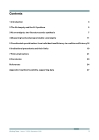
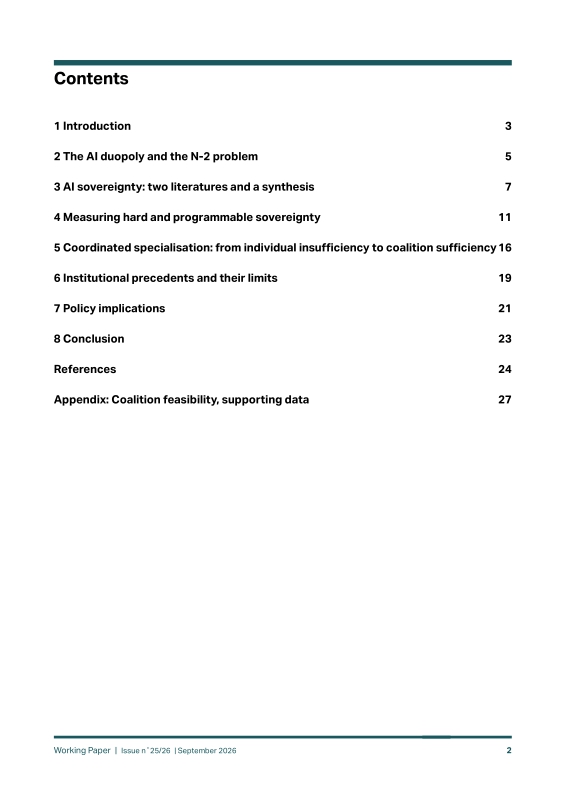
Contents 2
1. Introduction 3
2. The AI duopoly and the N-2 problem 5
2.1. Two full-stack sovereignty strategies 5
2.2. Why AI dependence exceeds monetary dependence 6
3. AI sovereignty: two literatures and a synthesis 7
3.1. The hard-sovereignty literature: sovereignty as productive autonomy 7
3.2. The soft-sovereignty literature: sovereignty as governance capacity 8
3.3. Programmable sovereignty: a bridging definition 9
3.4. Seven mechanisms 10
4. Measuring hard and programmable sovereignty 11
4.1. State of play 11
5. Coordinated specialisation: from individual insufficiency to coalition sufficiency 16
6. Institutional precedents and their limits 19
6.1. EuroHPC: pooled infrastructure under shared governance 19
6.2. India Stack: programmable architecture and its limits 20
6.3. The ASEAN Digital Economy Framework: regional governance as a partial building block 20
7. Policy implications 21
7.1. Lead with governance, not production 21
7.2. Anchor governance with a minimal hard fallback 22
7.3. Organise around demonstrated comparative advantage 22
7.4. Put governance in place before infrastructure 22
7.5. Make programmable sovereignty empirically measurable 22
8. Conclusion 23
References 24
Appendix: Coalition feasibility, supporting data 27
Figure 1. Numbers of AI related patents 11
Figure 2. Share of global AI GPU-cluster performance (% of total), 2026 12
Figure 3. Critical mineral processing concentration, 2020 and 2024 12
Figure 4. Total installed electricity capacity 13
*표시는 필수 입력사항입니다.
| 전화번호 |
|---|
| 기사명 | 저자명 | 페이지 | 원문 | 기사목차 |
|---|
| 번호 | 발행일자 | 권호명 | 제본정보 | 자료실 | 원문 | 신청 페이지 |
|---|
도서위치안내: / 서가번호:

우편복사 목록담기를 완료하였습니다.
*표시는 필수 입력사항입니다.
저장 되었습니다.
